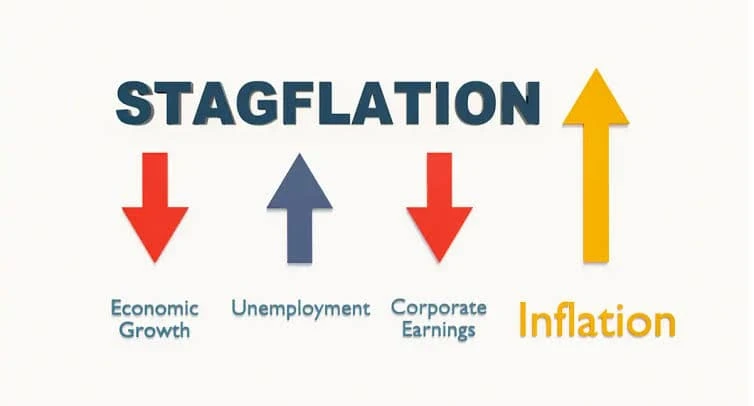
Stagflation means high inflation combined with weak growth and rising unemployment. With oil near $100, inflation above target and central banks raising rates again in 2026, the term is back in the headlines. This explainer covers what stagflation is, the 1970s comparison, today's data, and what it would mean for households and investors.
Quick answer
Stagflation is when an economy suffers high inflation and stagnant growth at the same time, usually with rising unemployment. It is difficult for policymakers because raising interest rates to fight inflation can weaken growth further. In 2026, a war-driven oil shock has pushed Brent crude above $100 a barrel for long periods, and US inflation is running around 3.4–3.8%. The Federal Reserve has started raising rates again. But growth has held up so far: the US grew 2.4% (annualised) in the first half of 2026, and unemployment was 4.1% in August. So the world is not in stagflation yet, but the risk is being watched closely.
Stagflation explained
Traditionally, inflation and unemployment were thought to move in opposite directions (the Phillips curve). Stagflation breaks that pattern:
| Normal boom | Normal recession | Stagflation |
|---|
| Growth ↑ | Growth ↓ | Growth ↓ or flat |
| Inflation ↑ | Inflation ↓ | Inflation ↑ |
| Unemployment ↓ | Unemployment ↑ | Unemployment ↑ |
The word combines "stagnation" and "inflation". It was popularised in the UK in the 1960s and became widespread in the 1970s.
The 1970s: the classic case
- 1973: the Arab oil embargo quadrupled oil prices.
- 1979: the Iranian Revolution triggered a second oil shock.
- In the US, inflation reached double digits and unemployment rose.
- Fed Chair Paul Volcker raised interest rates to around 20% in 1980–81, causing a deep recession but eventually breaking inflation.
The lesson for central banks was that letting inflation expectations rise can be very costly to reverse.
2026: similarities and differences
Similarities
- An energy supply shock linked to conflict involving Iran and the Gulf
- Inflation above target for more than five years in the US
- Central banks tightening despite geopolitical uncertainty
Differences
- Oil intensity is lower: modern economies use much less oil per unit of GDP than in the 1970s.
- Inflation expectations are anchored: the Fed says most long-term expectations remain near 2%.
- Growth is supported by AI investment: spending on data centres and chips is boosting activity.
- Labour markets are tight: unemployment is low, unlike the rising joblessness of the 1970s.
Key numbers to watch
| Indicator | Latest (as of early October 2026) |
|---|
| Brent crude | ~$101 per barrel (5 October) |
| US PCE inflation | 3.4% (12 months to August) |
| US unemployment | 4.1% (August) |
| US GDP growth | 2.4% annualised (H1 2026) |
| Fed funds rate | 3.75–4.00% |
Which countries are most at risk?
- Oil importers with weak currencies, such as many countries in South Asia and Africa
- Europe, which is sensitive to energy prices and has slower underlying growth
- Countries with high debt, where rising rates squeeze budgets
What stagflation would mean for you
- Higher living costs for fuel, food and transport
- Slower wage growth in real (inflation-adjusted) terms
- Higher loan and mortgage rates
- Weaker job security if companies cut back
- Investment challenges: both stocks and bonds can perform poorly. Investors often look at inflation-protected bonds, commodities and diversified portfolios.
This article is for information only and is not financial advice.
How policymakers respond
- Central banks must decide whether to prioritise fighting inflation, risking recession, or supporting growth, risking higher inflation.
- Governments may use targeted support, such as fuel subsidies or tax relief for vulnerable households, while trying not to add to inflation.
- Supply-side measures, including diversifying energy sources, building reserves and investing in renewables, reduce exposure to future shocks.
Frequently asked questions
What is stagflation in simple words?
Rising prices combined with a weak economy and rising unemployment.
Is the world in stagflation in 2026?
Not yet, based on available data. Inflation is elevated, but growth and employment have held up, especially in the US. The risk depends heavily on oil prices and interest rates.
What caused stagflation in the 1970s?
Mainly oil supply shocks in 1973 and 1979, combined with loose monetary policy and rising inflation expectations.
How do you fix stagflation?
There is no easy fix. Historically, central banks have raised interest rates sharply to bring inflation down, at the cost of a recession.
Conclusion
The 2026 oil shock has brought back fears of 1970s-style stagflation. Today's economy is less oil-dependent, inflation expectations are better anchored, and AI investment is supporting growth. Whether the world avoids stagflation will depend on energy markets in the Middle East and on how central banks handle the trade-off between inflation and growth.
Sources
- Federal Reserve, Vice Chair Jefferson speech (1 October 2026): https://www.federalreserve.gov/newsevents/speech/jefferson20261001a.htm
- Forbes, interest rate outlook (29 September 2026): https://www.forbes.com/sites/simonmoore/2026/09/29/what-to-expect-from-interest-rates-for-the-rest-of-2026/
- Oilprice.com, oil prices and Hormuz flows (5 October 2026): https://oilprice.com/Latest-Energy-News/World-News/Oil-Prices-Fall-as-Hormuz-Crude-Flows-Top-Pre-War-Levels.html
- Federal Reserve History, "The Great Inflation": https://www.federalreservehistory.org/essays/great-inflation