•
•
•
•
•
•
•

IMF lifts 2026 world growth to 3.1% as India stays fastest-growing major economy, but warns growth is narrow and fragile
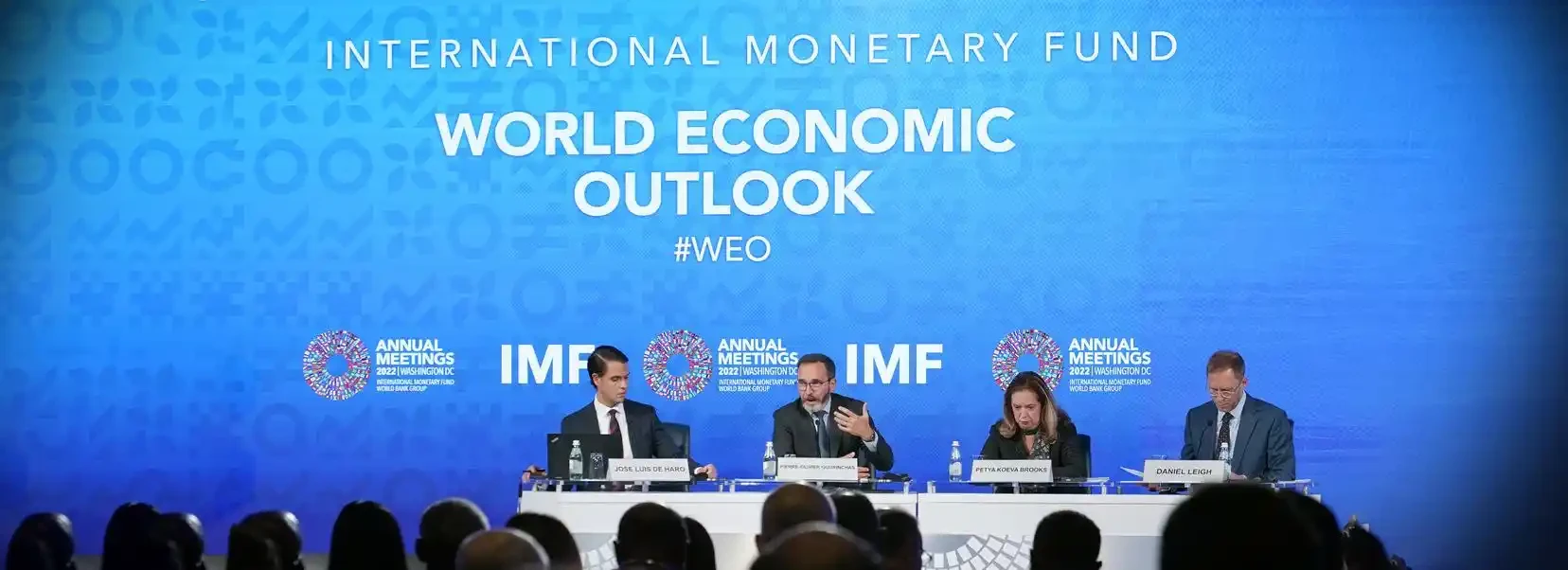
The International Monetary Fund (IMF) released its October 2026 World Economic Outlook (WEO) on 13 October 2026, just before the IMF and World Bank Annual Meetings in Bangkok. The IMF raised its 2026 global growth forecast to 3.1%, up from 3.0% in July but down from 3.5% in 2025, and projects 3.4% in 2027. India remains the fastest-growing major economy at about 7%, while China is forecast at 4.5% and the United States at 2.3%. Global inflation is expected at 4.7% in 2026, pushed up by an oil price assumption of about $96 a barrel. IMF research director Silvana Tenreyro summed it up: "The outlook is highly uneven."
| Economy / group | 2025 | 2026 (forecast) | 2027 (forecast) |
|---|---|---|---|
| World | 3.5% | 3.1% | 3.4% |
| Advanced economies | 2.0% | 2.1% | ~1.8–1.9% |
| United States | — | 2.3% | 2.3% |
| Euro area | — | 1.1% | 1.2% |
| Emerging & developing economies | 4.5% | 3.7% | 4.4% |
| China | 5.0% | 4.5% | 4.0% |
| India* | 7.7% | 7.0% | 7.0% |
| Emerging & developing Asia | — | 5.1% | — |
| Sub-Saharan Africa | — | 4.5% | — |
| Latin America & Caribbean | — | 2.3% | — |
| Emerging & developing Europe | — | 1.7% | — |
*India's figures are reported on a fiscal-year basis (FY27 and FY28). Figures are as reported by Fortune and The Week. Small differences between sources (for example, advanced economies in 2027) are shown as a range. Check the IMF's official tables for final numbers.
The world economy is holding up better than the IMF expected in July, despite the Middle East war and energy shock. But 3.1% is still well below 2025's pace, and below the pre-pandemic average of about 3.7%.
The IMF assumes oil prices rise about 41% in 2026, averaging roughly $96 a barrel. That is 16% higher than its April assumption. It also assumes shipping through the Strait of Hormuz returns gradually from March 2027, with conditions broadly normal later in the year. If the strait stays disrupted longer, growth could be weaker and inflation higher.
Global inflation is forecast at 4.7% in 2026, easing to 4.1% in 2027. In emerging and developing economies, inflation is seen at 5.7% this year. That explains why central banks such as the US Federal Reserve and the Reserve Bank of India have raised interest rates again in 2026.
According to Fortune, just 32 countries account for 95% of global growth, compared with 54 countries in April. The Middle East and Central Asia region is expected to contract in 2026 because of the war, before rebounding strongly in 2027.
AI-related investment is supporting growth, especially in the US. But the IMF notes that Taiwan and South Korea account for about 62% of net trade in AI computing hardware, and the US and China account for more than three-quarters of net imports. Managing Director Kristalina Georgieva warned that AI's effect on jobs is like "a slow moving tsunami, but a tsunami nonetheless."
3.1% in the October 2026 World Economic Outlook, up from 3.0% in July, with 3.4% projected for 2027.
About 7% for FY27 and FY28, making India the fastest-growing major economy.
The world economy has been more resilient than expected, supported partly by AI-related investment, even though oil prices have risen sharply.
About $96 per barrel on average, roughly 41% higher than in 2025.
The IMF publishes a WEO Update in January and July, with full reports in April and October.
The IMF's October 2026 outlook shows a world economy holding up under a major energy shock, but with growth that is slower, more uneven and more dependent on a few countries and sectors. For India, the message is strong growth with real oil and inflation risks. For businesses worldwide, the key themes are expensive energy, higher interest rates and growth concentrated in emerging markets.
This article is for information only and is not investment advice.
