•
•
•
•
•
•
•

Global growth at 3.1%, oil near $96, inflation at 4.7% and growth concentrated in fewer countries — a business leader's guide to the latest IMF forecast from Bangkok
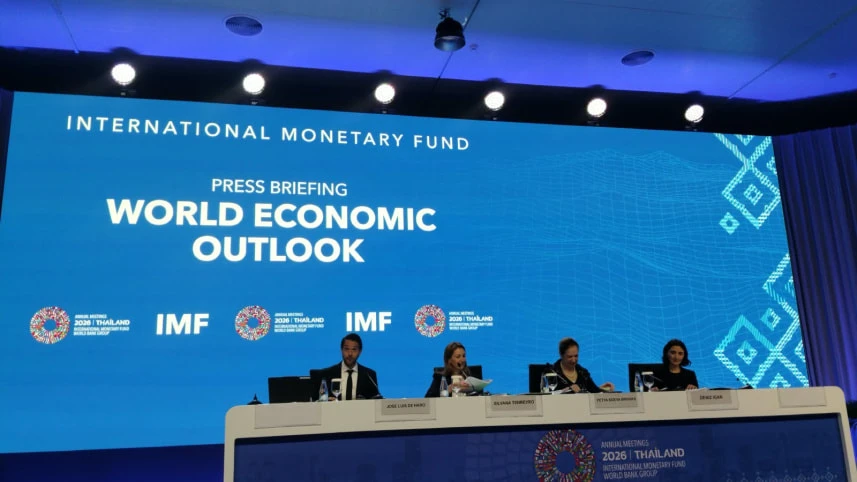
The International Monetary Fund released its October 2026 World Economic Outlook (WEO) on Tuesday, 13 October, as finance ministers and central bankers gathered in Bangkok for the annual meetings of the IMF and World Bank — the first held outside Washington in three years.
The top-line number looks almost reassuring: the IMF now expects the global economy to grow 3.1% in 2026, a slight upgrade from the 3.0% it projected in July. Growth is forecast to recover to 3.4% in 2027.
But that average conceals the real story. The world economy grew 3.5% in 2025, and this year's slowdown is landing very unevenly. The IMF's research director, Silvana Tenreyro, summed up the report by describing the outlook as highly uneven. According to the report, just 32 countries now account for 95% of global growth, compared with 54 countries as recently as April.
For businesses operating across borders, this is the key message of the October WEO: the global economy is not simply slowing — growth is being reallocated between countries depending on how exposed they are to the war-driven energy shock and how much they benefit from AI-related demand.
| Economy / Indicator | 2025 | 2026 forecast | 2027 forecast |
|---|---|---|---|
| World growth | 3.5% | 3.1% | 3.4% |
| Advanced economies | 2.0% | 2.1% | 1.9% |
| United States | — | 2.3% | 2.3% |
| Euro area | — | 1.1% | 1.2% |
| China | 5.0% | 4.5% | — |
| India | 7.7% | 7.0% | — |
| Emerging & developing economies | 4.5% | 3.7% | 4.4% |
| Middle East & Central Asia | — | Contraction | 6.3% |
| Global inflation | 4.1% | 4.7% | — |
| Oil price (avg.) | — | ~$96/barrel (up ~41%) | — |
Figures are IMF forecasts as reported on 13 October 2026; forecasts are revised every quarter.
The October outlook is best understood as the latest step in a year of sharp revisions.
| Release | 2026 global growth forecast | What drove it |
|---|---|---|
| January 2026 | 3.3% | Easing US tariffs, supply-chain adaptation, AI investment boom |
| April 2026 | 3.1% | Outbreak of the US–Israel war on Iran (28 February) and the Hormuz closure |
| July 2026 | 3.0% | Lingering energy shock, partly offset by tech-cycle demand |
| October 2026 | 3.1% | AI demand offsetting energy damage; growth more concentrated |
In January, the IMF had been upgrading its outlook on the back of lower tariffs and surging investment in data centres and artificial intelligence. The war that began on 28 February 2026 changed that trajectory. Iran's near-closure of the Strait of Hormuz — through which roughly a fifth of the world's oil and liquefied natural gas trade passed — triggered what officials have described as the largest energy supply shock on record.
In April, the IMF warned that a prolonged disruption could push global growth toward 2%, a level it described as a close call for a global recession. That worst case has so far been avoided.
The damage is concentrated in economies that import energy or sit near the conflict:
The IMF's forecasts assume that oil and gas shipments through Hormuz resume by March 2027. IMF Managing Director Kristalina Georgieva has cautioned that high energy prices would likely persist for some time even if the war ended soon. Gulf producers such as the UAE and Saudi Arabia have been fast-tracking alternative export routes, and ship-tracking data from Kpler showed Gulf crude exports near pre-war levels by the end of September — but this relies on rerouting rather than a normal Hormuz.
Business takeaway: Energy costs, freight insurance and shipping times are likely to remain elevated into 2027. Any renewed escalation would hit the forecast directly.
The single biggest reason the IMF did not cut its forecast further is AI-related demand. Spending on data centres, chips, networking equipment and power infrastructure is supporting growth in a handful of economies and in the global technology supply chain.
The benefits are highly concentrated. According to the IMF, the United States and China account for more than three-quarters of net import demand for computer chips and other AI-related equipment. Economies plugged into that supply chain — chip manufacturing, electronics assembly, power equipment — are gaining; those outside it are not.
AI's effect on jobs is a central theme in Bangkok. Georgieva has described AI's labour-market impact as slow-moving but tsunami-like, estimating that around 40% of jobs globally will be affected over time — augmented, downgraded or eliminated.
The IMF also flags that the AI boom carries financial risk: rising AI-related borrowing adds to overall debt, and the forecast assumes the surge in AI demand will moderate. If expected productivity gains disappoint, asset valuations built on those expectations could correct.
Business takeaway: AI is currently a growth engine, but a concentrated one. Companies should treat AI-driven demand as strong but cyclical, and watch for signs of an investment slowdown.
Ahead of the meetings, Georgieva urged both advanced and developing countries to strengthen their public finances, warning that mounting debt is a growing threat to financial stability. Tenreyro echoed the concern, noting that high borrowing costs make debt harder to service.
This matters for business in three ways:
The IMF expects the US economy to grow 2.3% in both 2026 and 2027, supported by AI-related investment. The US remains among the strongest of the advanced economies.
The euro area is forecast to grow just 1.1% this year and 1.2% in 2027, held back by its dependence on imported gas and oil.
China is forecast to expand 4.5% this year, down from 5.0% in 2025 and in line with Beijing's official target. Its role as a major source of AI-related import demand provides some support.
India is once again projected to be the world's fastest-growing major economy, at 7.0% in 2026, down from 7.7% in 2025. As a large energy importer, India is exposed to higher oil prices, but strong domestic demand continues to drive growth.
Direct exposure to the conflict, Iranian strikes on regional infrastructure and sharply reduced energy exports mean the region is expected to contract this year. A strong rebound in 2027 depends on shipping returning to normal.
Countries that import energy and lack exposure to AI supply chains face the toughest conditions. Those that export commodities other than oil, or that participate in electronics manufacturing, are doing relatively better.
With growth concentrated in fewer countries, expansion plans built on broad "emerging market growth" assumptions need revisiting. India, the US and economies tied to the technology supply chain stand out; energy-importing markets with high debt look riskier.
Budgets should assume elevated oil prices and higher shipping and insurance costs into 2027. Scenario planning should include a case where Hormuz disruption extends beyond March.
Global inflation rising to 4.7% means pricing pressure on inputs and wages, and potentially fewer interest-rate cuts. Companies with floating-rate debt or heavy refinancing needs are most exposed.
Energy-importing economies with large external debts face currency weakness. Firms with revenue in these markets should review hedging and pricing strategies.
AI demand is supporting suppliers of chips, servers, power equipment and cloud services. But a slowdown in AI capital spending would ripple through those same supply chains.
The 2026 shock reinforces lessons from the pandemic and the tariff disputes: dependence on a single route, supplier or region is a strategic vulnerability.
| Risk | Why it matters |
|---|---|
| Hormuz disruption beyond March 2027 | Would push oil prices higher and growth lower than forecast |
| Escalation of the Middle East war | Further damage to energy infrastructure and shipping |
| AI investment slowdown or valuation correction | Would remove the main support offsetting the energy shock |
| Rising public and corporate debt | Higher borrowing costs and potential financial stress |
| Persistent inflation | Could force central banks to keep rates high |
| Renewed trade tensions | Would add to supply-chain costs and uncertainty |
| Food insecurity | Higher fuel and fertiliser prices raise food costs in poorer countries |
In its October 2026 World Economic Outlook, the IMF projects global growth of 3.1% for 2026, up slightly from 3.0% in July but down from 3.5% in 2025. Growth is expected to reach 3.4% in 2027.
The upgrade is small and reflects strong AI-related investment, which is offsetting part of the damage from higher oil and gas prices. Growth is increasingly concentrated in countries insulated from the energy shock or benefiting from AI demand.
The IMF expects oil to average about $96 a barrel in 2026, up nearly 41% from last year.
India, forecast to grow 7.0% in 2026, remains the world's fastest-growing major economy.
The Middle East and Central Asia, which is expected to contract in 2026 before recovering in 2027 if energy shipping normalises.
It means global growth is increasingly driven by a small number of economies. In April, 54 countries accounted for the same share. This concentration makes the global outlook more fragile.
The IMF publishes full reports in April and October, with shorter updates in January and July.
No. This article explains published IMF forecasts and their general business implications. Forecasts are uncertain and frequently revised; businesses and investors should seek professional advice for specific decisions.
The October 2026 World Economic Outlook describes a global economy caught between two powerful forces: an energy shock from the Iran war that is raising costs and inflation, and an AI investment boom that is keeping growth alive in a limited set of countries. The headline 3.1% growth rate masks a widening gap between winners and losers. For international businesses, the priorities are clear — plan for higher energy and financing costs, focus on resilient markets, diversify supply chains and treat both the war and the AI cycle as the key variables to watch into 2027.
