
Japan Launches Historic Mars Moon Mission to Collect Samples for Earth

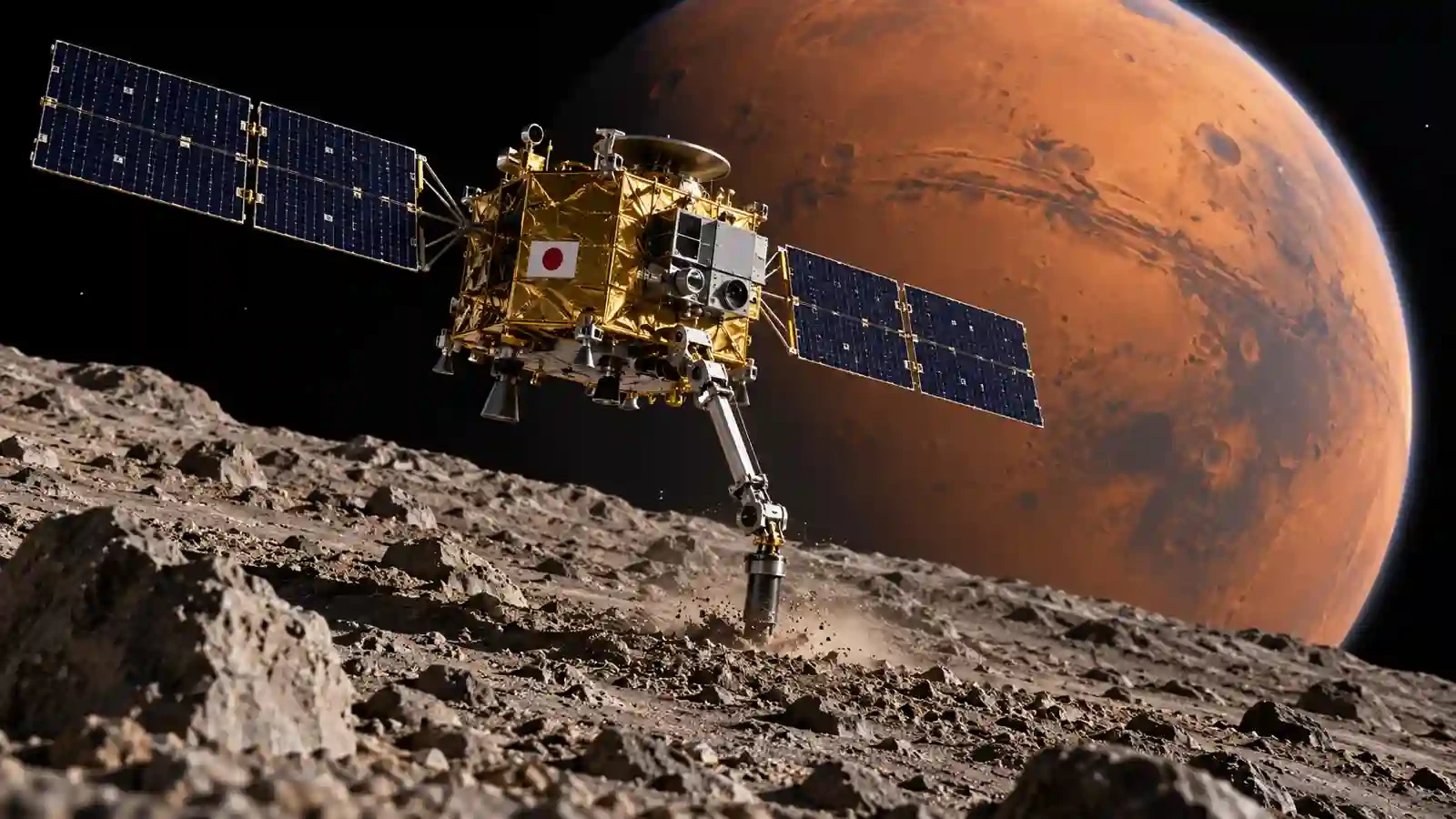
Japan Makes Space History With Ambitious Mission to Unlock the Secrets of Mars’ Moons
Science and Space News
Japan has taken a significant step forward in planetary exploration after successfully launching a spacecraft designed to investigate the mysterious moons of Mars and bring samples of their surface material back to Earth.
The Martian Moons eXploration mission, known as MMX, lifted off aboard Japan’s H3 rocket from the Tanegashima Space Center on October 20, 2026. The spacecraft was successfully placed on its planned trajectory, beginning a multiyear journey to the Red Planet.
Led by the Japan Aerospace Exploration Agency (JAXA), the mission aims to study Phobos and Deimos, Mars’ two small and unusual natural satellites. Scientists hope the observations and returned samples will resolve long-standing questions about how the moons formed and how the early Solar System evolved.
If successful, MMX will achieve a major milestone in space exploration by returning material from a moon of Mars for the first time.
MMX Mission: A New Chapter in Mars Exploration
The successful launch marks the beginning of one of Japan’s most ambitious planetary science projects.
Unlike conventional missions that observe distant worlds using cameras and scientific instruments, MMX is designed to travel to the Martian system, investigate both moons at close range, collect material from Phobos and return the samples to Earth.
The spacecraft is expected to reach Mars in August 2027. It will then conduct detailed observations of Phobos and Deimos, examining their surfaces, composition, gravity and internal structure.
Phobos will be the mission’s primary target. The spacecraft is planned to collect at least 10 grams of surface material before beginning its return journey.
The samples are expected to arrive on Earth in 2031, where laboratories will be able to study them using advanced techniques that cannot be fully replicated by instruments operating in space.
The mission could provide scientists with valuable evidence about the formation and evolution of the Martian system.
Why Are Scientists Interested in Phobos and Deimos?
Mars has two moons, but their origins remain uncertain.
Phobos is the larger and closer of the pair, orbiting only about 6,000 kilometres above the Martian surface. Deimos is smaller and follows a more distant orbit.
Both moons have irregular shapes and relatively small dimensions compared with Earth's Moon. Their unusual characteristics have made them important subjects of planetary research.
Scientists are investigating two leading explanations for their formation.
The first suggests that Phobos and Deimos may be captured asteroids. Under this theory, the moons formed elsewhere in the Solar System before Mars’ gravity pulled them into orbit.
The second proposes that the moons formed from debris created when a large object struck Mars. Material ejected by the impact may subsequently have gathered into smaller bodies orbiting the planet.
Determining which explanation is correct could improve scientific understanding of how planets and their satellites formed billions of years ago.
The samples collected by MMX could reveal chemical and mineralogical clues that help distinguish between these possibilities.
NASA and International Partners Support the Mission
Although MMX is led by Japan, the project represents a significant international collaboration involving space agencies and research teams from several countries.
NASA is contributing scientific equipment, communications support and expertise. Its MEGANE instrument will measure gamma rays and neutrons emitted from Phobos to help determine the moon’s elemental composition.
The agency is also contributing a pneumatic sampling technology demonstration designed to collect surface material using bursts of high-pressure nitrogen gas.
These measurements will complement Japan’s own sampling system and scientific instruments.
European partners are contributing the Idefix rover, developed jointly by Germany’s aerospace centre, DLR, and France’s space agency, CNES.
The rover is expected to reach Phobos around late 2028 or early 2029. It will investigate the surface and help researchers understand the terrain and conditions that the main spacecraft will encounter during its sampling operations.
This international approach combines Japanese spacecraft engineering, American scientific instruments and European robotic technology in a single mission.
Idefix Rover: Exploring an Unfamiliar World
One of the mission’s most intriguing elements is the Idefix rover, which is designed to operate in the extremely low-gravity environment of Phobos.
The moon’s gravity is less than one-thousandth of Earth's, making movement and surface operations particularly challenging.
A conventional rover designed for Earth or Mars could struggle to maintain traction under such conditions. Even small movements could produce unexpected bouncing or displacement.
Idefix has therefore been engineered to operate in this unfamiliar environment. Following its planned deployment, it will attempt to orient itself, deploy its solar panels and begin surface exploration.
The rover is expected to operate for approximately 100 days, collecting information about the terrain and local environment.
Its observations could help scientists understand the physical properties of Phobos and support the spacecraft’s sampling activities.
The mission will also test technologies that could prove valuable for future robotic exploration of small asteroids and other low-gravity bodies.
How the Mission Could Help Explain the Origins of Life
MMX is not designed to discover life directly on Mars or its moons. Instead, its scientific importance lies partly in what it could reveal about the early Solar System and the distribution of materials essential for habitability.
Scientists are interested in how water-bearing minerals and organic compounds moved through the young Solar System, and how those materials may have reached the rocky planets.
If Phobos contains material linked to Mars’ geological history, the samples could offer clues about ancient impact events and the exchange of material between Mars and its surroundings.
Alternatively, if the moon proves to be a captured asteroid, its composition could reveal information about the population of small bodies that existed during the Solar System’s early history.
Either outcome would contribute to a better understanding of planetary formation and the conditions that may allow life to emerge.
The findings could also inform future missions to Mars, including efforts to study its ancient environment and evaluate its potential to have supported microbial life.
MMX Mission Timeline: From Launch to Earth Return
The spacecraft's journey will unfold over several years, with major milestones planned along the way.
- October 20, 2026: Successful launch from Japan aboard the H3 rocket.
- August 2027: Expected arrival at Mars and beginning of detailed observations of its moons.
- Late 2028 to early 2029: Planned deployment of the Idefix rover on Phobos.
- December 2028 onward: Planned Phobos surface-sampling operations, subject to mission conditions.
- 2031: Targeted return of the collected samples to Earth.
These dates represent the mission’s planned schedule. Deep-space operations are complex, and milestones can change depending on spacecraft performance, navigation and surface conditions.
Conclusion: A Landmark Achievement for Global Space Science
Japan’s successful MMX launch marks an important milestone in humanity’s exploration of the Martian system.
By studying Phobos and Deimos at close range and bringing samples back to Earth, the mission could help settle fundamental questions about the origins of Mars’ moons and the evolution of the early Solar System.
Its international partnerships also demonstrate how countries can combine scientific expertise and advanced technology to pursue ambitious space exploration goals.
The most significant results will come later, as the spacecraft reaches Mars, examines the moons and attempts its sample collection and return operations.
For now, MMX has successfully begun its journey. If the mission achieves its objectives, scientists could soon have access to material from a previously unexplored part of the Martian system, opening a new chapter in planetary science.