
Asteroid Missions 2026: NASA’s Bennu Discoveries and ESA’s Hera Mission

NASA and Europe’s Asteroid Missions Reveal New Clues About Earth’s Origins and Planetary Defence
Asteroid Missions Open a New Chapter in Space Exploration and Earth’s Protection
Humanity’s understanding of asteroids is advancing through two major space exploration efforts: NASA’s OSIRIS-REx mission, which returned samples from asteroid Bennu, and the European Space Agency’s Hera mission, which is examining the aftermath of a deliberate collision with another asteroid.
Although the missions have different objectives, both are addressing fundamental scientific questions: How did the solar system form? What chemical ingredients existed before life emerged on Earth? And could scientists change the trajectory of an asteroid that threatens our planet?
NASA’s OSIRIS-REx spacecraft delivered its sample capsule to Earth in September 2023, providing researchers with pristine extraterrestrial material to study. The mission’s primary sample-return phase formally concluded on September 30, 2026, while the spacecraft itself continues its journey under a new name, OSIRIS-APEX.
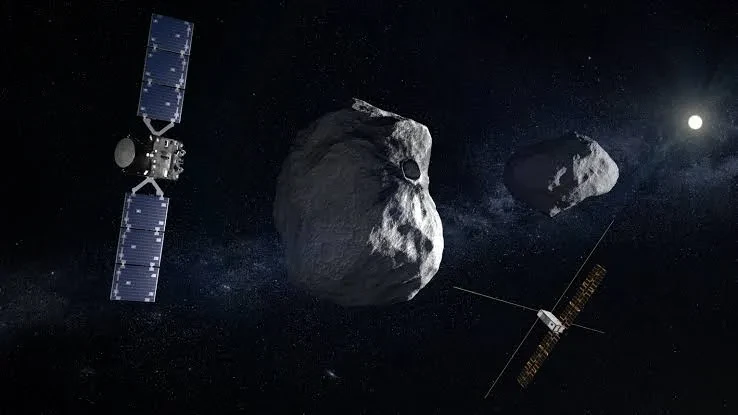
At the same time, Europe’s Hera spacecraft is approaching the Didymos-Dimorphos asteroid system to examine the results of NASA’s 2022 Double Asteroid Redirection Test (DART). Together, these missions are expanding scientific knowledge while helping establish the technologies needed for future planetary defence.
NASA’s OSIRIS-REx Mission: Bringing an Asteroid to Earth
Launched on September 8, 2016, OSIRIS-REx travelled to near-Earth asteroid Bennu to collect surface material and return it to Earth for detailed laboratory analysis.
On October 20, 2020, the spacecraft performed a touch-and-go manoeuvre, briefly contacting Bennu’s surface with its robotic sampling arm. It collected rocks and dust before beginning the journey home.
The sample capsule landed in Utah on September 24, 2023, carrying approximately 121.6 grams (4.3 ounces) of asteroid material. This exceeded the mission’s original minimum collection target of 60 grams and provided scientists with a valuable archive of material from the early solar system.
Unlike observations made through telescopes, laboratory analysis allows researchers to examine the sample’s chemistry, mineral structure and isotopic composition in extraordinary detail.
The findings have already challenged assumptions about asteroids and their role in the development of planets. Researchers found that Bennu contains water-bearing minerals, carbon-rich compounds and organic molecules, offering clues about the materials present during the solar system’s earliest stages.
What Bennu Revealed About Water and the Ingredients of Life
One of the most significant findings from OSIRIS-REx is evidence that Bennu contains minerals formed through interactions with water on its ancient parent body.
Bennu itself is too small to have sustained long-lived bodies of liquid water in the way Earth does. However, its parent asteroid appears to have experienced aqueous alteration, a process in which liquid water reacts with minerals.
The returned material also contains carbon-rich chemistry and amino acids, molecules important to life as we know it. These discoveries do not demonstrate that life existed on Bennu or elsewhere in the asteroid’s history. Instead, they show that some of the chemical ingredients associated with life were present in primitive solar-system material.
The results strengthen scientific interest in the possibility that asteroids helped deliver water and organic compounds to the early Earth.
Scientists are continuing to investigate how Bennu’s parent body formed, how its minerals changed over time and how material from different regions of the early solar system became mixed together.
Bennu Was Not the Asteroid Scientists Expected
OSIRIS-REx also revealed that Bennu’s surface was substantially more rugged and loosely structured than some pre-mission observations had suggested.
Instead of finding extensive areas of smooth, fine-grained material, scientists encountered a landscape covered with boulders. During the sampling manoeuvre, the collection mechanism penetrated the surface with surprisingly little resistance, demonstrating that some of the asteroid’s material was loosely packed.
This discovery has implications for future asteroid missions. Spacecraft approaching small bodies must account for their weak gravity, unpredictable surface conditions and potentially fragile structures.
The mission’s tracking data has also helped scientists refine Bennu’s orbit and estimate its future impact risk. Although Bennu remains an asteroid of interest for planetary defence, current calculations indicate that an Earth impact is unlikely.
OSIRIS-REx therefore delivered more than a sample: it improved scientific understanding of asteroid composition, surface behaviour and orbital evolution.
\<WritingBlock id="57291" variant="document">### ESA’s Hera Mission: Investigating the Aftermath of an Asteroid Impact
While OSIRIS-REx brought material back to Earth, the European Space Agency’s Hera mission is investigating whether a spacecraft can deliberately alter an asteroid’s motion in a predictable and measurable way.
Hera launched on October 7, 2024, and is travelling towards the Didymos binary asteroid system. Its main target is Dimorphos, a smaller asteroid orbiting the larger body Didymos.
In September 2022, NASA’s DART spacecraft deliberately collided with Dimorphos at approximately 6.6 kilometres per second. The experiment successfully shortened the asteroid moonlet’s orbital period around Didymos by approximately 33 minutes, demonstrating that a kinetic impact can change an asteroid’s motion. \<Cite refs={["turn856299search5","turn856299news11"]}/>
However, changing an asteroid’s orbit is only part of the challenge. Scientists also need to understand the asteroid’s mass, internal structure, surface properties and the consequences of the collision before they can confidently apply this technique to a genuine planetary threat.
That is where Hera comes in.
The spacecraft is designed to survey the asteroid pair at close range, map the impact region and measure the physical properties of both bodies. It will also deploy two small CubeSats, Milani and Juventas, to investigate surface composition and internal structure.
These measurements will help scientists turn the DART experiment into a more thoroughly understood planetary-defence technique.
Why Asteroid Deflection Matters for Earth
Asteroid impacts are a natural part of the solar system’s history. Although catastrophic collisions are rare, a sufficiently large object striking Earth could have serious consequences for life and the global environment.
Planetary defence focuses on finding potentially hazardous asteroids, calculating their future trajectories and developing methods to reduce the risk of impact.
The DART-Hera programme explores one possible solution: kinetic impact deflection. Rather than destroying an asteroid, a spacecraft collides with it to change its velocity slightly. If performed sufficiently early, even a small change in velocity could cause a threatening asteroid to miss Earth.
The technique’s effectiveness depends on several factors, including the asteroid’s mass, composition, internal structure and how much material is ejected by the collision.
Hera’s observations are therefore important because they will help researchers determine how much the DART impact changed Dimorphos and why the result occurred.
The mission is not responding to an imminent asteroid threat. Instead, it is testing and refining technology that could be useful if a dangerous object were discovered in the future.
OSIRIS-APEX: NASA’s Next Journey to an Asteroid
The end of OSIRIS-REx’s sample-return mission does not mean the spacecraft has stopped exploring.
After releasing its sample capsule in 2023, the spacecraft continued through space under the name OSIRIS-APEX, short for OSIRIS-Apophis Explorer.
Its next destination is Apophis, a near-Earth asteroid expected to make a close approach to Earth on April 13, 2029. Current predictions indicate that Apophis will pass safely by our planet.
OSIRIS-APEX is expected to study the asteroid after its close approach, investigating how Earth's gravitational influence may affect its surface and physical properties.
This extended mission builds on the engineering and navigation experience gained at Bennu. It also demonstrates how a spacecraft designed for one scientific objective can continue contributing to research after completing its original mission. \<Cite refs={["turn856299search4","turn856299search2"]}/>
What These Missions Mean for the Future of Space Science
The OSIRIS-REx and Hera programmes illustrate two complementary approaches to asteroid exploration.
OSIRIS-REx provides physical samples that scientists can examine using sophisticated laboratory equipment on Earth. Hera, by contrast, will deliver close-range measurements of an asteroid system that has already experienced a controlled impact.
Together, their findings could improve understanding of planetary formation, the distribution of water and organic compounds in the early solar system, and the engineering requirements for asteroid deflection.
The missions also highlight the importance of international cooperation. Planetary defence depends on reliable observations, shared scientific knowledge and technologies that can be developed and tested well before an emergency arises.
As researchers continue studying Bennu’s returned material and Hera investigates Dimorphos, new findings may reshape scientific models of how asteroids form, evolve and respond to external forces.
NASA’s OSIRIS-REx mission has returned a valuable sample that is revealing clues about the early solar system and the chemistry associated with life. Meanwhile, ESA’s Hera mission is investigating the results of humanity’s first successful asteroid-deflection experiment. Together, these missions are advancing space science and helping prepare for the possibility of protecting Earth from a future asteroid threat.