
Antarctic Sea Ice Hits Near-Record Low as New Study Warns of Faster Arctic Winter Loss

Quick Facts: Global Sea Ice and Climate Change
| Detail | Key Finding |
|---|---|
| Antarctic sea ice maximum | 17.59 million sq km |
| Date of Antarctic maximum | September 14, 2026 |
| Antarctic record ranking | Third-lowest maximum in satellite records |
| Arctic winter projection | Around 1 million sq km less ice than earlier estimates |
| Ancient climate evidence | Sediment records from approximately 6,000 years ago |
| Research journal | Nature Geoscience |
Antarctica Records Another Exceptionally Low Winter Sea Ice Maximum
Antarctica’s sea ice has reached another worrying milestone, with satellite observations showing that the annual winter maximum in 2026 was the third-lowest recorded since monitoring began.
According to NASA and the National Snow and Ice Data Center (NSIDC), Antarctic sea ice likely reached its maximum extent on September 14, covering approximately 17.59 million square kilometres. This was about one million square kilometres below the long-term average.
The finding adds to growing scientific concern about changes in the polar regions, where sea ice plays an important role in regulating temperatures, supporting marine ecosystems and influencing the exchange of heat between the ocean and atmosphere.
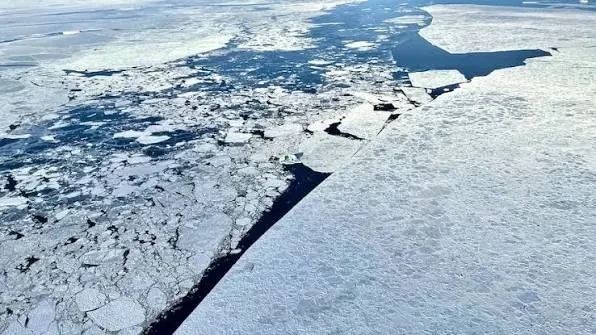
The European Space Agency’s Copernicus Sentinel-3 satellite also captured an image of West Antarctica on September 30, showing sea ice extending around the Antarctic Peninsula and into parts of the Weddell Sea.
Although Antarctic sea ice naturally expands during the Southern Hemisphere’s winter and retreats during summer, the latest measurements highlight how unusual recent years have been.
Antarctic Sea Ice Decline: From Record Highs to Record Lows
Antarctic sea ice does not follow exactly the same pattern as Arctic sea ice. The Arctic is an ocean surrounded by land, while Antarctica is a continent surrounded by the Southern Ocean. This geography allows Antarctic sea ice to spread across large areas during winter before melting back during summer.
Between 1979 and 2014, Antarctic sea ice extent increased by roughly 1% per decade, although scientists have debated the significance of this trend because annual ice coverage varies considerably.
That pattern changed after 2015, when substantial decreases began to emerge. Since then, Antarctic sea ice has generally remained below average, despite occasional recoveries.
Both the record-low summer minimum and winter maximum occurred in 2023. The 2026 winter maximum now ranks among the lowest in the satellite record, adding to the evidence that the Antarctic sea-ice system is experiencing significant variability and sustained periods of reduced coverage.
Scientists continue to investigate the relative roles of ocean temperatures, atmospheric circulation, winds and natural climate variability. The latest figures alone do not establish a single cause, but they provide another important data point for understanding long-term polar climate change.
New Research Suggests Arctic Winter Sea Ice Loss Could Be Worse
While Antarctica’s latest measurements reveal the current state of winter ice coverage, a separate study has raised concerns about the future of Arctic sea ice.
Researchers from the University of Cambridge and Mexico’s Centro de Investigación en Matemáticas (CIMAT) have found that future Arctic winter sea ice could shrink by around one million square kilometres more than previous projections suggested.
The study, published in Nature Geoscience, addresses a major uncertainty in climate science: computer models often disagree about how much Arctic sea ice will remain during winter as the planet warms.
Summer sea ice decline has received considerable attention, but winter ice is also crucial. It helps regulate the movement of heat and moisture between the Arctic Ocean and the atmosphere, influencing weather patterns far beyond the polar region.
By refining climate models using evidence from the distant past, the researchers believe they can produce more reliable projections of where winter sea ice is likely to disappear in the coming decades.
How Ancient Arctic Evidence Is Improving Climate Models
To improve predictions, the research team examined ocean sediment cores containing chemical markers preserved from a warmer period approximately 6,000 years ago.
During this part of the mid-Holocene, changes in Earth’s orbit contributed to different climatic conditions, including reduced Arctic sea ice. The sediments contain a biomarker known as IP₂₅, produced by certain algae associated with sea ice.
Researchers analysed this marker alongside other biological indicators associated with open-water conditions. Together, these clues helped them reconstruct how much sea ice existed in the Arctic thousands of years ago.
The team then compared the ancient evidence with simulations from 27 climate models. Using a statistical method called Bayesian weighting, they gave greater influence to models that more accurately reproduced the historical conditions.
The comparison suggested that climate models had generally overestimated the amount of Arctic winter sea ice.
After adjusting the models, researchers estimated that future winter sea ice loss could be around one million square kilometres greater than previously projected. The approach also reduced the uncertainty range in projections by as much as 85%.
The findings do not eliminate uncertainty from climate forecasting, but they provide a stronger evidence-based framework for assessing the Arctic’s future.
Why Winter Sea Ice Loss Matters for Global Weather
Sea ice is more than a frozen surface covering polar oceans. It influences how much heat escapes from the ocean into the atmosphere and how energy moves through the climate system.
When sea ice retreats, darker ocean water becomes exposed and absorbs more solar energy than reflective ice. This can contribute to additional warming in the region, although the effects vary with season, weather and ocean conditions.
Changes in Arctic winter ice may also influence atmospheric circulation and weather patterns in parts of Europe and North America. Researchers have linked Arctic changes with shifts in winter conditions, including colder spells and heavier snowfall in some regions, although the exact connections remain an active area of scientific investigation.
The Cambridge-led study also suggests that precipitation projections could change when climate models are refined. Its analysis points to the possibility that snowfall over southeast Greenland and rainfall in the Mediterranean may be underestimated, with potential implications for Greenland’s ice sheet and flood risks in southern Europe.
These are projected risks, not predictions that a specific winter or flood event will occur. Further research is needed to determine how these changes may develop and interact.
What Do the Latest Sea Ice Findings Mean for Climate Change?
The Antarctic observations and Arctic modelling study address different questions. One measures the extent of sea ice recorded in 2026; the other revises estimates of how much Arctic winter ice may remain in the future.
Together, however, they highlight the importance of improving climate monitoring and forecasting.
Satellite observations provide consistent measurements of polar ice coverage, while ancient climate records help researchers test whether computer models accurately represent how the Earth responds to changing conditions.
For policymakers, coastal communities and industries that depend on reliable weather and climate information, better projections can improve long-term risk assessment. They can also help scientists investigate potential consequences for ecosystems, shipping routes, ocean circulation and infrastructure.
The findings should not be interpreted as proof that every aspect of polar ice loss is accelerating at the same rate. Arctic and Antarctic sea ice respond to different regional conditions, and their annual measurements can fluctuate significantly.
Nevertheless, the latest evidence reinforces the need to monitor both polar regions closely as global temperatures change.
Polar Sea Ice Research Enters a Critical Phase
Antarctica’s third-lowest winter sea ice maximum in 2026 and the revised outlook for Arctic winter ice underline the value of combining satellite data with historical climate evidence.
NASA, the NSIDC and the European Space Agency continue to monitor changes in Antarctic sea ice, while researchers are using ancient biological markers to improve projections for the Arctic.
As more observations become available, scientists hope to establish a clearer picture of how polar sea ice will respond to future warming—and how those changes may influence weather, ecosystems and the wider climate system.
The message from the latest research is clear: understanding polar ice requires looking at both what satellites are measuring today and what the Earth’s climate history can reveal about tomorrow.