
NASA’s Perseverance Rover Breaks Mars Driving Record After 45.22 Kilometres

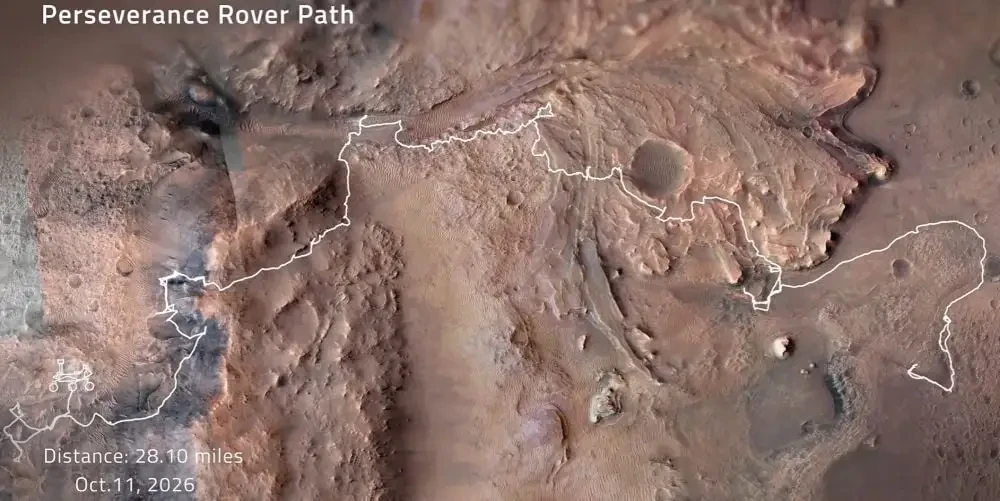
Quick Facts: NASA Perseverance Rover Record
| Detail | Information |
|---|---|
| Record distance | 45.22 km (28.10 miles) |
| Previous record holder | NASA’s Opportunity rover |
| Previous distance | 45.16 km (28.06 miles) |
| Record date | October 11, 2026 |
| Mission location | Jezero Crater, Mars |
| Key technology | AutoNav autonomous navigation |
| Extended mission | Expected to continue through approximately the end of 2028 |
NASA’s Perseverance Rover Sets a New Driving Record on Mars
NASA’s Perseverance Mars rover has made space exploration history by driving farther across the surface of another world than any vehicle before it. On October 11, 2026, the robotic explorer’s odometer reached 45.22 kilometres (28.10 miles), narrowly surpassing the previous record of 45.16 kilometres held by NASA’s Opportunity rover.
The milestone came on Perseverance’s 2,006th Martian day, known as a sol. The rover achieved the feat in approximately five and a half years on Mars, while Opportunity took nearly 15 years to accumulate a comparable distance during its mission from 2004 to 2018.
NASA announced the achievement on October 12, highlighting how improvements in rover mobility, autonomous navigation and mission planning have expanded the capabilities of robotic exploration.
Although the distance difference between the two rovers is small, the achievement marks a major step forward in the development of technology that allows spacecraft to travel across challenging planetary terrain with increasing independence.
How Perseverance Surpassed Opportunity’s Record
The key to Perseverance’s record-breaking journey is its advanced autonomous navigation system, known as AutoNav.
Mars is millions of kilometres from Earth, depending on the planets’ positions. Communication signals take time to travel between the two planets, meaning rover operators cannot steer the vehicle in real time as they would a remote-controlled car.
Instead, mission planners on Earth identify destinations and waypoints. AutoNav then helps Perseverance analyse the ground ahead, identify obstacles and calculate a safe route as it drives.
Using images from its navigation cameras, the rover builds a three-dimensional representation of the surrounding terrain. It can evaluate rocks, uneven ground and other potential hazards while continuing its journey.
NASA reports that Perseverance has used autonomous navigation for more than 90% of its total driving distance. By comparison, the early autonomous driving system used by Opportunity and its twin, Spirit, accounted for about 5% of their driving.
The technological difference is substantial. NASA’s first Mars rover, Sojourner, evaluated the path ahead using around 20 measurement points. Perseverance can process approximately 600,000 measurement points each time it examines the terrain.
The rover can cover as much as 412 metres in a single Martian day, depending on terrain and driving conditions. This ability allows it to travel efficiently while leaving more time and energy for scientific investigations.
Exploring Ancient Rocks Around Jezero Crater
Perseverance is not travelling simply to accumulate kilometres. Its primary mission is to investigate Mars’ geological history and search for evidence that the planet may once have supported microbial life.
The rover landed in Jezero Crater in February 2021. Scientists selected the region because geological evidence indicates that it once contained a lake and a river delta—environments that could have provided conditions suitable for ancient microbial life.
During its exploration, Perseverance has travelled from the crater floor and an ancient delta towards the crater rim, examining rocks formed during different stages of Martian history.
When it broke the driving record, the rover was travelling through an area near the western rim known as Lac de Charmes, heading towards a location called Idubi. Researchers hope to investigate rocks that could preserve evidence of ancient hydrothermal systems, where heated water interacted with rock.
Such environments are scientifically important because water-rock interactions can create chemical conditions that may support microbial life. However, finding evidence of a potentially habitable environment does not, by itself, prove that life existed there.
The rover has also collected 29 rock and regolith samples, according to NASA’s October 2026 update. These samples represent different geological settings across the crater and its rim, preserving material that could help scientists reconstruct the planet’s early history.
Perseverance’s Record Could Help Reveal Mars’ Past
The record-breaking journey increases the amount of terrain Perseverance can reach during its mission. Longer drives mean researchers can investigate more rock formations, compare different geological environments and select promising locations for closer study.
One of the rover’s important earlier findings involved a rock nicknamed Cheyava Falls, which displayed features scientists considered a potential biosignature. Such findings require further analysis before they can be interpreted as evidence of past life.
Perseverance’s exploration of the crater rim could reveal a different chapter of Martian history. Some of the impact-related rocks in this region are approximately four billion years old, offering access to geological evidence that has largely been erased on Earth by erosion and plate tectonics.
Mars does not have Earth-like active plate tectonics, which means some ancient geological features may remain preserved for much longer.
The rover’s mobility therefore has a direct scientific benefit: it can reach a wider variety of rocks and investigate environments that might otherwise remain inaccessible.
NASA Extends Perseverance’s Mission Through 2028
NASA has approved the first extension of the Perseverance mission, which began in October 2026 and is expected to support exploration of the Jezero Crater rim through approximately the end of 2028.
The mission team has reported that the rover’s mobility systems remain operational and that durability testing has produced encouraging results. This gives scientists an opportunity to continue gathering data and expanding the rover’s driving record.
Following its work around Lac de Charmes, Perseverance is expected to continue along the crater rim and head south towards Rainbow Falls, an area that includes a large block of ancient crust uplifted by the impact that formed Jezero Crater.
The team will continue balancing travel with scientific objectives, including imaging geological formations, analysing rocks and collecting samples.
A New Milestone in Robotic Space Exploration
Perseverance’s achievement reflects decades of progress in NASA’s Mars rover programme. From the short journeys of Sojourner to Opportunity’s nearly 15-year mission and now Perseverance’s advanced autonomous driving, each generation has expanded what robotic explorers can accomplish.
The record is more than a distance statistic. Improved navigation allows a rover to cover ground more efficiently, investigate a wider range of geological features and make better use of its operational lifetime.
As Perseverance continues exploring Jezero Crater, scientists hope its observations and samples will deepen understanding of Mars’ ancient environments and whether conditions there were ever suitable for life.
For now, the 45.22-kilometre milestone establishes Perseverance as the farthest-travelling vehicle on another world—and with its mission extended, the rover may add considerably more distance to that record in the years ahead.