
ISRO’s Aditya-L1 and Europe’s Proba-3 Reveal New Clues About Solar Storms

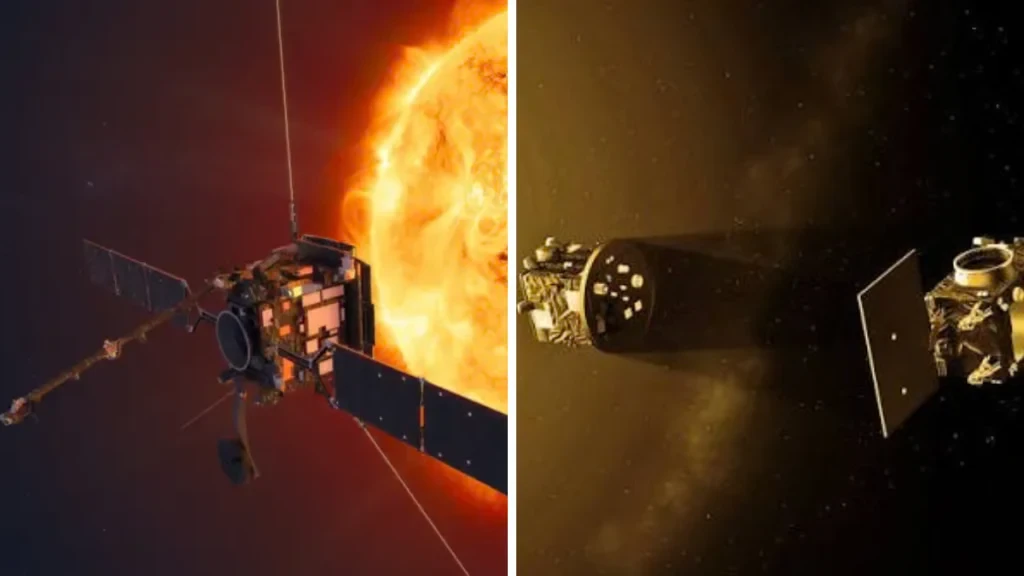
India and Europe Join Forces to Study Solar Eruptions
India’s Aditya-L1 solar mission and the European Space Agency’s Proba-3 have delivered new insights into some of the Sun’s most powerful events. For the first time, scientists have jointly analysed observations of the same solar eruptions captured by both missions, improving their understanding of how these events develop close to the Sun.
Researchers at Bengaluru’s Indian Institute of Astrophysics (IIA) combined data from two specialised instruments: the Visible Emission Line Coronagraph (VELC) aboard Aditya-L1 and the ASPIICS coronagraph aboard Proba-3.
The study, published in the journal Astronomy & Astrophysics, examined coronal mass ejections (CMEs)—large eruptions that release enormous quantities of magnetised plasma from the Sun’s outer atmosphere into space.
By combining observations from the two spacecraft, scientists measured the mass, density and energy of these eruptions in the inner solar corona. The findings demonstrate how international cooperation and complementary space technologies can provide a more complete picture of solar activity.
What Are Coronal Mass Ejections and Why Do They Matter?
Coronal mass ejections are among the major drivers of space weather. During a CME, large clouds of charged particles and magnetic fields are expelled from the Sun and travel through interplanetary space.
When directed towards Earth, these eruptions can interact with the planet’s magnetic field and disturb the near-Earth space environment. Depending on their strength and direction, they can contribute to geomagnetic storms and affect satellites, navigation systems, radio communications and electrical infrastructure.
Understanding how CMEs form, expand and carry energy is therefore important for improving space weather research and assessing potential risks to modern technology.
However, studying these eruptions close to the Sun is challenging. The Sun’s bright visible surface can overwhelm the much fainter corona, making it difficult for instruments to observe the earliest stages of an eruption.
Earlier space-based coronagraphs provided valuable observations but could not fully track the early evolution of some faint CMEs. The new joint study offers a way to overcome some of these limitations.
How Aditya-L1 and Proba-3 Complement Each Other
The breakthrough comes from the different capabilities of the two missions.
Aditya-L1, India’s first dedicated space-based solar observatory, carries VELC, an instrument developed by the Indian Institute of Astrophysics in collaboration with ISRO. It observes the solar corona close to the Sun and collects spectroscopic data that help scientists understand the properties of the hot gas involved in an eruption.
Aditya-L1 operates in a halo orbit around the Sun–Earth Lagrange Point 1, approximately 1.5 million kilometres from Earth towards the Sun. This position allows it to observe the Sun continuously, without the regular interruptions caused by Earth’s day-night cycle.
Proba-3, meanwhile, is an ESA mission designed around precision formation flying. Its two spacecraft operate approximately 150 metres apart, with one spacecraft blocking the Sun’s bright disc from the other. This creates an artificial solar eclipse in space, enabling the ASPIICS instrument to image the corona.
The two instruments provide different but complementary information. ASPIICS helps determine the eruption’s shape, movement and mass through imaging, while VELC’s spectroscopic measurements help estimate gas density and thermal energy.
Together, these observations give researchers a more detailed view of how solar eruptions evolve than either instrument could provide alone.
Two Solar Eruptions Reveal Different Energy Patterns
The research team jointly observed two CMEs recorded on September 14 and September 16, 2025.
The first eruption travelled at approximately 645 kilometres per second, while the second moved at around 145 kilometres per second. The observations revealed differences in their expansion and the way energy was distributed within them.
Scientists found that the density of the slower CME decreased more steeply with height, indicating stronger early expansion. The results also showed that the two eruptions differed in how their energy was divided between thermal and kinetic forms.
For the September 14 event, thermal energy accounted for approximately 1% of the total estimated energy. In the September 16 eruption, thermal energy increased until it was comparable to kinetic energy. The estimated magnetic energy in the events was comparable to or greater than their kinetic energy.
These differences matter because CMEs do not all behave in the same way. Their speed, density, magnetic properties and energy distribution influence how scientists interpret their development and potential interactions with the surrounding space environment.
The findings provide new observational constraints on the physical processes shaping CMEs near their origin.
Aditya-L1 Could Improve Future Space Weather Research
The latest research adds to the growing scientific value of Aditya-L1, which was launched in September 2023 and reached its halo orbit around L1 in January 2024.
According to solar physicists, continuous observation is crucial because the Sun produces eruptions that vary in size, speed and direction. Not every CME is aimed at Earth, and not every eruption that travels towards the planet causes the same level of disruption.
Better observations close to the Sun can help researchers understand which properties influence an eruption’s development and how its characteristics change as it travels through space.
This knowledge is relevant to countries that rely on satellites for telecommunications, weather forecasting, navigation and other essential services. It can also support research into how geomagnetic disturbances affect power systems and other technology-dependent infrastructure.
However, the new study does not mean scientists can yet predict the exact effects of every solar eruption on Earth. More observations and long-term research are needed to establish more reliable connections between a CME’s early properties and its eventual impact.
A Major Step for India’s Space Science Programme
The collaboration between Aditya-L1 and Proba-3 highlights the growing importance of international partnerships in space science. By combining instruments designed for different types of observations, researchers can test measurements against one another and investigate solar phenomena that are difficult to study using a single spacecraft.
For India, the findings underline the scientific capabilities of ISRO’s solar mission and the contribution of Bengaluru-based researchers to international solar physics.
For the wider scientific community, the study offers a clearer view of how coronal mass ejections begin and evolve close to the Sun.
As solar observatories continue collecting data, scientists hope to improve their understanding of space weather and the processes that connect solar activity with Earth’s technological environment.
The latest results mark an important step towards that goal: by observing the same solar eruptions through two complementary instruments, Aditya-L1 and Proba-3 are helping researchers uncover details that were previously difficult to measure.