
Indian Scientists Reveal How Black Hole Spin Affects X-Ray Flickering

Black Hole Spin Research: New Insights Into X-Ray Flickering
Indian scientists have made progress in explaining one of the intriguing features of black holes: the rapid, almost rhythmic changes in X-ray brightness produced by matter swirling around them. The research explores how a black hole’s rotation affects the movement of surrounding material and the frequencies of the radiation it emits.
The study was led by researchers from the Aryabhatta Research Institute of Observational Sciences (ARIES), an autonomous institute under India’s Department of Science and Technology. Scientists from Poland’s Nicolaus Copernicus Astronomical Center and M.J.P. Rohilkhand University in Bareilly also contributed to the work.
Published in the Journal of High Energy Astrophysics, the study uses numerical simulations to investigate how matter falling towards a spinning black hole behaves under extreme physical conditions. Its findings provide a possible explanation for why some black hole systems exhibit rapid X-ray variations across a wide range of frequencies.
How Black Holes Produce X-Ray Flickering
Black holes are regions of space where gravity is so strong that nothing can escape from within the event horizon, including light. Although a black hole itself cannot be observed directly through ordinary light, scientists can study its surroundings to understand its properties.
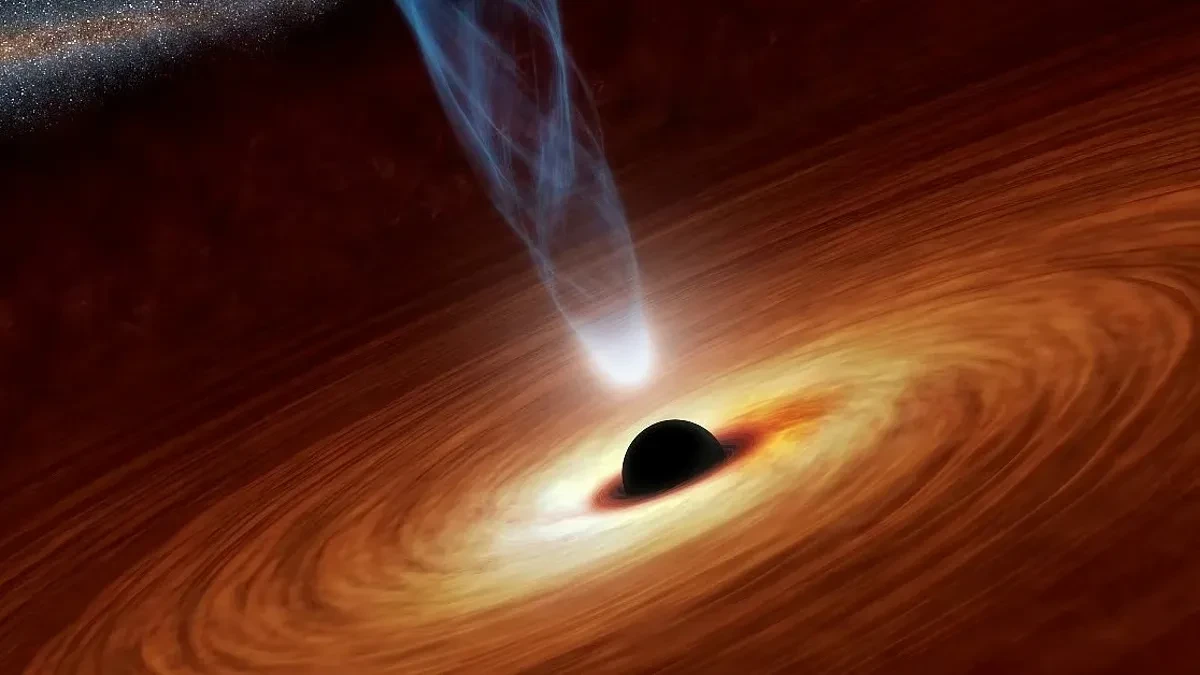
Gas and other matter drawn towards a black hole can form an accretion disc — a rapidly moving flow of material that heats up and releases high-energy radiation, including X-rays. The brightness of this radiation can change over time as conditions in the flow evolve.
Some systems display nearly regular variations known as quasi-periodic oscillations (QPOs). These signals are important because their frequencies and patterns can offer clues about the physical processes occurring close to a black hole, where gravity and matter behave under extreme conditions.
However, explaining both low-frequency and high-frequency oscillations within a consistent physical model has been a challenge. The new research examines whether the changing behaviour of shocks within the accretion flow can account for these variations.
Why Black Hole Spin Matters
The researchers used computer simulations developed by ARIES’s Numerical and Theoretical Astrophysics Group to model viscous accretion flows. Viscosity describes the internal friction within moving material and plays an important role in how the flow evolves.
The simulations indicate that when viscosity crosses a critical threshold, a shock structure that would otherwise remain stable can become unstable and begin oscillating. These oscillations can generate the recurring changes in radiation identified as QPOs.
Black hole spin significantly affects this process.
In slowly spinning black holes, the simulations indicate that the oscillating shock tends to remain farther from the black hole, producing predominantly lower-frequency signals. In rapidly spinning black holes, the shock moves closer to the black hole, allowing oscillations across a wider frequency range.
For a black hole with a mass approximately ten times that of the Sun, the model predicts that very rapid rotation could produce QPO frequencies exceeding 100 hertz — more than 100 cycles per second. This offers a potential explanation for the high-frequency signals observed in black hole X-ray binary systems.
The team also identified a relationship between QPO frequency and the energy distribution of emitted photons. This could provide another way to investigate the physical conditions in the regions surrounding spinning black holes.
What the Discovery Means for Astronomy
The findings could help researchers develop more consistent models of how black holes influence matter and radiation in their immediate surroundings. By connecting black hole spin, shock oscillations and X-ray variability within a single numerical framework, the study offers a way to investigate signals that have previously been difficult to explain together.
The research is particularly relevant to black hole X-ray binaries, systems in which a black hole draws matter from a companion star. Observations of their changing X-ray emissions allow astronomers to study processes occurring in regions that cannot be examined directly.
The work also highlights the importance of combining theoretical astrophysics with numerical simulations. While the results offer a physical explanation for the observed patterns, further comparisons with astronomical observations will be important for testing the model and determining how broadly it applies to different black hole systems.
As scientists continue to study the universe’s most extreme objects, understanding how black hole spin shapes the behaviour of surrounding matter could help refine estimates of their properties and reveal more about the physics operating near their event horizons.