•
•
•
•
•
•
•

From Nasser's nationalisation of the canal to the first UN peacekeeping force
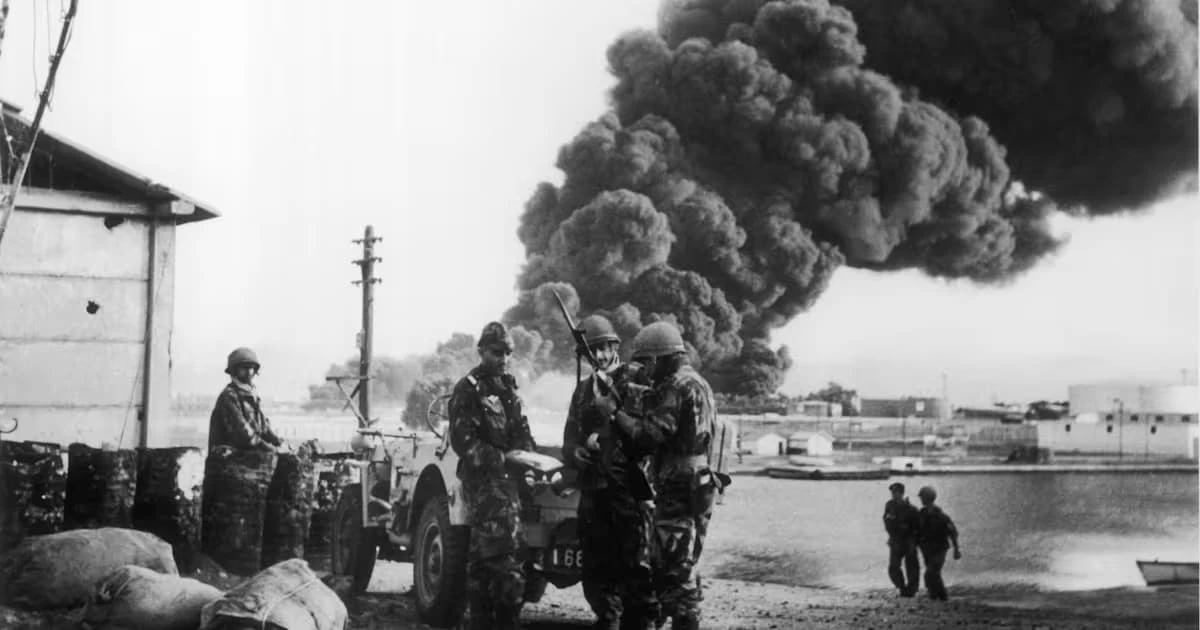
The Suez Crisis of 1956 was a military and diplomatic confrontation over the Suez Canal. After Egyptian President Gamal Abdel Nasser nationalised the canal on 26 July 1956, Israel invaded the Sinai Peninsula on 29 October. Britain and France, under a secret plan with Israel, then launched air strikes and landed troops near the canal. Strong pressure from the United States and the Soviet Union, together with UN action, forced a ceasefire on 6–7 November and a withdrawal. The crisis showed Britain's decline as a world power and created the first UN peacekeeping force. The 70th anniversary falls on 29 October 2026.
The Suez Canal, opened in 1869, links the Mediterranean and the Red Sea, shortening voyages between Europe and Asia. In the 1950s it was the main route for Europe's oil from the Gulf. It was run by the Suez Canal Company, which was largely owned by British and French shareholders.
| Date (1956) | Event |
|---|---|
| 26 July | Nasser nationalises the Suez Canal Company |
| 22–24 October | Secret Protocol of Sèvres agreed by Britain, France and Israel |
| 29 October | Israel invades the Sinai |
| 30 October | Britain and France issue an ultimatum to Egypt and Israel |
| 31 October | Anglo-French air strikes begin |
| 5–6 November | British and French paratroopers and marines land at Port Said |
| 6–7 November | Ceasefire under heavy US pressure |
| December 1956 | British and French forces withdraw |
| March 1957 | Israel withdraws from Sinai |
The UN Emergency Force (UNEF I), created in November 1956, was the first armed UN peacekeeping force. It supervised the withdrawal and separated Egyptian and Israeli forces. UN peacekeeping has since deployed to dozens of conflicts.
Suez showed that Britain and France could no longer act as great powers without US support. It sped up decolonisation and shifted influence in the Middle East toward the US and USSR.
Nasser became the leading figure of Arab nationalism, influencing politics across the region for more than a decade.
The Suez Canal and the Red Sea remain central to world trade. Today, Houthi attacks near the Bab al-Mandeb strait, at the Red Sea's southern end, are again forcing ships to avoid the route, reducing canal traffic and Egypt's revenues. Seventy years later, control of this waterway is still a major geopolitical issue.
A 1956 conflict in which Israel, Britain and France attacked Egypt after Nasser nationalised the Suez Canal. It ended with their withdrawal under international pressure.
Militarily the invaders made gains, but politically Egypt and Nasser came out stronger, and Britain and France suffered a major setback.
Eisenhower feared the invasion would push Arab states toward the Soviet Union, and he objected to not being consulted, especially during the Hungarian crisis.
The UN Emergency Force, the first armed UN peacekeeping mission, created in 1956 to supervise the end of the Suez Crisis.
The Suez Crisis was a turning point of the 20th century. It ended Britain's claim to independent great-power status, made Nasser a regional leader, and led to the creation of UN peacekeeping. With the Red Sea again a conflict zone, its lessons are still relevant 70 years later.
