•
•
•
•
•
•
•

16 October 1946 and the legacy of the International Military Tribunal
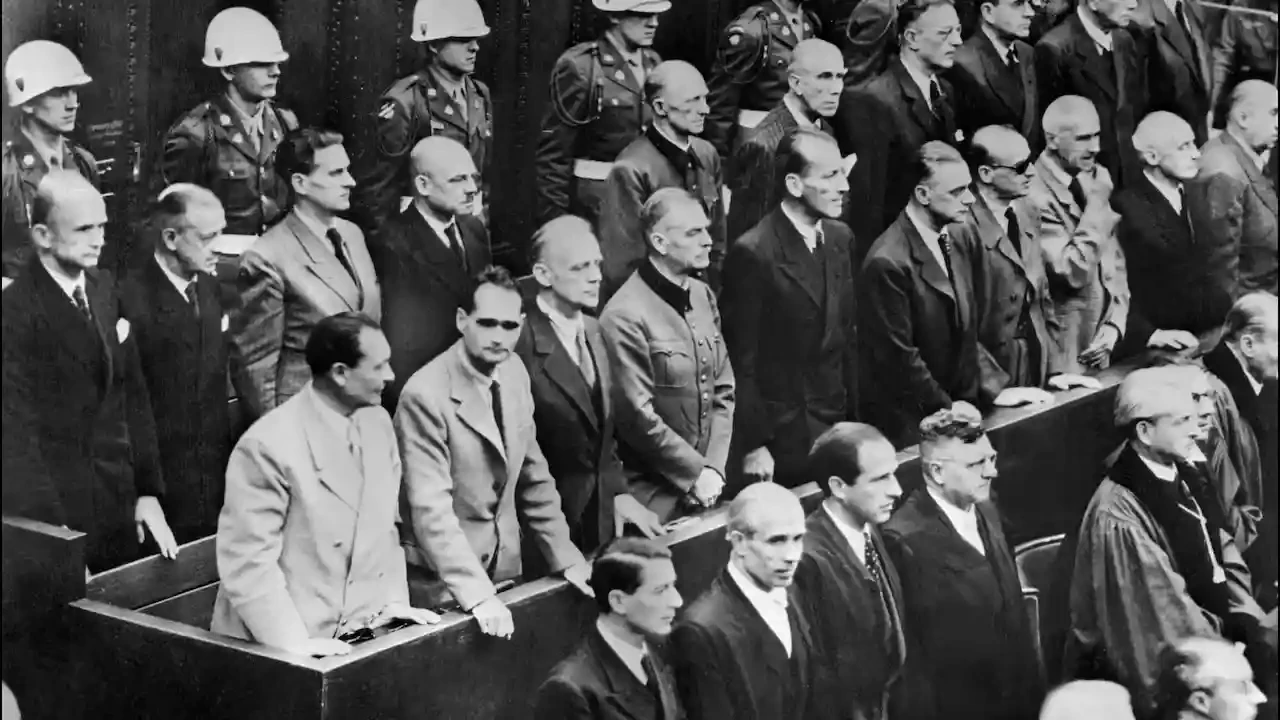
Eighty years ago, on 16 October 1946, ten senior Nazi leaders convicted by the International Military Tribunal (IMT) at Nuremberg were executed by hanging. The tribunal, created by the victorious Allies (the United States, United Kingdom, Soviet Union and France), was the first time leaders of a state were tried before an international court for crimes against peace, war crimes and crimes against humanity. Its legacy runs through today's International Criminal Court and modern human rights law.
| Item | Detail |
|---|---|
| Court | International Military Tribunal |
| Location | Palace of Justice, Nuremberg, Germany |
| Trial dates | 20 November 1945 – 1 October 1946 |
| Defendants indicted | 24 |
| Defendants tried | 22 (one died before trial; one was ruled unfit) |
| Death sentences | 12 (one, Martin Bormann, in absentia) |
| Executions | 10, on 16 October 1946 |
| Acquittals | 3 |
Nuremberg was chosen partly for practical reasons: its Palace of Justice was largely intact and had an attached prison. It also had symbolic weight as the city of the Nazi Party's mass rallies and of the 1935 Nuremberg race laws.
The London Charter of August 1945 set out four counts:
The trial presented extensive evidence of the Holocaust, including Nazi documents and film footage of the camps.
On 1 October 1946, the tribunal delivered its judgment:
Göring died by suicide on the night of 15 October 1946, hours before his scheduled execution. Bormann, sentenced in absentia, was later found to have died in Berlin in May 1945. The remaining ten were hanged in the early hours of 16 October.
In 1950, the UN's International Law Commission summarised the Nuremberg Principles. Key ideas include:
Nuremberg influenced a series of later institutions:
The link is personal as well as legal. Navi Pillay, who won the 2026 Nobel Peace Prize, served as a judge at the Rwanda tribunal and the ICC, institutions that grew out of the Nuremberg tradition.
Nuremberg was not free of controversy:
Even so, most historians see the trial as a major achievement: the evidence was tested in court, defendants had lawyers, and some were acquitted.
Eighty years later, questions first raised at Nuremberg are still debated: accountability for leaders, the legality of wars of aggression, and the authority of international courts. With conflicts in Ukraine, the Middle East and elsewhere, the principle that individuals answer for international crimes remains central to arguments about justice and peace.
In the early hours of 16 October 1946.
Ten defendants from the main trial were hanged. Göring died by suicide the night before, and Bormann was sentenced in absentia.
Rules of international law drawn from the trial, including individual criminal responsibility and the rejection of "superior orders" as a full defence.
Yes. Courtroom 600 in the Palace of Justice is part of the Memorium Nuremberg Trials museum.
The executions of 16 October 1946 closed the main Nuremberg trial. Its larger result was the idea that no leader is above the law. Eighty years later, that principle still shapes international courts and the global debate on accountability.
