•
•
•
•
•
•
•

Germany celebrates German Unity Day every October 3, commemorating the historic 1990 reunification that ended decades of Cold War division between East and West Germany.
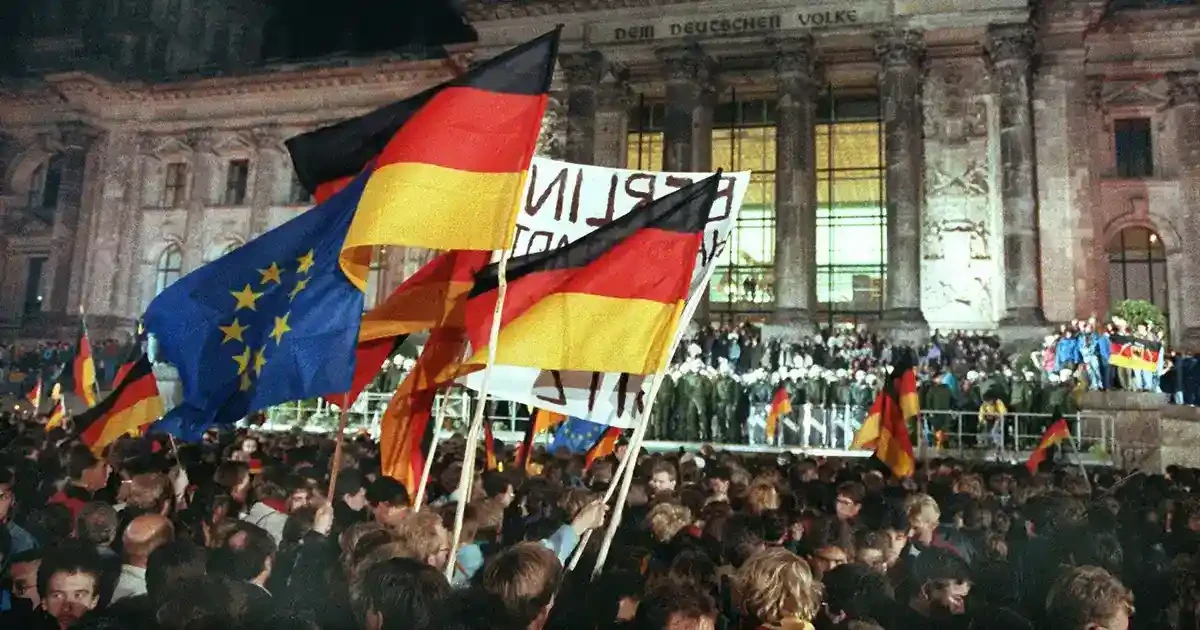
Germany is celebrating German Unity Day (Tag der Deutschen Einheit) on October 3, 2026, marking 36 years since the country's reunification.
For much of the second half of the 20th century, Germany was divided into two separate states: the Federal Republic of Germany (West Germany) and the German Democratic Republic (East Germany).
That division was one of the defining consequences of the Cold War. Families, communities and a nation with a shared history found themselves separated by political systems and heavily guarded borders.
The process that eventually brought Germany back together was remarkably rapid once it began. The Berlin Wall fell on November 9, 1989, and less than a year later, on October 3, 1990, German reunification became official.
Today, October 3 is observed throughout Germany as the country's national holiday.
The roots of Germany's post-war division can be traced to the end of World War II in 1945.
After Nazi Germany surrendered, the country was divided into occupation zones controlled by the United States, Britain, France and the Soviet Union.
Berlin, despite being located deep inside the Soviet occupation zone, was also divided among the four victorious Allied powers.
As tensions between the Soviet Union and the Western Allies intensified, the political and economic systems in the two parts of Germany increasingly moved in different directions.
In 1949, two German states were formally established.
The western occupation zones developed into the Federal Republic of Germany, commonly known as West Germany. In the Soviet-controlled eastern zone, the German Democratic Republic, or East Germany, was established.
The two countries represented competing political and economic systems during the Cold War.
The division became even more visible in 1961, when East German authorities constructed the Berlin Wall.
The wall separated East Berlin from West Berlin and became one of the most powerful symbols of the Cold War.
For East German citizens, crossing into the West was heavily restricted. Border fortifications, checkpoints and security measures made unauthorized crossings extremely dangerous.
The wall remained in place for 28 years.
Its existence represented more than a physical barrier. It came to symbolise the broader ideological division between the communist Eastern bloc and the democratic Western countries.
For many Germans, therefore, the wall represented the separation of families, communities and a country that had previously existed as a single political entity.
By the late 1980s, political conditions in Eastern Europe were changing rapidly.
Reform movements were gaining strength, and the Soviet Union under Mikhail Gorbachev was pursuing policies that differed from the previous approach to political control in Eastern Europe.
Inside East Germany, growing numbers of citizens began participating in peaceful demonstrations.
Public pressure increased as people demanded greater freedom of movement, political reform and other changes.
The situation reached a dramatic turning point on November 9, 1989.
East German authorities announced changes to travel regulations, and confusion surrounding the announcement contributed to crowds gathering at border crossings.
The border guards eventually opened the crossings.
People from East and West Berlin began moving freely through the previously restricted checkpoints, while crowds gathered on and around the wall.
The Berlin Wall had effectively fallen.
However, the fall of the wall and German reunification were two different events.
The wall fell in November 1989, but the two German states remained separate until October 1990.
The period between November 1989 and October 1990 was filled with rapid political change.
East Germany held its first and only free parliamentary election in March 1990.
Political negotiations then focused on how the two German states could be brought together.
The process involved not only East and West Germany but also the four Allied powers that had retained responsibilities connected with Germany following World War II.
A major step came when East Germany's People's Chamber voted in August 1990 to accede to the Federal Republic of Germany under Article 23 of the Basic Law.
Further legal and political preparations followed.
The Treaty of Unification established the framework for bringing the two German systems together.
Finally, the decisive date arrived.
At midnight on October 3, 1990, German reunification officially took effect.
The German Democratic Republic ceased to exist as a separate state, and its territory became part of the Federal Republic of Germany.
The moment formally ended the political division of Germany.
The German government describes the reunification as the result of democratic decisions and treaty-based agreements.
October 3 was subsequently established as Germany's national holiday and became known as Tag der Deutschen Einheit — Day of German Unity.
The date therefore commemorates the formal reunification rather than the fall of the Berlin Wall itself.
A common point of confusion is the difference between November 9 and October 3.
November 9, 1989, is remembered internationally as the date the Berlin Wall fell.
October 3, 1990, is the date Germany was officially reunified.
The country chose October 3 as its national holiday because it represents the formal completion of German unity.
German Unity Day has since become an annual opportunity to remember the country's divided past and the events that brought the two German states together.
In 2026, the central German Unity Day celebrations are being held in Bremen from October 2 to October 4.
The official programme includes a large citizens' festival with exhibitions, cultural activities, discussions and opportunities for the public to interact with representatives of Germany's federal institutions.
The 2026 celebrations are taking place under the theme:
"VIELE STÄRKEN – EIN LAND"
which translates approximately as "Many Strengths – One Country."
The German federal government is also participating in the event, while the Bundestag is presenting interactive programmes including discussions, quizzes and a simulated parliamentary session.
The programme is designed not only to celebrate reunification but also to encourage public discussion about democracy, Germany's history and the country's future.
Although reunification took place 36 years ago, its consequences continue to shape Germany.
The integration of East and West Germany required enormous economic, political and social changes.
The former East German states experienced major structural transformations following reunification. Industries were reorganised, institutions were integrated and infrastructure was modernised.
Economic differences between eastern and western Germany have also remained an important subject of public discussion.
At the same time, eastern Germany has developed new economic strengths.
According to Germany's official information portal, international investments and technology projects have increasingly expanded in eastern regions. Examples include Tesla's production facility in Brandenburg and semiconductor investment in Dresden.
This illustrates how the story of German unity continues to evolve beyond the events of 1989 and 1990.
The political story of German reunification is also a deeply human one.
For people who lived through the division, reunification meant that a border separating German communities disappeared.
Families who had been separated by political restrictions could travel more freely. Citizens of East Germany gained access to political and economic freedoms that had previously been restricted.
For younger generations, however, the division may feel increasingly like history rather than lived experience.
This creates another role for German Unity Day: preserving the memory of how quickly political systems can change and how significant peaceful civic movements can become.
The story of German reunification can be understood as a sequence of major milestones:
1945 — Germany is divided after World War II.
1949 — West Germany and East Germany are established as separate states.
1961 — The Berlin Wall is constructed.
1989 — Growing protests and political changes lead to the opening and fall of the Berlin Wall on November 9.
1990 — Political negotiations and legal agreements prepare the way for reunification.
October 3, 1990 — East Germany joins the Federal Republic of Germany and German reunification officially takes effect.
2026 — Germany celebrates 36 years of unity, with Bremen hosting the central German Unity Day celebrations.
German reunification was one of the defining events at the end of the Cold War in Europe.
It transformed Germany's political geography and became part of the wider transformation taking place across Central and Eastern Europe.
The reunification also demonstrated how quickly geopolitical circumstances could change once political pressure, public movements and international diplomacy converged.
Today, German Unity Day connects that history with modern Germany.
Every October 3, the country looks back at the end of its division while also reflecting on the continuing process of building social, economic and political cohesion across the country.
