•
•
•
•
•
•
•

More than 4,000 inscriptions, hundreds of signs, no Rosetta Stone: inside the century-old mystery of the Harappan script
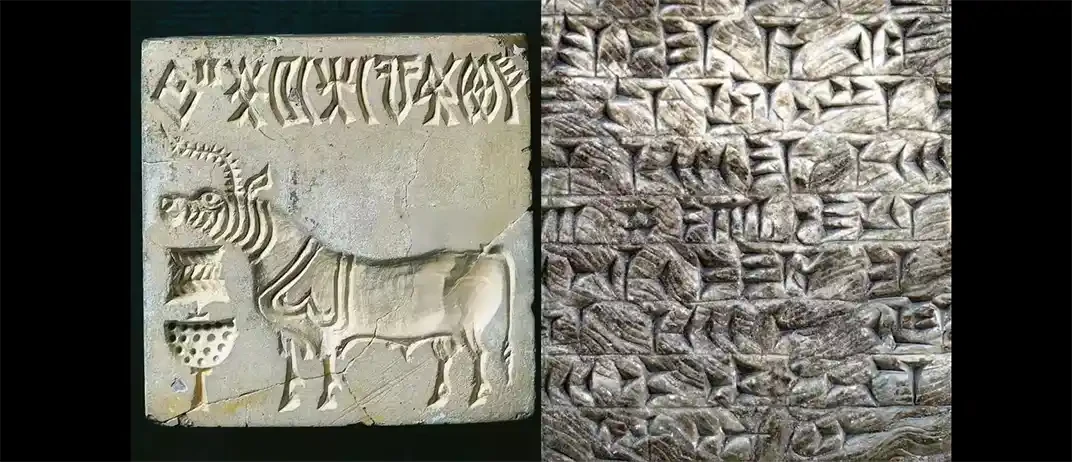
The Indus script, also called the Harappan script, is the system of signs used by the people of the Indus Valley Civilisation, one of the world's three earliest urban cultures alongside Mesopotamia and Egypt. It appears mainly during the Mature Harappan period, roughly 2600–1900 BCE, at sites spread across present-day Pakistan and north-western India.
Egyptian hieroglyphs and Mesopotamian cuneiform were both deciphered in the 19th century. The Indus script was not. More than 150 years after the first inscribed seal was published, nobody can confidently read a single Indus inscription, and scholars still disagree about which language it recorded, or even whether it recorded a language at all.
That long silence is exactly why the subject is back in the headlines.
In January 2025, Tamil Nadu Chief Minister M K Stalin announced a prize of US$1 million for any individual or organisation that deciphers the script to the satisfaction of archaeological experts. He made the announcement at a Chennai conference marking a century since archaeologist Sir John Marshall told the world about the Indus civilisation in 1924. The event was organised by the state archaeology department with the Indus Research Centre at the Roja Muthiah Research Library.
At the same event, Stalin released a study by the Tamil Nadu State Department of Archaeology, which reported that a large share of graffiti marks found on pottery at Tamil Nadu sites have parallels among Indus signs. The researchers digitised roughly 15,000 graffiti-marked potsherds from about 140 sites and compared them with Indus signs. Other experts have pointed out that visual similarity alone does not establish a shared language or script.
In August 2025, the Archaeological Survey of India held a three-day international conference titled "Decipherment of Indus Script: Current Status and Way Forward" in Greater Noida, inviting researchers to present their work and claims.
Researchers are increasingly applying statistics, cryptanalysis and machine learning to the problem. Several independent researchers have announced decipherments in recent years, but none has been accepted by the wider scholarly community.
Indus signs survive on small, durable objects rather than long texts:
| Object type | Notes |
|---|---|
| Stamp seals | The most famous examples; usually carved steatite with an animal motif (often the "unicorn") and a short line of signs |
| Sealings | Clay impressions made by seals, likely used on goods or packages |
| Copper tablets | Small plates with signs, sometimes with images |
| Miniature tablets | Moulded or incised clay and faience tablets |
| Pottery | Signs and graffiti incised on pots |
| Tools, ivory rods, bangles | Occasional short inscriptions |
Indus inscriptions have been found at major cities such as Mohenjo-daro, Harappa, Dholavira, Rakhigarhi and Ganeriwala, and some seals have turned up as far away as Mesopotamia, a sign of long-distance trade. No inscriptions have survived on perishable materials such as cloth, palm leaf or wood, so any longer texts that may once have existed are lost.
| Year | Milestone |
|---|---|
| 1870s | Alexander Cunningham publishes a Harappan seal, the first Indus sign to reach scholars |
| 1920s | Excavations at Harappa and Mohenjo-daro reveal a vast Bronze Age civilisation; Marshall announces it in 1924 |
| 1960s–70s | Finnish and Soviet teams independently apply computer analysis to the signs |
| 1977 | Iravatham Mahadevan publishes The Indus Script: Texts, Concordance and Tables, the standard reference |
| 1994 | Asko Parpola publishes Deciphering the Indus Script, arguing for a Dravidian language |
| 2004 | Steve Farmer, Richard Sproat and Michael Witzel argue the signs may not be language-based writing at all |
| 2009 | Rajesh Rao and colleagues publish a statistical study suggesting the signs behave like a language |
| 2025 | Tamil Nadu announces the $1 million prize; ASI hosts an international decipherment conference |
Mahadevan's concordance, built from about 2,900 inscribed objects, indexed every occurrence of every sign in every position. It has since been put online for free by the Indus Research Centre in Chennai, and most decipherment attempts still rely on it.
Egyptian hieroglyphs were cracked largely because the Rosetta Stone carried the same text in Greek. No Indus inscription has ever been found alongside a known script. Without such a "key", researchers cannot link signs to sounds or meanings.
The average Indus inscription is only about five signs long. Many have just one or two signs. The longest single-sided texts run to around 14–17 signs. Decipherers need longer passages to spot grammar, repeated words and sentence structure.
For other ancient scripts, scholars at least knew roughly which language family to test. For the Indus script, candidates proposed include Proto-Dravidian, Indo-Aryan (Sanskrit-related), Munda and languages with no living descendant. If the underlying language died out without a trace, decipherment may be impossible even with perfect analysis.
Even counting the signs is contested:
| Scholar | Year | Distinct signs |
|---|---|---|
| Iravatham Mahadevan | 1977 | 417 |
| Asko Parpola | 1994 | 386 |
| Bryan Wells | 2015 | 694 |
The number matters. A few dozen signs suggests an alphabet, around 50–100 suggests a syllabary, and several hundred suggests a mixed logo-syllabic system, where some signs stand for whole words and others for sounds, as in early cuneiform.
Estimates now put the number of known inscriptions at more than 4,700, but many are duplicates from the same seal, damaged, or only a sign or two long. Modern AI models generally need far more data than this to find reliable patterns.
Championed by Asko Parpola and Iravatham Mahadevan, this view holds that the Indus people spoke an early form of the Dravidian language family, today represented by Tamil, Telugu, Kannada and Malayalam. Supporters point to features such as possible word order and suffix patterns. The theory has wide support among Indus specialists but no proof.
Some researchers argue the script records an early Indo-Aryan language and that the later Brahmi script descended from it. In late 2024, an independent researcher writing as Yajnadevam released a paper claiming to read Indus inscriptions as Sanskrit using cryptanalytic methods. The paper has not been peer-reviewed or independently verified, and mainstream scholars remain sceptical.
In 2004, Steve Farmer, Richard Sproat and Michael Witzel argued that the signs may be a non-linguistic symbol system, such as emblems for clans, offices or deities, rather than writing that encodes speech. They cited the extreme brevity of the texts and the large number of signs that appear only once.
In 2009, computer scientist Rajesh Rao and colleagues measured how predictable each sign is from the one before it, a property called conditional entropy. They found the Indus sequences sat between rigid and random systems, close to known languages such as Sumerian, Old Tamil and Sanskrit. Critics responded that the method cannot by itself prove a script is linguistic. The debate continues.
Other researchers study the script's function rather than its sounds. Some analyses of seals and tablets suggest they may have recorded administrative information such as trade, taxation, commodities or labour allocation. These approaches do not "read" the signs but may narrow down what they were used for.
Despite the disagreements, a few points are widely accepted:
Reading the Indus script would be one of the biggest breakthroughs in the history of archaeology. It could reveal:
That last point is why the topic is politically and culturally sensitive in India. Different decipherment claims carry different implications for regional and national histories, which is one reason the scholarly bar for acceptance is so high.
Artificial intelligence helped researchers read carbonised Roman scrolls from Herculaneum in the Vesuvius Challenge, and the Tamil Nadu prize was announced against that backdrop of optimism. But the problems are different. The Herculaneum scrolls were written in known languages; the challenge was reading damaged text. The Indus script's problem is that nobody knows what the signs mean or what language lies behind them.
AI can help sort signs, detect patterns, compare corpora and test hypotheses at scale. Most specialists believe a real breakthrough will still need new evidence: longer inscriptions, a bilingual text from a trading partner such as Mesopotamia, or a large new find at an unexcavated site.
No. Many people have claimed solutions, but none has been accepted by experts, and the script remains officially undeciphered.
Tamil Nadu Chief Minister M K Stalin announced it in January 2025 for anyone who deciphers the script to the satisfaction of archaeological experts.
There is no bilingual inscription like the Rosetta Stone, the texts are very short, the underlying language is unknown, and experts disagree on how many distinct signs exist.
Iravatham Mahadevan's 1977 concordance lists 417 distinct signs. Other scholars have proposed lists ranging from about 386 to 694.
Most evidence indicates it was usually written from right to left.
Nobody knows for certain. Leading proposals include an early Dravidian language and an early Indo-Aryan language, but neither has been proven.
Some researchers have suggested Brahmi descended from the Indus script, but there is a gap of well over a thousand years between them and no accepted proof of a direct link.
The Indus script is a rare thing in modern history: a major civilisation's writing that we can see, photograph, catalogue and statistically analyse, yet still cannot read. The $1 million prize, India's national conference and new computational tools have revived interest in the puzzle, but its core obstacles remain: short texts, no bilingual key and an unknown language. Until new evidence turns up, the voices of the Indus cities will stay just out of reach.
