•
•
•
•
•
•
•

How Gandhi's 24-day walk to Dandi launched the Civil Disobedience Movement
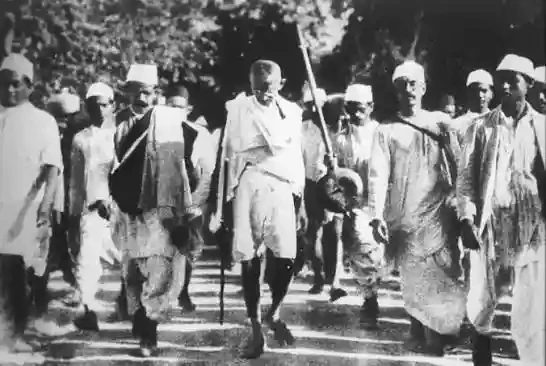
The Salt March, also called the Dandi March or Salt Satyagraha, was a 24-day non-violent protest led by Mahatma Gandhi from March 12 to April 6, 1930. Gandhi and 78 volunteers walked roughly 385 kilometres (about 240 miles) from Sabarmati Ashram in Ahmedabad to the coastal village of Dandi in present-day Navsari district, Gujarat. There, Gandhi picked up a lump of natural salt, symbolically breaking the British monopoly on salt. The act launched the nationwide Civil Disobedience Movement.
Under the Salt Act of 1882, the British government held a monopoly on the manufacture and sale of salt and levied a tax on it. Indians were barred from producing or collecting salt themselves, even from the sea.
Gandhi chose salt because:
Many Congress leaders were initially sceptical of such a modest-sounding target. The response proved them wrong.
At its Lahore session in December 1929, the Indian National Congress adopted Purna Swaraj (complete independence) as its goal and authorised civil disobedience. January 26, 1930 was celebrated as Independence Day. Gandhi wrote to Viceroy Lord Irwin on March 2, 1930, listing demands including abolition of the salt tax. When the demands were not met, the march began.
| Date | Event |
|---|---|
| March 2, 1930 | Gandhi's letter to Viceroy Irwin |
| March 12, 1930 | March begins from Sabarmati Ashram |
| March 12 – April 5 | Marchers pass through villages in Kheda, Bharuch and Surat districts |
| April 5, 1930 | Arrival at Dandi |
| April 6, 1930 | Gandhi picks up salt on the Dandi shore |
| May 5, 1930 | Gandhi arrested |
| May 21, 1930 | Dharasana Salt Works satyagraha |
| March 5, 1931 | Gandhi–Irwin Pact signed |
Along the way, Gandhi addressed large gatherings, urging people to boycott foreign cloth, give up liquor and join the satyagraha. Thousands joined at various points.
After Dandi, salt laws were broken across India:
By most estimates, around 60,000 people were arrested during the movement.
After Gandhi's arrest, Sarojini Naidu led volunteers to the Dharasana Salt Works in May 1930. Column after column of unarmed volunteers walked forward and were beaten by police without striking back. American journalist Webb Miller's reports of the scene were published widely and turned international opinion against British rule.
In March 1931, Gandhi and Lord Irwin signed an agreement:
The salt tax itself was not abolished until after independence.
The National Salt Satyagraha Memorial at Dandi, opened in 2019, recreates the march with sculptures of Gandhi and the marchers. Each year, Gandhi Jayanti on October 2 is observed across India and, since 2007, as the United Nations International Day of Non-Violence.
About 24 days, from March 12 to April 5, 1930, with salt picked up on April 6.
To protest the British monopoly and tax on salt, which burdened all Indians and especially the poor.
No. The Gandhi–Irwin Pact allowed coastal residents to make salt for personal use, but the tax was abolished only after independence.
Sarojini Naidu, after Gandhi's arrest on May 5, 1930.
The Salt March turned an everyday commodity into a symbol of freedom. Its disciplined non-violence, mass participation and global impact make it one of the defining moments of India's freedom struggle.
