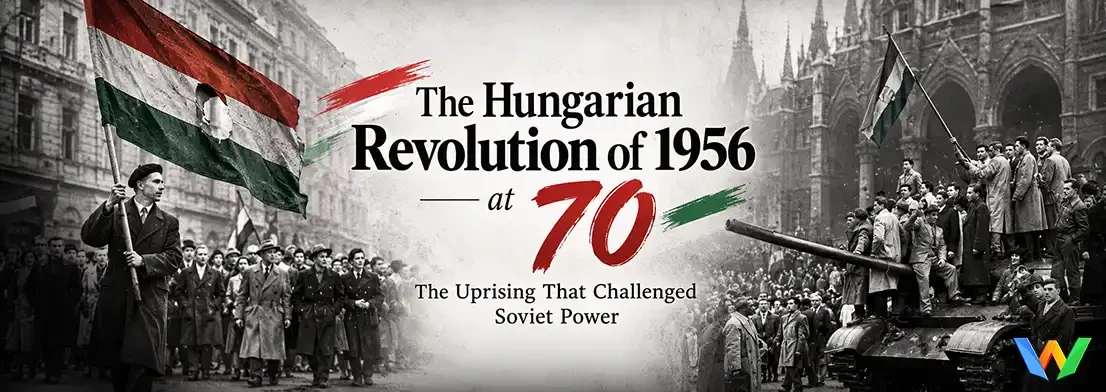
On 23 October 1956, a student demonstration in Budapest grew into a nationwide revolt against Soviet-backed rule in Hungary. Soviet forces crushed it within weeks. Seventy years on, this article explains the causes, the key events and figures, the human toll and the revolution's lasting legacy.
The Hungarian Revolution of 1956 began on 23 October 1956, when students and workers in Budapest marched to demand reforms and an end to Soviet domination. Within days the protest became a nationwide uprising. Reformist Imre Nagy became prime minister and announced Hungary's withdrawal from the Warsaw Pact. On 4 November, the Soviet army invaded and crushed the revolution. Around 2,500 Hungarians were killed and about 200,000 fled abroad. 23 October is now a national holiday in Hungary, and 2026 marks the 70th anniversary.
Background: why Hungarians rebelled
After World War II, Hungary fell under Soviet control. The communist regime of Mátyás Rákosi used secret police terror, show trials, forced collectivisation of farms and harsh economic policies.
In 1956, things began to change:
- In February, Soviet leader Nikita Khrushchev denounced Stalin's crimes in his "Secret Speech", encouraging reformers across the Eastern Bloc.
- In Poland, workers' protests in Poznań (June) and political changes in October showed that pressure could bring reform.
- In Hungary, intellectuals in the Petőfi Circle openly debated freedom and reform.
Timeline of the revolution
| Date (1956) | Event |
|---|
| 23 October | Students march in Budapest; the Stalin statue is toppled; secret police fire on crowds at the radio building |
| 24 October | Imre Nagy is appointed prime minister; Soviet troops enter Budapest |
| 28 October | Ceasefire; Soviet forces begin withdrawing from the capital |
| 30 October | Nagy announces an end to one-party rule |
| 1 November | Nagy declares Hungary's neutrality and withdrawal from the Warsaw Pact |
| 4 November | Massive Soviet invasion; János Kádár installed as leader |
| November–January | Resistance crushed; mass arrests and refugee exodus |
- Imre Nagy: reform communist prime minister who sided with the revolution. He was arrested, secretly tried and executed in June 1958.
- János Kádár: installed by Moscow after the invasion. He ruled Hungary until 1988, later introducing limited economic reforms ("goulash communism").
- Pál Maléter: army officer who joined the revolution and was executed alongside Nagy.
- Ordinary citizens: students, workers and young "Pest lads" who fought Soviet tanks in the streets.
The human cost
- About 2,500 Hungarians killed and many thousands wounded
- About 700 Soviet soldiers killed
- Around 200,000 refugees fled, mainly to Austria and then on to the West
- After the revolution, hundreds were executed and thousands imprisoned
The West's response
Many Hungarians hoped for Western help, encouraged in part by broadcasts such as Radio Free Europe. None came. The United States was unwilling to risk war with the Soviet Union. The world's attention was also divided by the Suez Crisis, which began on 29 October 1956 when Israel invaded Egypt, followed by British and French intervention.
Legacy
- Cold War lesson: the revolution showed both the fragility of Soviet control and Moscow's willingness to use force, as it did again in Czechoslovakia in 1968.
- Reburial of Nagy: on 16 June 1989, Imre Nagy was reburied in a public ceremony attended by hundreds of thousands. It was a turning point in Hungary's peaceful transition to democracy.
- Republic Day: on 23 October 1989, the Hungarian Republic was proclaimed, linking the new democracy to the revolution.
- National memory: 23 October is a public holiday, and the holed Hungarian flag with the communist emblem cut out remains a symbol of 1956.
Frequently asked questions
When did the Hungarian Revolution start?
On 23 October 1956, with a student-led demonstration in Budapest.
Why did the Hungarian Revolution fail?
The Soviet Union sent overwhelming military force on 4 November 1956, and Western powers did not intervene.
What happened to Imre Nagy?
He was arrested after the invasion, tried in secret and executed in June 1958. He was rehabilitated and reburied with honours in 1989.
How many people died in the 1956 Hungarian Revolution?
Around 2,500 Hungarians and about 700 Soviet soldiers died. Some 200,000 Hungarians fled the country.
Conclusion
Seventy years later, the Hungarian Revolution of 1956 is remembered as one of the Cold War's defining moments: a brief popular revolt for freedom and independence that was crushed by force. Its memory helped shape Hungary's return to democracy in 1989.
Sources
- Encyclopædia Britannica, "Hungarian Revolution": https://www.britannica.com/event/Hungarian-Revolution-1956
- Wilson Center Digital Archive, 1956 Hungarian Revolution collection: https://digitalarchive.wilsoncenter.org/topics/1956-hungarian-revolution
- House of Terror Museum, Budapest: https://www.terrorhaza.hu/en