•
•
•
•
•
•
•

Saturn reached opposition on October 4, 2026, shining at its brightest of the year. Here's how to spot the rings, moons, and other October sky events.
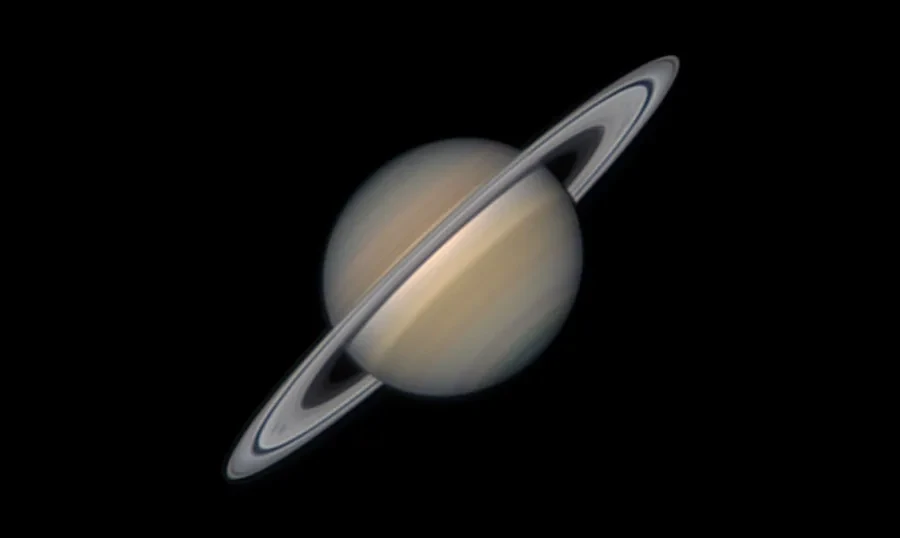
Autumn brings crisp nights, and this year it also brings Saturn at its best. On the night of October 3–4, 2026, the ringed planet reached opposition, the point where Earth and Saturn sit on the same side of the Sun. Sky & Telescope's Bob King describes it as falling "under the magical spell" of the Lord of the Rings, and anyone who has seen Saturn through a telescope knows the feeling.
The planet will stay bright and easy to find for weeks, so there is no need to panic if you missed opposition night.
Opposition happens when Earth sits between the Sun and Saturn. That puts Saturn on the opposite side of our sky from the Sun, so it rises around sunset and stays up for much of the night. NASA notes that this makes opposition one of the best chances all year to see the planet.
The geometry has practical benefits:
Saturn's opposition comes around roughly every 378 days, which is why the date shifts through the calendar from year to year.
This season Saturn sits in the faint constellation Pisces, beneath the Great Square of Pegasus. In early September it stood about 20° above the southeastern horizon at the end of evening twilight. It has also crept almost 5° higher in declination over the past year, which helps. Observers prize every extra degree of altitude because it means less of the blurring that comes from looking through thick air near the horizon.
To the naked eye, Saturn looks like a steady, golden "star" with no twinkle. Look east after sunset on October evenings. For Saturn, you want to look low in the east at around 9 p.m. in early October. As the weeks pass, it will appear higher earlier in the evening.
Saturn is also moving backwards against the stars for much of the autumn, in what astronomers call retrograde motion. It pauses on December 11 and then resumes its normal eastward drift.
Last year, Saturn's rings were almost edge-on to us, so thin that they briefly seemed to vanish into a razor-blade line. That is part of Saturn's long cycle. This year the rings have tipped open again, and we are looking at their southern face. That view will continue for about a dozen years, until the next ring-plane crossing in 2038–2039.
The tilt isn't growing steadily just yet. It sat at about 7.6° on October 1, and shrinks to around 6.6° by October 31. It reaches a minimum near 6.1° before opening wider again from early December. The shift is small and comes from the combined motion of Earth and Saturn. Saturn will also keep getting closer to Earth at each opposition, and the two will be closest in 2032.
Naked eye: Saturn appears as a bright, golden, non-twinkling point of light.
Binoculars: They show Saturn as a small golden disc. Steady them on a wall or tripod for the best view.
Small telescope (around 25× magnification): Even this shows the rings clearly. It is the "wow" moment for first-time viewers, and many say the planet barely looks real.
6-inch or larger telescope: The planet starts to show real detail. The Cassini Division, the dark gap between the A and B rings, becomes visible in steady air. The brightest cloud bands also come into view.
Cloud belts on Saturn are low in contrast. The easiest features are the bright Equatorial Zone and the dark South Equatorial Belt, especially its northern edge. On good nights the polar regions look slightly darker. Some observers use coloured filters (blue or light blue) to bring out the bands, so it is worth experimenting.
Opposition is a good time to look for Saturn's moons. Sky & Telescope notes the planet has 293 confirmed satellites, but only a handful are within reach of amateur telescopes:
Free tools such as Sky & Telescope's Saturn moons tracker can help you identify each one on any night.
Around opposition, Saturn's rings briefly look brighter than the planet itself, an effect called the Seeliger effect. Dust-like particles in the rings reflect light straight back toward its source, while Saturn's cloud tops do not. The effect peaks over a day or two and should be strongest from about October 3 to 5. It is subtle, but regular observers can notice it in the eyepiece.
Astrophotographers report that this is a busy season for ring spokes, dark, short-lived smudges that rotate with the rings. They are thought to be dust lifted by electric forces linked to Saturn's magnetic field. They are essentially impossible to see by eye, but imagers with planetary cameras are capturing them.
NASA also points to a new finding: last month, Hubble observations revealed a ten-sided wave around Saturn's south pole. It appears to be strengthening, which gives scientists a rare chance to watch a giant atmospheric pattern develop. It adds to the well-known hexagon-shaped jet stream at the north pole.
Saturn isn't the only attraction this month:
Moon phases for the month: Third Quarter on October 3, New Moon October 10, First Quarter October 18, and Full Moon October 25. The darker nights around the new moon will be the best time for faint objects.
Saturn's 2026 opposition is a good moment to look up. The rings are opening up again, the planet is climbing higher in the sky, and it is bright enough to spot even from a city. You don't need expensive equipment, just a clear evening and a little patience. With Jupiter, the Orionids and the Pleiades also on the calendar, October is a good month to spend time outdoors under the stars.
