Humans have studied Mars with spacecraft since 1965. This guide traces key missions from Mariner 4 and Viking to Mangalyaan, Curiosity, Perseverance and China's Zhurong, explains what we have learned about water and habitability, and outlines future sample-return and crewed ambitions.
Mars has fascinated people for centuries. Since the 1960s, robotic spacecraft have transformed it from a reddish dot into a world with ancient riverbeds, polar ice caps, towering volcanoes and a thin atmosphere. This guide, published during World Space Week (October 4–10), traces the major missions and what they revealed.
Mars at a Glance
| Feature | Mars | Earth |
|---|
| Diameter | About 6,779 km | About 12,742 km |
| Gravity | About 38% of Earth's | 1 g |
| Day length | 24 h 37 min (a "sol") | 24 h |
| Year | About 687 Earth days | 365 days |
| Atmosphere | Thin, about 95% CO₂ | Nitrogen and oxygen |
| Moons | Phobos, Deimos | 1 |
Olympus Mons, the largest known volcano in the Solar System, and Valles Marineris, a canyon system thousands of kilometres long, are on Mars.
The Early Era: Flybys and First Landings
- Mariner 4 (NASA, 1965): First successful Mars flyby, returning the first close-up photos, which showed a cratered surface.
- Mars 3 (Soviet Union, 1971): First soft landing, though contact was lost within seconds.
- Mariner 9 (NASA, 1971): First spacecraft to orbit another planet, mapping volcanoes and canyons.
- Viking 1 and 2 (NASA, 1976): Landers sent back images and conducted biology experiments; results were inconclusive about life.
The Rover Revolution
- Sojourner (1997): The first Mars rover, part of Mars Pathfinder.
- Spirit and Opportunity (2004): Twin rovers found strong evidence of past water. Opportunity operated for almost 15 years, far beyond its 90-sol plan.
- Curiosity (2012): A car-sized nuclear-powered rover in Gale Crater that showed the area once hosted a lake with conditions suitable for microbial life.
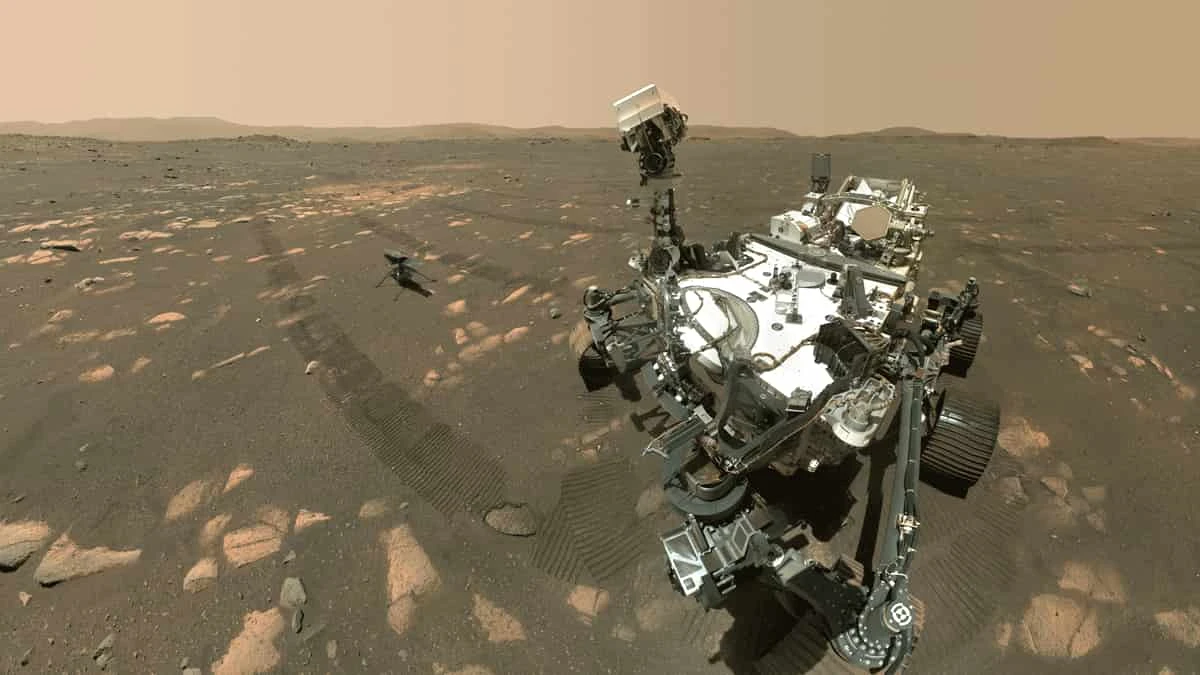
- Perseverance (2021): Landed in Jezero Crater, an ancient river delta, on February 18, 2021. It is collecting rock samples for possible return to Earth and tested MOXIE, which produced oxygen from Martian CO₂.
- Ingenuity (2021–2024): The first powered, controlled flight on another planet, completing 72 flights before damage ended its mission in January 2024.
India's Mangalyaan
The Mars Orbiter Mission (MOM), known as Mangalyaan, launched on November 5, 2013, and entered Mars orbit on September 24, 2014.
- India became the first Asian nation to reach Mars orbit and the first country to do so on its first attempt.
- It was widely noted for its low cost compared with other interplanetary missions.
- Designed for six months, it operated for about eight years until contact was lost in 2022.
- It studied the Martian atmosphere, surface features and the moon Deimos.
ISRO has discussed a future Mars lander mission.
Other Nations at Mars
- ESA's Mars Express (2003) and ExoMars Trace Gas Orbiter (2016) study the atmosphere and subsurface.
- UAE's Hope orbiter (2021) studies Martian weather and climate.
- China's Tianwen-1 (2021) delivered an orbiter and the Zhurong rover, making China the second country to operate a rover on Mars.
What We Have Learned
- Water: Mars once had rivers, lakes and possibly oceans. Water ice exists today at the poles and beneath the surface.
- Habitability: Ancient Mars had environments that could have supported microbial life.
- Atmosphere loss: Mars lost much of its atmosphere over billions of years, partly due to the solar wind after its magnetic field faded.
- Organic molecules: Curiosity and Perseverance have found organic compounds, which are not proof of life but are ingredients of interest.
- Methane puzzle: Methane detections have varied between instruments, and their source remains debated.
What Comes Next
- Mars Sample Return: Plans to bring Perseverance's samples to Earth have faced cost and schedule challenges, and their future depends on budget decisions.
- ESA's Rosalind Franklin rover: Planned for launch around 2028, with a drill to sample below the surface.
- China's Tianwen-3: A sample-return mission planned for launch around the late 2020s.
- Human missions: NASA, SpaceX and others discuss crewed Mars missions, but radiation, life support, landing large payloads and the return journey remain major challenges.
Frequently Asked Questions
How long does it take to reach Mars?
Typically about six to nine months, depending on planetary alignment and spacecraft trajectory.
Has life been found on Mars?
No. Missions have found evidence of past habitable conditions but no confirmed signs of life.
When did Mangalyaan reach Mars?
Why is Mars red?
Iron oxide (rust) in its dust and rocks gives it a reddish colour.
Conclusion
Six decades of exploration have turned Mars into the most studied planet beyond Earth. The biggest questions, whether life ever existed there and whether humans can live there, still drive the next generation of missions.