•
•
•
•
•
•
•

How Deisseroth, Hegemann and Nagel gave scientists a way to control brain cells with light
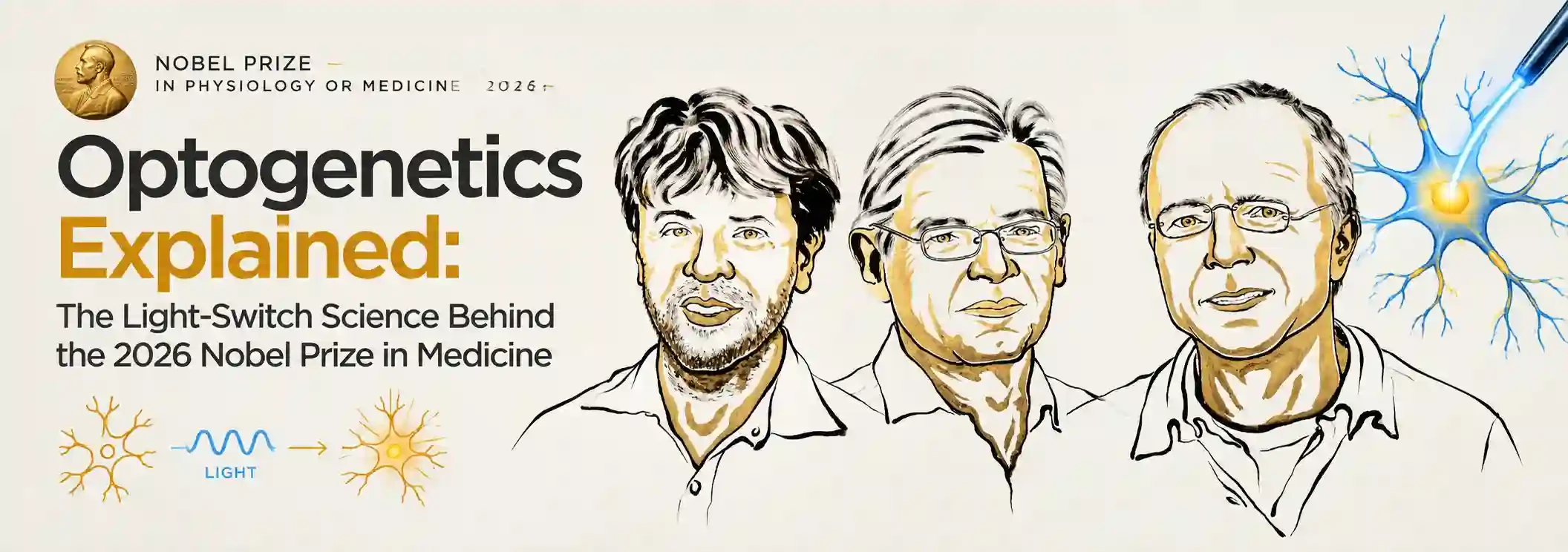
On 5 October 2026, the Nobel Assembly at the Karolinska Institutet awarded the Nobel Prize in Physiology or Medicine to Karl Deisseroth (Stanford University, USA) and to German scientists Peter Hegemann and Georg Nagel, "for discoveries concerning light-gated ion channels and optogenetics." Their work lets scientists switch specific nerve cells on or off with flashes of light. That turned out to be one of the most powerful tools in modern neuroscience.
Optogenetics combines optics (light) and genetics. Researchers use genetic techniques to give selected cells a light-sensitive protein. When light of the right colour reaches those cells, the protein opens a channel in the cell membrane and changes the cell's electrical activity.
In practice, that means:
Drugs or electrodes affect many cells at once. Optogenetics lets scientists ask direct cause-and-effect questions, such as does activating these specific cells produce this behaviour?
The story starts with green algae such as Chlamydomonas reinhardtii, which swim toward light. Peter Hegemann spent years studying how these algae sense light. In the early 2000s, Hegemann, Georg Nagel and colleagues identified channelrhodopsins: proteins that act as ion channels opened directly by light. In 2003 they described channelrhodopsin-2 (ChR2) and showed it could make animal cells respond to light.
In 2005, a team led by Karl Deisseroth at Stanford, working with Nagel and colleagues, put ChR2 into mammalian neurons. They showed that pulses of blue light could trigger nerve impulses with millisecond precision. Deisseroth's lab then built the toolkit that made the method widely usable: delivery with viral vectors, fibre-optic light delivery into the brains of living animals, and improved light-sensitive proteins.
| Year | Milestone |
|---|---|
| 2002–2003 | Channelrhodopsins identified; ChR2 shown to work as a light-gated channel |
| 2005 | Light-controlled firing of mammalian neurons demonstrated |
| Late 2000s | Optogenetics used in freely moving animals |
| 2021 | First reported partial vision restoration in a person using an optogenetic therapy |
Optogenetics is now used in thousands of laboratories. It has helped researchers:
Most optogenetics remains a research tool, but clinical uses are starting. In 2021, researchers reported in Nature Medicine that a man with retinitis pigmentosa, a genetic cause of blindness, regained partial vision. He received an optogenetic gene therapy in one eye and wore special light-stimulating goggles. Other trials are exploring treatments for vision loss. Researchers are also studying optogenetic approaches for hearing and pain.
There are challenges. Gene therapy must be safe and long-lasting, and light has to reach tissue deep in the body.
Karl Deisseroth, Peter Hegemann and Georg Nagel, for discoveries concerning light-gated ion channels and optogenetics.
A light-sensitive protein from algae that forms an ion channel. When light hits it, it opens and lets charged particles flow into the cell.
Mostly in research so far. Early clinical studies, especially for inherited blindness, have shown promising results.
Research focuses on vision loss, and it is being investigated for neurological and psychiatric conditions. Most applications are still experimental.
The 2026 Nobel Prize in Medicine honours a chain of discoveries that runs from pond algae to precise control of brain circuits. Optogenetics has changed how scientists study the brain, and it may one day lead to new treatments for blindness and brain disorders.
