•
•
•
•
•
•
•

How nonlinear effects and autocatalysis changed asymmetric synthesis and the origin-of-life debate
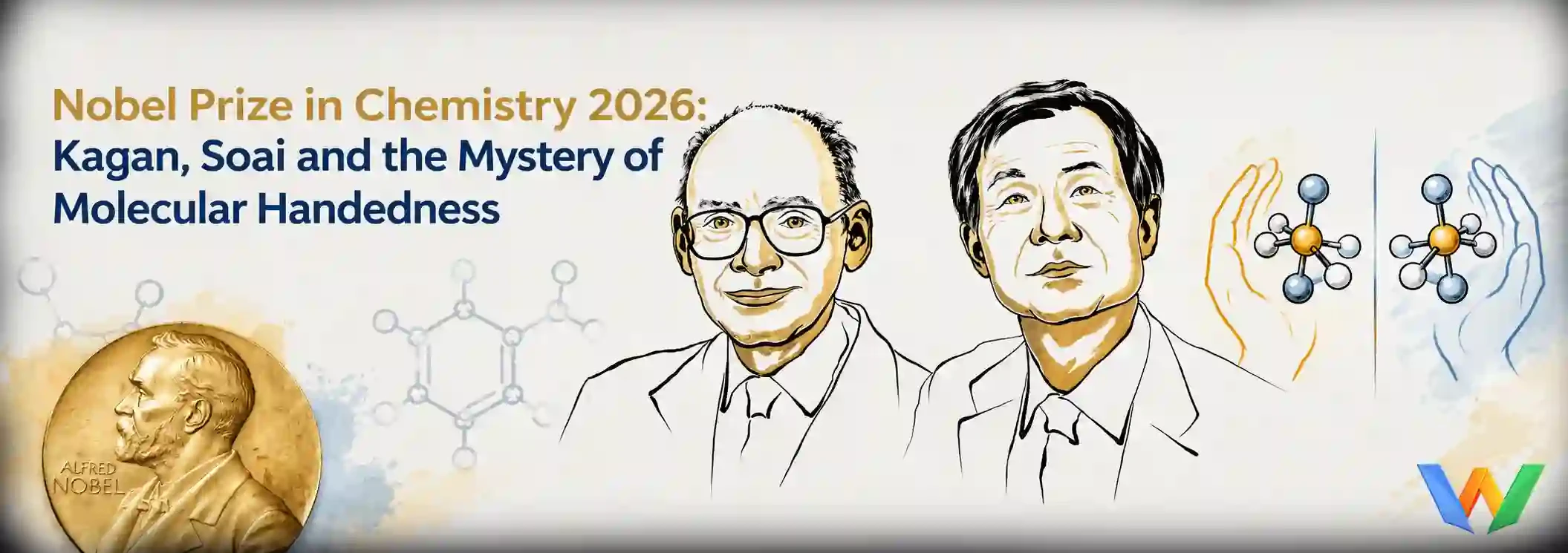
On 7 October 2026, the Royal Swedish Academy of Sciences awarded the Nobel Prize in Chemistry to Henri B. Kagan (France) and Kenso Soai (Japan) for the discovery of nonlinear effects and autocatalysis in asymmetric organic synthesis. In simple terms, they showed how a small preference for one "hand" of a molecule can be amplified in chemical reactions. That is important for making medicines efficiently, and it offers a possible answer to why life on Earth uses molecules of only one handedness.
Many molecules are chiral: they exist in two mirror-image forms that cannot be superimposed, like your left and right hands. These two forms are called enantiomers.
The two hands can behave very differently in the body:
Asymmetric synthesis is the craft of making mostly one hand rather than a 50:50 mix (called a racemic mixture). The 2001 Nobel Prize in Chemistry honoured pioneers of asymmetric catalysis, and the 2021 prize honoured asymmetric organocatalysis.
Kagan, a pioneer of asymmetric catalysis, designed early chiral ligands such as DIOP in the early 1970s. In 1986 his team described the nonlinear effect (NLE).
Chemists had assumed that if a chiral catalyst was only partly pure (say 50% excess of one hand), the product's purity would drop in proportion. Kagan showed this is not always true:
This happens because catalyst molecules can pair up or cluster, and mixed pairs may behave differently from same-handed pairs. Kagan's insight gave chemists a diagnostic tool to understand reaction mechanisms and a way to get pure products from imperfect catalysts.
In 1995, Kenso Soai and colleagues reported what became known as the Soai reaction. In it, a chiral product, a pyrimidyl alcohol formed using diisopropylzinc, acts as a catalyst for its own formation. That is called asymmetric autocatalysis.
The remarkable part is that the product can amplify a tiny initial imbalance. Starting from a very slight excess of one hand, repeated cycles produce a product that is almost entirely one hand. Soai's group showed that triggers as subtle as chiral crystals or circularly polarised light could tip the balance.
| Concept | Discoverer | Key idea |
|---|---|---|
| Nonlinear effect | Henri Kagan (1986) | Catalyst purity and product purity are not always proportional |
| Asymmetric autocatalysis | Kenso Soai (1995) | A chiral product catalyses its own formation and amplifies small imbalances |
Life on Earth uses almost exclusively left-handed amino acids and right-handed sugars. This property, called homochirality, has long puzzled scientists. The Soai reaction was the first clear laboratory demonstration that chemistry alone can amplify a tiny random bias into near-total handedness. That supports theories about how life's homochirality could have arisen.
Pharmaceutical companies must make single-enantiomer drugs safely and cheaply. Understanding nonlinear effects helps chemists design more efficient catalysts and understand reaction mechanisms.
Both discoveries show that catalysts do not always act as lone molecules. Aggregation and feedback can change outcomes dramatically.
Henri B. Kagan and Kenso Soai, for the discovery of nonlinear effects and autocatalysis in asymmetric organic synthesis.
A chemical reaction in which a chiral alcohol catalyses its own formation and amplifies a small excess of one mirror-image form into an almost pure product.
When the purity of a reaction's product is not directly proportional to the purity of the chiral catalyst, because catalyst molecules interact with each other.
The two mirror-image forms of a drug can have different effects. Producing the right form improves safety and effectiveness.
The 2026 chemistry prize recognises two discoveries about how small asymmetries can grow into large ones. Kagan's nonlinear effects and Soai's self-replicating reaction changed how chemists design catalysts, and they offer one of the most interesting chemical explanations for why life chose one hand.
