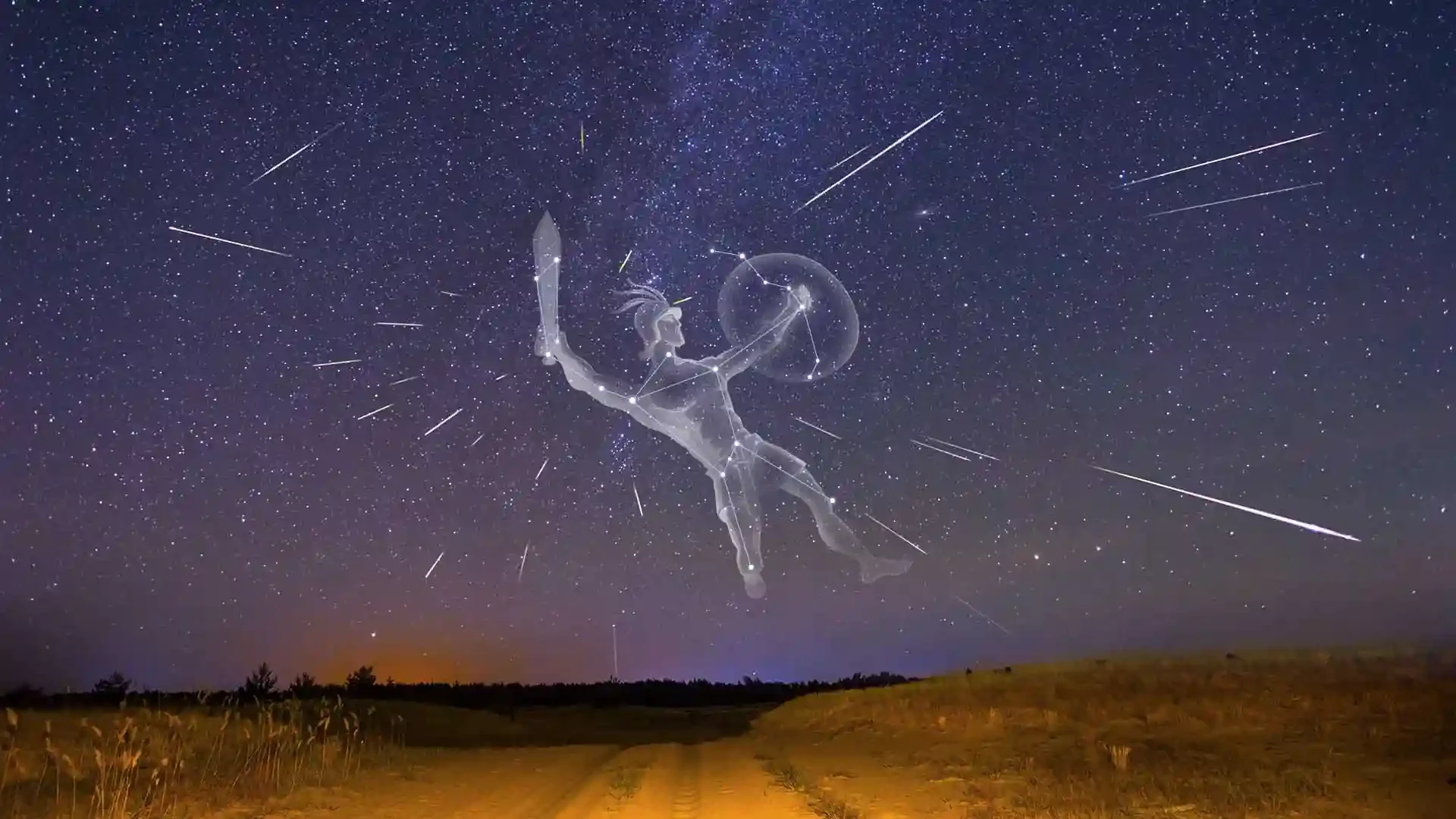
The Orionid meteor shower, created by dust from Halley's Comet, peaks around the night of 21–22 October 2026. With the waxing gibbous Moon setting after midnight, the pre-dawn hours offer the best views. This guide covers when and where to look, how many meteors to expect and practical viewing tips.
Quick answer
The Orionid meteor shower is active from early October to early November each year and peaks around 21–22 October. In 2026, the best viewing will be in the pre-dawn hours of 21 and 22 October. The waxing gibbous Moon (about 10 days after the 10 October new Moon) will set around or after midnight, leaving darker skies before dawn. Under dark skies, observers can expect around 10–20 meteors per hour at the peak. The Orionids are made of dust from Halley's Comet.
Orionids 2026 at a glance
| Item | Detail |
|---|
| Active period | Roughly 2 October – 7 November |
| Peak | Night of 21–22 October 2026 |
| Best time | After moonset, from about 1–2 a.m. until dawn |
| Expected rate | ~10–20 meteors per hour (dark sky) |
| Speed | About 66 km per second |
| Parent body | Comet 1P/Halley |
| Radiant | Near the constellation Orion, close to the star Betelgeuse |
What causes the Orionids?
As Halley's Comet orbits the Sun about every 76 years, it sheds dust and small rock particles along its path. Each October, Earth passes through this debris. The particles hit our atmosphere at around 66 km per second and burn up, creating bright streaks of light.
Halley's dust also produces a second shower, the Eta Aquariids, in May. Halley's Comet itself was last seen from Earth in 1986 and will return in 2061.
Why the Orionids are special
- Speed: they are among the fastest meteors, often leaving glowing trains that linger for a second or two.
- Fireballs: the shower occasionally produces bright fireballs.
- Visibility: the radiant in Orion is visible from both the Northern and Southern Hemispheres, so most of the world can see them, including all of India.
How to watch: step by step
- Check the weather: look for a clear night around 20–22 October.
- Get away from city lights: go to a rural area, hill station, beach or open field.
- Go out after midnight: Orion rises in the late evening, and the best rates come in the hours before dawn when the radiant is high.
- Let your eyes adjust: spend 20–30 minutes in the dark without looking at your phone.
- Look broadly: meteors can appear anywhere in the sky. Looking about 45–60 degrees away from Orion often shows longer trails.
- Be patient: meteors come in bursts and lulls. Plan to watch for at least an hour.
- No equipment needed: binoculars and telescopes are not useful because their field of view is too narrow.
Tips for viewers in India
- Best timing: roughly 2 a.m. to 5:30 a.m. IST on 21 and 22 October.
- Dark-sky spots: high-altitude regions such as Ladakh (Hanle), Spiti Valley and rural areas of Rajasthan and the Western Ghats offer excellent dark skies.
- Air quality: post-monsoon haze and urban pollution in north Indian cities can reduce visibility, so travel away from major cities if possible.
Photographing meteors
- Use a camera on a tripod with a wide-angle lens.
- Set manual focus to infinity, a high ISO (1600–3200) and exposures of 15–25 seconds.
- Take continuous shots for an hour. Most frames will be empty, but some will catch a meteor.
Frequently asked questions
When is the Orionid meteor shower 2026 peak?
Around the night of 21–22 October 2026, with the best views in the pre-dawn hours.
Can I see the Orionids from India?
Yes. The shower is visible across India. Head to a dark location away from city lights after midnight.
How many meteors will I see?
Up to about 10–20 per hour under dark skies at the peak. Fewer are visible from cities.
Are the Orionids from Halley's Comet?
Yes. They are debris shed by Comet 1P/Halley.
Conclusion
The Orionids are a reliable autumn meteor shower with a famous parent comet. Find a dark spot, get up before dawn on 21 or 22 October 2026, and look up to see fragments of Halley's Comet burning in the atmosphere.
Sources
- NASA Science, "Orionids": https://science.nasa.gov/solar-system/meteors-meteorites/orionids/
- American Meteor Society, meteor shower calendar: https://www.amsmeteors.org/meteor-showers/meteor-shower-calendar/
- Royal Museums Greenwich, Orionid meteor shower guide: https://www.rmg.co.uk/stories/space-astronomy/orionid-meteor-shower