•
•
•
•
•
•
•

NASA’s James Webb Space Telescope has revealed an unusual bulge in the atmosphere of WASP-17b, showing how extreme heat and powerful winds shape distant exoplanets.
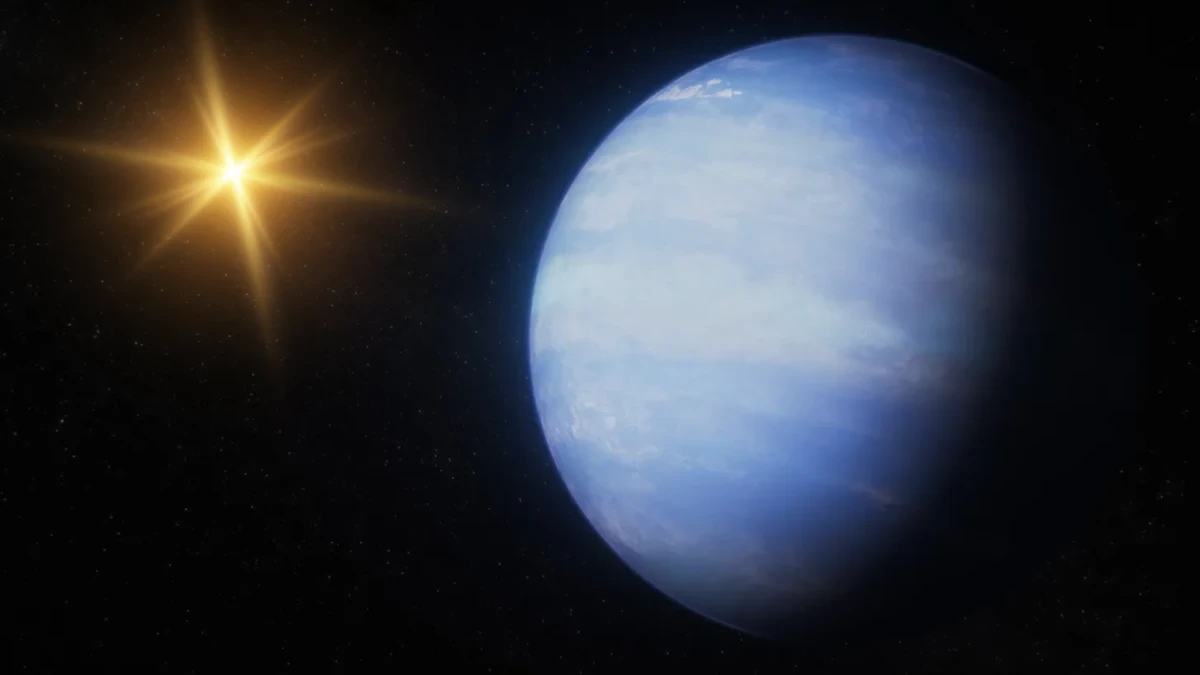
Astronomers have discovered a surprising feature on a distant world: an atmosphere that extends farther outward on one side than the other. The observation, made using NASA’s James Webb Space Telescope (JWST), offers a new way to understand the extreme weather conditions found on planets beyond our solar system.
The planet, WASP-17b, is located approximately 1,300 light-years from Earth. It belongs to a class of giant planets known as hot Jupiters, which orbit extremely close to their host stars and experience intense heat.
Researchers found that its atmosphere is not perfectly symmetrical. Instead, the evening side near the planet’s equator appears to extend farther into space than the morning side.
The difference is linked to powerful atmospheric winds that transport heat around the planet. As hot gas moves from the permanently illuminated side towards the darker hemisphere, temperature differences develop around the planet’s atmosphere, influencing how far the gas expands.
The study, jointly led by researchers at Cornell University and the University of Bristol, was published in Nature Astronomy in October 2026. It demonstrates how advanced telescope observations can test predictions about the atmospheric behaviour of distant planets.
WASP-17b is a gas giant that orbits close to its parent star. Unlike Jupiter in our solar system, which takes nearly 12 years to complete one orbit around the Sun, hot Jupiters typically circle their stars in just a few days.
Their close orbits expose them to intense stellar radiation, creating atmospheric temperatures and weather patterns that differ dramatically from those found on Earth.
WASP-17b is thought to have one hemisphere that remains permanently facing its star and another that remains in darkness. This arrangement produces a strong contrast between the planet’s dayside and nightside.
However, the two hemispheres are not completely isolated from one another. Atmospheric circulation transports energy around the planet, redistributing heat and shaping the temperature patterns that astronomers can observe.
These processes can produce powerful winds, temperature differences and changes in atmospheric density. The gas expands differently depending on its temperature, helping explain why the planet’s atmospheric outline appears uneven.
Studying hot Jupiters provides scientists with an opportunity to investigate atmospheric physics under extreme conditions. Although these planets are very different from Earth, the underlying principles of heat transfer, fluid motion and atmospheric chemistry can help researchers understand how planetary atmospheres operate more generally.
The discovery relied on a new observational approach known as transmission strings, developed by astrophysicists at the University of Bristol. The method allows researchers to examine different parts of an exoplanet’s atmospheric edge rather than treating the entire boundary as one uniform region.
To understand how it works, imagine a planet passing in front of its host star. During this transit, a small amount of starlight travels through the planet’s outer atmosphere before reaching the telescope.
Different gases absorb particular wavelengths of light. By analysing these changes, astronomers can identify atmospheric chemicals and investigate the physical conditions of the planet.
Traditional techniques often combine the measurements from the planet’s atmospheric edge into an averaged spectrum. While useful, this can hide differences between individual regions.
The transmission strings technique takes a more detailed approach. It separates information from different parts of the atmospheric boundary, allowing scientists to estimate how far the atmosphere extends at different angles around the planet.
The result is a more spatially detailed picture of the planet’s atmospheric structure.
For WASP-17b, this method revealed the uneven extension near the equator, providing observational evidence that the atmosphere’s shape changes with its local temperature and circulation.
The technique builds on the extraordinary sensitivity of the James Webb Space Telescope, which can detect subtle changes in starlight from distant planetary systems.
One of the most important findings is the connection between the atmospheric bulge and the planet’s powerful winds.
The hemisphere facing the star receives intense radiation, heating its atmosphere. Winds then transport some of this hot gas towards the planet’s darker side. As the gas circulates and cools, the temperature and atmospheric structure change.
Researchers found that the evening side is hotter and extends farther outward than the morning side. This difference matches predictions from earlier atmospheric models.
The discovery is significant because it provides observational support for a long-standing scientific expectation: the atmosphere of a hot Jupiter should not necessarily have the same temperature or radius everywhere around its edge.
Temperature affects the physical behaviour of gases. Under otherwise comparable conditions, hotter gas expands, while cooler gas occupies a smaller volume. On a giant planet exposed to extreme stellar heating, these differences can produce measurable variations in the height of the atmosphere.
The observations also revealed information about temperature variations between the planet’s equator and polar regions, as well as between its illuminated and dark hemispheres.
These measurements help astronomers move beyond broad estimates of an exoplanet’s atmospheric conditions towards a more detailed understanding of its three-dimensional structure.
The findings do not mean that scientists have photographed the atmosphere in the same way a camera photographs Earth’s clouds. Instead, they have reconstructed spatial differences using the light passing through the atmosphere during a planetary transit.
The study represents an important advance in exoplanet atmosphere research. More than 6,000 exoplanets have been confirmed, and each new observation helps astronomers understand the variety of worlds that exist beyond our solar system.
However, studying the atmosphere of a planet located hundreds or thousands of light-years away is challenging. These planets are usually too distant and faint for scientists to examine directly in the way they study Earth or nearby planetary bodies.
Astronomers therefore rely on techniques such as transit spectroscopy, eclipse mapping and measurements of changes in a planet’s brightness.
Each technique provides different information. Transit observations can reveal gases in an atmosphere, while observations made as a planet moves behind its star can help map temperature differences across its visible surface.
The new transmission strings approach adds another tool to this growing collection. By distinguishing different sections of the atmospheric boundary, it could help scientists investigate how temperature, chemistry and atmospheric circulation vary across distant worlds.
In the future, similar techniques may help researchers study planets with more complicated atmospheres, including those with strong winds, unusual cloud structures or significant differences between their dayside and nightside.
The method could also improve comparisons between observations and computer simulations, helping scientists refine models of planetary climates.
One of the broader questions in astronomy is whether scientists can eventually characterise the atmospheres of smaller, potentially habitable planets.
Hot Jupiters are easier targets for many atmospheric studies because they are large and often pass in front of bright stars. Smaller rocky planets generally produce much weaker signals, making their atmospheres harder to investigate.
The successful application of transmission strings to WASP-17b is a proof of concept, not a guarantee that the same level of detail can immediately be achieved for Earth-sized planets.
Nevertheless, improving atmospheric mapping methods is an important step towards studying a wider range of exoplanets.
For rocky worlds, scientists are particularly interested in identifying atmospheric gases, understanding temperature conditions and determining whether an environment might support liquid water. No single measurement can establish that a planet hosts life, and atmospheric evidence must be interpreted carefully.
More precise techniques could help researchers distinguish atmospheric features that would otherwise be hidden by averaged measurements.
As telescopes become more capable and scientists develop better analytical methods, researchers may be able to investigate increasingly subtle differences in the atmospheres of smaller planets.
The James Webb Space Telescope was designed to study the universe in infrared wavelengths, enabling it to examine distant galaxies, star formation and the atmospheres of planets beyond our solar system.
Its sensitivity allows researchers to detect small changes in light that reveal information about distant planetary environments. The WASP-17b study demonstrates how that capability can be combined with innovative mathematical techniques to uncover details that were previously difficult to measure.
The observations were collected through the telescope’s TST DREAMS programme, which focuses on detailed studies of exoplanet atmospheres using multiple instruments and spectroscopic observations.
The research received support from NASA, the UK Research and Innovation Science and Technology Facilities Council, and the Klarman Fellowship.
The discovery also highlights the value of collaboration between international research teams. Astronomers, atmospheric physicists and data specialists can combine their expertise to turn small variations in starlight into detailed information about worlds far beyond the reach of spacecraft.
The discovery of a lopsided atmosphere on WASP-17b provides fresh evidence that distant planets are dynamic, three-dimensional worlds rather than simple spheres with uniform atmospheric conditions.
By using the James Webb Space Telescope and the transmission strings technique, researchers detected differences in the atmospheric boundary that match predictions about heat transport and powerful winds.
The findings mark an important advance in exoplanet mapping, showing that astronomers can investigate atmospheric variations across different regions of a distant planet.
While WASP-17b is an extreme gas giant and not an Earth-like world, understanding its atmosphere helps scientists test the physical principles that govern planetary climates.
As researchers apply these techniques to more planets, the study could help build a clearer picture of alien weather, atmospheric chemistry and the remarkable diversity of worlds in the universe.
