•
•
•
•
•
•
•

From Einstein's equations to the first images of M87* and Sagittarius A*
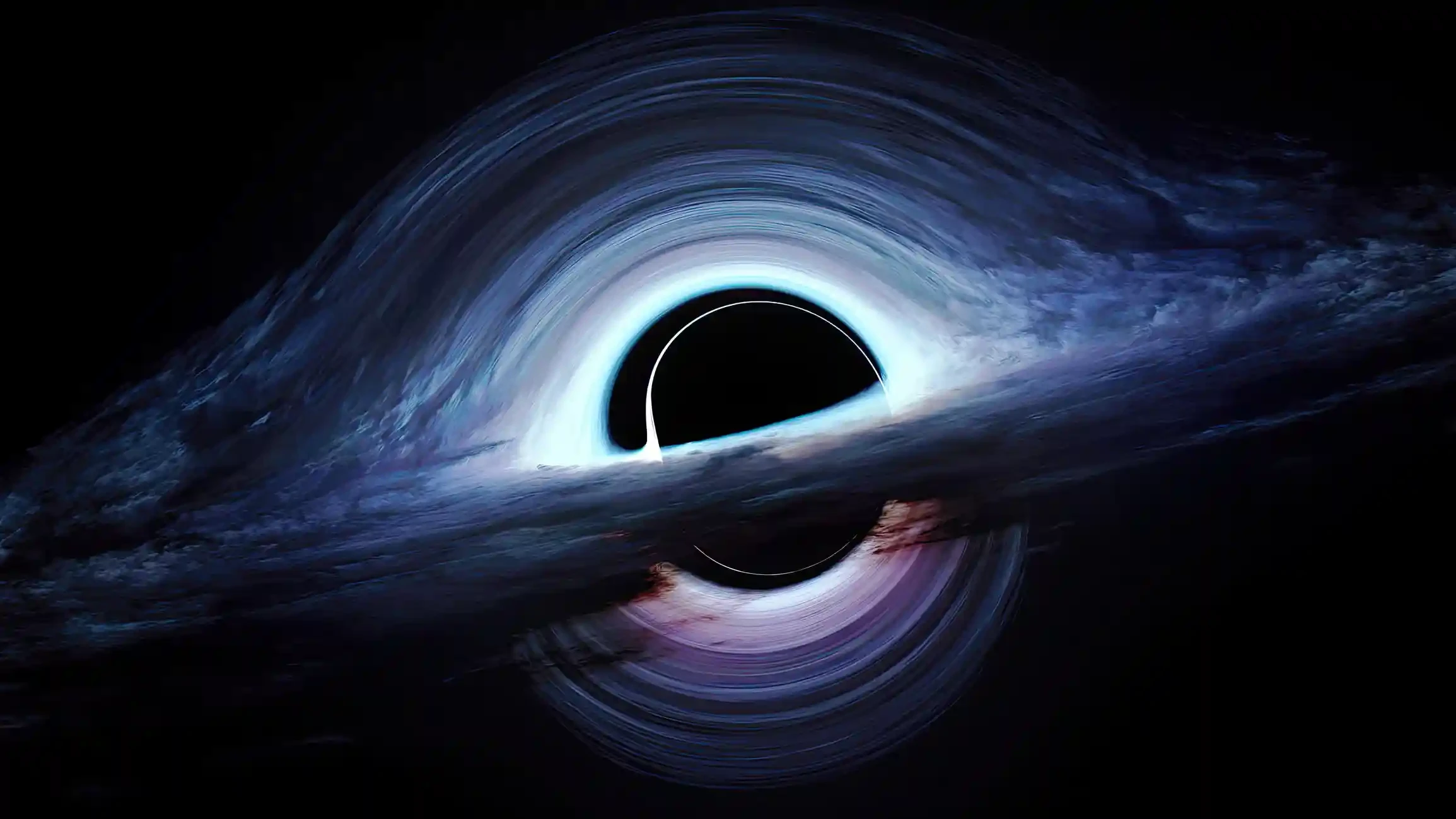
A black hole is a region of space where matter is packed so densely that its gravity prevents anything, including light, from escaping. Black holes were once purely theoretical. Today, astronomers have detected them through gravitational waves, tracked stars orbiting them and even produced images of their shadows.
| Type | Typical mass | How it forms |
|---|---|---|
| Stellar-mass | A few to tens of solar masses | Collapse of massive stars |
| Intermediate-mass | Hundreds to hundreds of thousands of solar masses | Uncertain; possibly mergers in dense clusters |
| Supermassive | Millions to billions of solar masses | Grow at galaxy centres over cosmic time |
| Primordial (hypothetical) | Wide range | Possibly formed in the early universe |
When a star much more massive than the Sun runs out of nuclear fuel, its core can collapse. If the remaining core is massive enough, no known force can stop the collapse, and a black hole forms, often accompanied by a supernova explosion.
For decades, teams led by Genzel and Ghez tracked stars orbiting an invisible object at the Milky Way's centre, showing it has about four million times the mass of the Sun.
On September 14, 2015, the LIGO detectors recorded ripples in spacetime from two black holes merging about 1.3 billion light-years away. The announcement in 2016 opened gravitational-wave astronomy and won the 2017 Nobel Prize in Physics.
The Event Horizon Telescope (EHT), a global network of radio telescopes, released the first image of a black hole's shadow in April 2019, showing the supermassive black hole at the centre of galaxy M87, about 6.5 billion solar masses.
In May 2022, the EHT released an image of Sagittarius A*, the black hole at the centre of the Milky Way.
The James Webb Space Telescope has found evidence of surprisingly massive black holes in the early universe, challenging models of how quickly they can grow.
In 1974, Stephen Hawking predicted that quantum effects cause black holes to emit faint radiation and slowly evaporate. This raised the information paradox: if a black hole evaporates, what happens to information about what fell in? Resolving it is a major goal for theories that unite quantum mechanics and gravity.
Not directly, since light cannot escape. We see its effects: glowing gas, orbiting stars, gravitational waves and the shadow against surrounding light.
Candidates identified through the Gaia mission lie roughly 1,500 to 2,000 light-years away, far too distant to pose any danger.
No known black hole is close enough to threaten Earth.
Black holes began as mathematical curiosities and are now observed phenomena. They test the limits of physics, and questions about their interiors and evaporation remain among science's deepest puzzles.
