
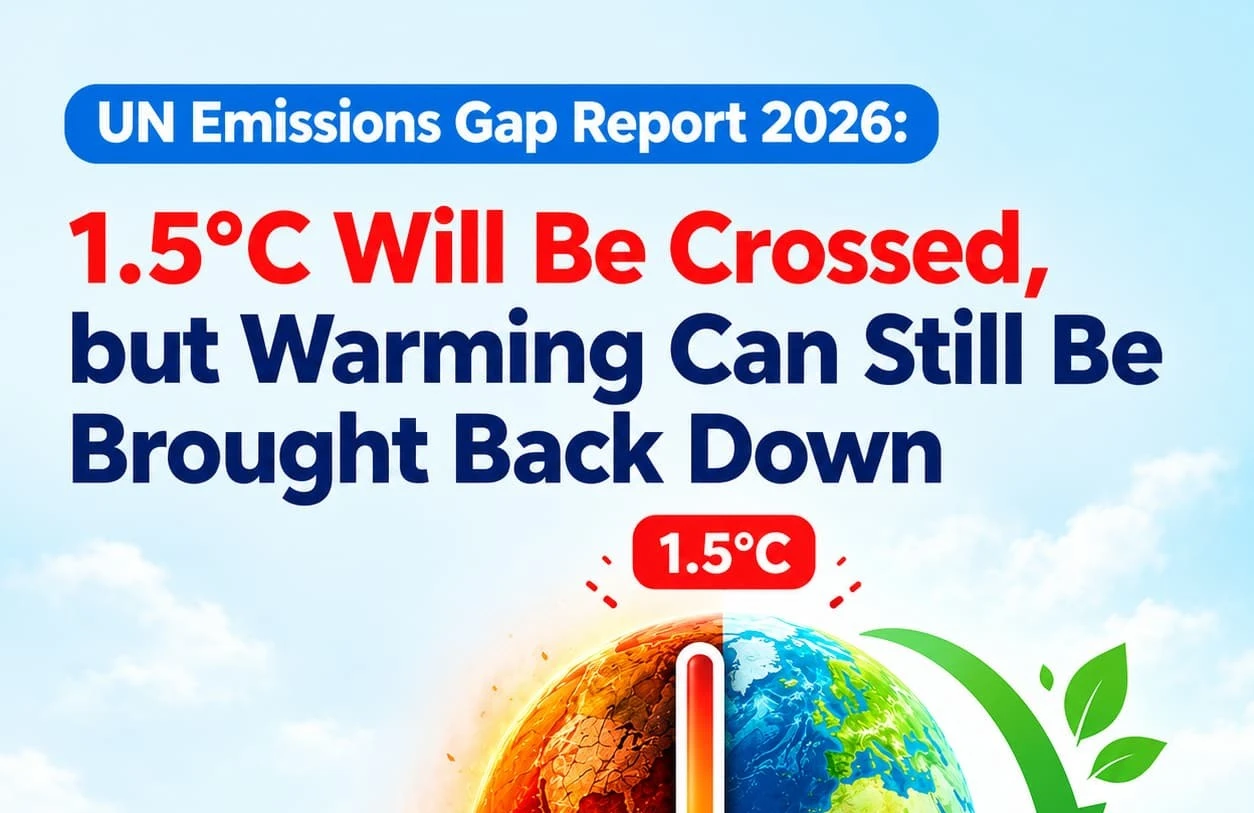
UN Emissions Gap Report 2026: 1.5°C Will Be Crossed, but Warming Can Still Be Brought Back Down

What happened
The UN Environment Programme (UNEP) released its Emissions Gap Report 2026, titled The Point of Return, on 21 October. Its central message is blunt: the world will overshoot the Paris Agreement's 1.5°C limit. The report's more hopeful point is that the overshoot does not have to be permanent.
In the lowest-overshoot scenario, warming would peak at around 1.7–1.8°C around mid-century before falling back to 1.5°C or below by 2100.
The numbers that matter
| Measure | Finding |
|---|---|
| Warming by 2100 under current policies | 2.8°C |
| If all national pledges (NDCs) are met | 2.6°C |
| If pledges plus net-zero targets are met | 2.1°C |
| Cuts needed vs 2025 levels to return to 1.5°C | 18% by 2030, 45% by 2035, 69% by 2040 |
| Average annual cut needed (2025–2035) | Nearly 6% a year |
| CO₂ removal needed by 2100 | About 320 gigatonnes |
The report says each five years of CO₂ emissions at today's levels adds roughly 0.1°C of warming.
Some good news, too
Global emissions in 2025 were roughly flat compared with 2024, though UNEP says it is too early to call a peak. Solar power has grown about seven times faster than earlier projections assumed, and wind has beaten optimistic forecasts. The report identifies 63 structural changes — from renewables investment to carbon pricing — that have measurably cut emissions.
For 2035, it recommends tripling renewable electricity capacity, cutting coal's share of energy supply by more than half and reducing methane emissions by 25%, compared with 2025.
Why it matters
The report lands weeks before COP31, where countries will be under pressure to strengthen their climate plans. Every year above 1.5°C raises the risk of irreversible changes to ice sheets, permafrost, ocean circulation and coral reefs.
"We've spent decades postponing cuts to emissions and now we're facing the consequences," said Anne Olhoff of the UNEP-Copenhagen Climate Centre.
UNEP also warns that carbon-removal technologies remain expensive and largely unproven, and cannot substitute for cutting emissions now.
Sources
- UNEP – "As temperatures spike, new report outlines humanity's options for containing climate change" (unep.org, 21 Oct 2026)
- UNEP – Emissions Gap Report 2026 publication page
- NewClimate Institute – The Emissions Gap Report 2026