•
•
•
•
•
•
•

What they are, why they matter and what the latest deforestation data and new funding mean for 2026
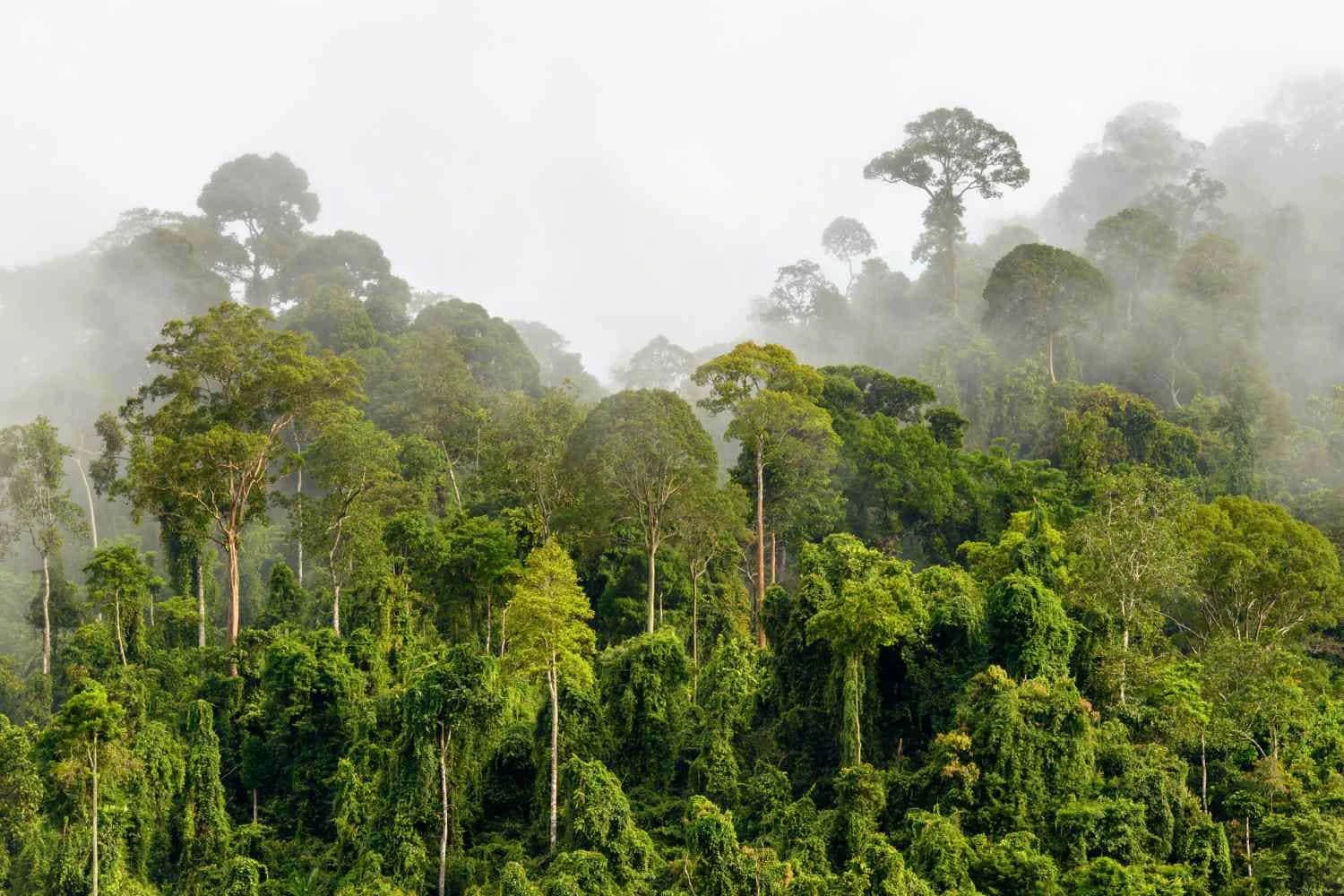
Tropical rainforests are Earth's most biodiverse land ecosystems and some of its most important climate regulators. They are also at the centre of 2026's biggest forest news. New data shows tropical primary rainforest loss fell sharply in 2025, a new global fund is trying to pay countries to keep trees standing, and fire is a growing threat. This guide explains what tropical rainforests are, why they matter and what the latest deforestation data reveals.
A tropical rainforest is a dense, evergreen forest found near the equator, where it is warm and wet all year round. Temperatures stay fairly constant, so there is no true cold or dry season.
Global Forest Watch focuses on primary rainforests in the humid tropics, meaning areas of mature forest that are especially important for biodiversity, carbon storage and regulating regional and local climate. Because primary forests have never been cleared, they are far richer in species and carbon than younger or planted forests, and they can take centuries to recover if destroyed.
| Layer | What It Is Like |
|---|---|
| Emergent | The tallest trees rise above the canopy, exposed to sun and wind |
| Canopy | A dense leafy roof where much of the forest's wildlife lives |
| Understory | A shaded zone of shrubs, young trees and vines |
| Forest floor | Dark and humid, where leaf litter decays quickly and recycles nutrients |
Most tropical rainforest lies in three regions: the Amazon Basin in South America, the Congo Basin in Central Africa and the forests of Southeast Asia, including Indonesia and Malaysia. Smaller blocks survive in Central America, Madagascar and the Pacific. Brazil, Colombia, Bolivia, the Democratic Republic of Congo, Cameroon and Madagascar all feature prominently in the latest forest-loss data.
According to University of Maryland data hosted on Global Forest Watch, the world lost 4.3 million hectares of tropical primary rainforest in 2025. That is 36% lower than in 2024, when climate-fuelled fires pushed forest loss to a record high. Global tree cover loss also fell by 14%.
Brazil led the improvement, with forest loss excluding fires 41% below 2024 and at its lowest rate on record. Colombia's loss fell 17%, its second lowest year since 2016, and Malaysia's government efforts helped stabilise loss there. Elizabeth Goldman of Global Forest Watch called the drop encouraging and proof of what decisive government action can achieve, but warned that part of it reflects a lull after an extreme fire year.
The caution matters. As researcher Matthew Hansen put it, protecting rainforest requires good years forever, not just one.
The biggest new policy is the Tropical Forest Forever Facility, launched by Brazil at COP30 in Belém in November 2025. It is designed as an investment fund whose profits reward tropical forest countries for keeping forests standing, aiming to mobilise $125 billion in public and private finance. It commits at least 20% of payments to Indigenous Peoples and local communities.
Funding is now moving. The UK announced a £400 million investment on September 3, 2026, subject to final governance and due diligence, having declined to fund it at COP30. Germany's draft budget includes €127 million for the fund in 2027. Meeting forest goals will also depend on whether the TFFF secures enough funding and how effectively rules such as the EU Deforestation Regulation are enforced. Attention now turns to COP31 later this year.
What is the difference between deforestation and tree cover loss?
Tree cover loss includes any removal of trees, including fire and logging, while deforestation is human-caused, long-term removal of forest.
Is rainforest loss getting better?
Loss fell in 2025, but it remains very high and fires are a rising risk.
What is the TFFF?
A new fund that pays countries for protecting standing tropical forests.
Why do primary forests matter more than plantations?
They hold far more biodiversity and carbon and cannot easily be replaced.
The 2025 data shows that policy can slow rainforest destruction fast. The challenge for 2026 and beyond is turning one good year into a lasting trend, backed by finance, enforcement and the communities who live in the forest.
