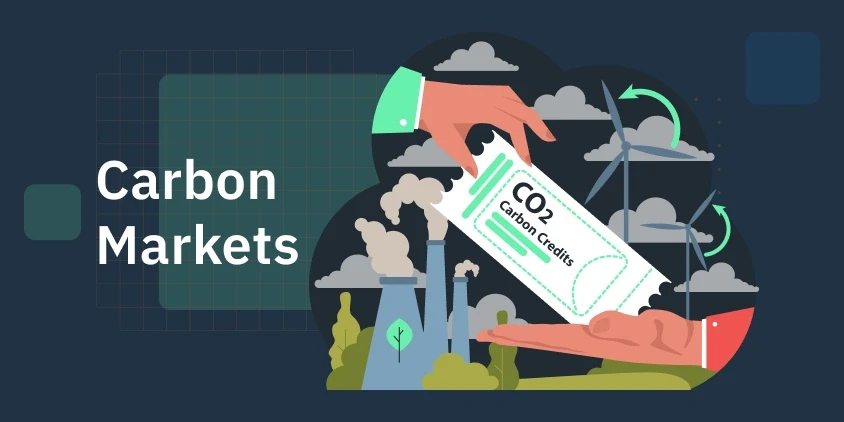
Carbon markets put a price on greenhouse gas emissions through tradable permits or credits. This guide explains cap-and-trade and intensity-based systems, voluntary offsets, Paris Agreement Article 6, the EU carbon border tax, and how India's Carbon Credit Trading Scheme works for industries and project developers.
A carbon market is a system in which greenhouse gas emissions are given a price and can be traded. The idea is simple: if emitting carries a cost, companies have a financial incentive to cut emissions where it is cheapest to do so. Carbon markets now cover a significant share of global emissions, and India is building its own through the Carbon Credit Trading Scheme (CCTS).
Two Main Types of Carbon Markets
1. Compliance Markets
Created by governments, which require covered companies to hold permits or meet targets.
- Cap-and-trade: The government sets a cap on total emissions and issues allowances. Companies that emit less than their allowances can sell the surplus; those that emit more must buy. The EU Emissions Trading System (EU ETS), launched in 2005, is the largest long-running example.
- Intensity-based (baseline-and-credit): Companies must reduce emissions per unit of output, such as tonnes of CO₂ per tonne of cement, rather than meeting an absolute cap. Companies that outperform their target earn credits. India's CCTS follows this approach.
2. Voluntary Carbon Markets
Companies and individuals voluntarily buy carbon credits from projects that reduce or remove emissions, such as renewable energy, forest protection, clean cookstoves or direct air capture, to offset their own footprint. Quality varies widely, and concerns about greenwashing have led to stronger integrity standards.
What Is a Carbon Credit?
One carbon credit typically represents one tonne of carbon dioxide equivalent (tCO₂e) reduced or removed. High-quality credits must be:
- Additional: The reduction would not have happened without carbon finance.
- Measurable and verified by independent auditors.
- Permanent, or with safeguards against reversal.
- Not double-counted.
Article 6 of the Paris Agreement
Article 6 allows countries to cooperate in meeting their climate targets:
- Article 6.2: Bilateral trading of emission reductions between countries, known as internationally transferred mitigation outcomes (ITMOs).
- Article 6.4: A UN-supervised crediting mechanism, the successor to the Kyoto Protocol's Clean Development Mechanism. Key rules were agreed at COP29 in Baku (2024).
The EU's Carbon Border Adjustment Mechanism (CBAM)
The EU's CBAM puts a carbon price on imports of carbon-intensive goods such as steel, aluminium, cement, fertilisers, hydrogen and electricity. After a reporting-only transitional phase from October 2023, the definitive phase began on January 1, 2026, with importers required to account for embedded emissions. Indian exporters of steel and aluminium are among those affected, and India has raised concerns about CBAM's impact on developing countries.
India's Carbon Credit Trading Scheme (CCTS)
Legal Basis
The Energy Conservation (Amendment) Act, 2022 empowered the government to set up a carbon market. The CCTS was notified in June 2023.
Institutions
- National Steering Committee for the Indian Carbon Market for governance
- Bureau of Energy Efficiency (BEE) as administrator
- Grid Controller of India as registry
- Trading expected through power exchanges regulated by the Central Electricity Regulatory Commission
Compliance Mechanism
- Energy-intensive sectors receive greenhouse gas emission intensity targets.
- Initial sectors for targets include aluminium, cement, chlor-alkali and pulp and paper, with others such as steel, refineries, petrochemicals and textiles expected to follow.
- Entities that beat targets receive Carbon Credit Certificates; those that miss must buy them.
- The scheme is designed to transition from the earlier Perform, Achieve and Trade (PAT) energy-efficiency scheme.
Offset Mechanism
Non-obligated entities can register projects that reduce or remove emissions, using approved methodologies, and earn credits.
Why Carbon Markets Matter for India
- They create a price signal for low-carbon investment in heavy industry.
- A domestic price may help Indian exporters respond to CBAM and similar measures.
- They support India's climate goals, including reducing the emissions intensity of GDP by 45% by 2030 from 2005 levels and reaching net zero by 2070.
Criticisms and Risks
- Intensity targets can allow absolute emissions to rise with output.
- Weak verification or low prices undermine effectiveness.
- Low-quality offsets may overstate climate benefits.
- Small and medium enterprises may struggle with monitoring and reporting costs.
Frequently Asked Questions
Is India's carbon market cap-and-trade?
No. The compliance mechanism uses emission-intensity targets rather than an absolute cap.
Who can earn carbon credits under CCTS?
Obligated entities that beat their targets, and registered projects under the offset mechanism.
What is CBAM and why does it matter to India?
It is the EU's carbon price on certain imports, affecting Indian exports of steel, aluminium and other covered goods.
Conclusion
Carbon markets turn climate goals into financial incentives. India's CCTS is still developing, but it could become a key tool for decarbonising industry and competing in a world where carbon increasingly carries a price.