•
•
•
•
•
•
•

What earthquakes are, how they happen, their types, the biggest and deadliest quakes in history and how to stay safe
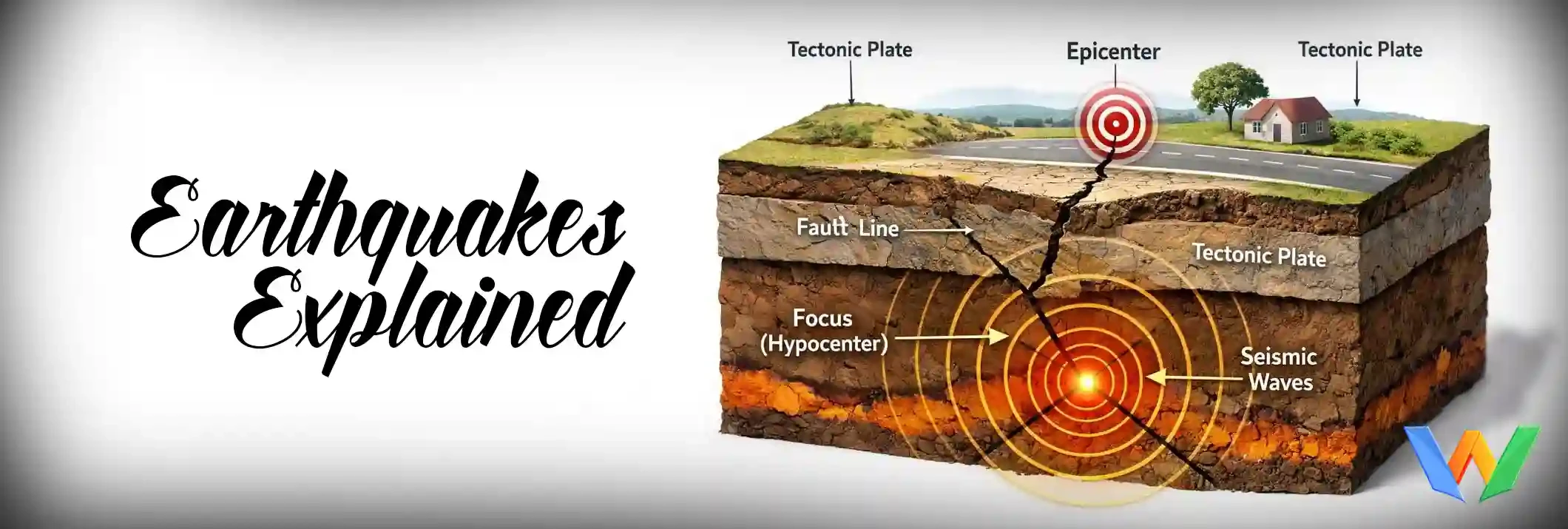
In a few seconds, an earthquake can shake buildings, break roads and change a landscape that took millions of years to form. Yet most people know surprisingly little about what is happening beneath their feet. This complete guide explains what an earthquake is, how earthquakes occur, the different types of earthquakes and the biggest and deadliest earthquakes in history, along with practical safety tips that could help you in an emergency.
An earthquake is the shaking of the Earth's surface caused by a sudden release of energy in the crust or upper mantle. That energy travels outward as seismic waves, which is what we feel as shaking.
Two terms come up in every earthquake report:
Earthquakes range from tiny tremors that only instruments can detect to catastrophic events that flatten cities. The word "earthquake" can also describe the many small movements that happen constantly around the world without anyone noticing.
The Earth's outer shell, the lithosphere, is broken into large pieces called tectonic plates. These plates float on the softer, slowly flowing mantle below and move a few centimetres each year, about as fast as your fingernails grow. Where plates meet, they interact in three main ways:
Plates do not glide smoothly. Rough edges lock together along cracks in the crust called faults, while the plates keep pushing. Over decades or centuries, stress builds up and the rocks bend like a stretched spring. When the stress exceeds the strength of the rock, the fault suddenly slips, and the stored energy is released as an earthquake.
This idea is known as the elastic rebound theory. It was developed after the 1906 San Francisco earthquake, when scientists noticed that fences crossing the fault had been sharply offset.
The released energy travels as waves:
The gap between P-wave and S-wave arrival is how seismologists estimate distance from an earthquake.
A large earthquake is often followed by aftershocks, smaller quakes that occur as the crust adjusts. Sometimes smaller foreshocks come before the main event, though they can only be identified as foreshocks in hindsight.
Around 90% of the world's earthquakes, and most of its largest, occur along the Ring of Fire, a horseshoe-shaped zone around the Pacific Ocean that includes Japan, Indonesia, Chile, Alaska and the US West Coast. Another major belt runs through the Mediterranean, the Middle East and the Himalayas, where the Indian plate collides with Eurasia.
A seismograph records ground motion and produces a trace called a seismogram. Networks of seismographs help scientists locate earthquakes within minutes.
| Class | Magnitude | Typical Effect |
|---|---|---|
| Micro | Below 3.0 | Usually not felt |
| Minor | 3.0 to 3.9 | Often felt, rarely damaging |
| Light | 4.0 to 4.9 | Noticeable shaking, minor damage |
| Moderate | 5.0 to 5.9 | Can damage poorly built structures |
| Strong | 6.0 to 6.9 | Damage in populated areas |
| Major | 7.0 to 7.9 | Serious damage over large areas |
| Great | 8.0 and above | Devastating, can be felt for hundreds of kilometres |
| Type | Depth | Notes |
|---|---|---|
| Shallow | 0 to 70 km | Most common and usually the most damaging |
| Intermediate | 70 to 300 km | Felt over wide areas |
| Deep | 300 to 700 km | Rarely damaging at the surface |
The shaking itself is only part of the danger. Earthquakes can trigger:
Most deaths come not from the ground shaking itself but from buildings that were not designed to resist it.
Some earthquakes stand out for their size, others for the devastation they caused. The largest are not always the deadliest, because death tolls depend on population, building quality and whether a tsunami follows.
| Year | Location | Magnitude | Why It Matters |
|---|---|---|---|
| 1556 | Shaanxi, China | About 8 (estimate) | Deadliest known earthquake, with an estimated 830,000 deaths |
| 1755 | Lisbon, Portugal | About 8.5 to 9 (estimate) | Earthquake, tsunami and fires destroyed the city and shaped European thought |
| 1906 | San Francisco, USA | About 7.9 | Fires razed much of the city; led to the elastic rebound theory |
| 1950 | Assam and Tibet | 8.6 | Among the largest earthquakes ever recorded on land; India's biggest |
| 1960 | Valdivia, Chile | 9.5 | Largest earthquake ever recorded; tsunami crossed the Pacific |
| 1964 | Alaska, USA | 9.2 | Second largest recorded; massive ground and tsunami damage |
| 1976 | Tangshan, China | About 7.6 | Official toll of about 242,000 deaths |
| 2001 | Bhuj, India | 7.7 | Around 20,000 deaths in Gujarat |
| 2004 | Indian Ocean (Sumatra) | About 9.1 | Tsunami killed about 227,000 people across 14 countries |
| 2005 | Kashmir | 7.6 | Around 87,000 deaths |
| 2008 | Sichuan, China | 7.9 | Nearly 87,000 dead or missing |
| 2010 | Haiti | 7.0 | Estimates of deaths range from about 100,000 to over 300,000 |
| 2011 | Tohoku, Japan | 9.1 | Huge tsunami and the Fukushima nuclear accident; around 18,000 dead or missing |
| 2015 | Nepal | 7.8 | Around 9,000 deaths and widespread damage to heritage sites |
| 2023 | Turkey and Syria | 7.8 and 7.5 | More than 50,000 deaths in a sequence of two powerful quakes |
More recently, a magnitude 8.8 earthquake struck off Russia's Kamchatka Peninsula in July 2025, one of the strongest in more than a decade, and a magnitude 7.7 earthquake hit Myanmar in March 2025, causing thousands of deaths.
Earthquakes like Haiti 2010 and Turkey 2023 show that building quality matters as much as magnitude. Chile's 1960 and Japan's 2011 events show how tsunamis can cause damage far from the source. These disasters pushed countries to improve building codes, tsunami warning systems and public education.
India's geology makes it vulnerable. The Indian plate is pushing into Eurasia, building the Himalayas and causing frequent earthquakes. The national hazard map divides the country into seismic zones, with Zone V the most severe, covering parts of the Himalayan belt, the Northeast, Kutch in Gujarat and the Andaman and Nicobar Islands. Historic events include the 1897 Assam, 1905 Kangra, 1934 Bihar-Nepal, 1950 Assam-Tibet, 1993 Latur and 2001 Bhuj earthquakes.
No reliable method exists to predict the exact time, place and size of an earthquake. Scientists can map faults, estimate the long-term chance of a damaging earthquake in a region and monitor changes in the crust. Earthquake early warning systems can detect the first P-waves and send alerts seconds before stronger shaking arrives, which can be enough time to stop trains or take cover.
What causes an earthquake?
Mostly the sudden slipping of rock along faults where tectonic plates meet, releasing stored energy as seismic waves.
What is the difference between magnitude and intensity?
Magnitude measures the energy released, while intensity describes how strong the shaking is at a particular place.
Which was the biggest earthquake ever recorded?
The 1960 Valdivia earthquake in Chile, with a magnitude of 9.5.
Which earthquake killed the most people?
The 1556 Shaanxi earthquake in China, with an estimated 830,000 deaths.
Can earthquakes be predicted?
No. Scientists can estimate probabilities and issue early warnings seconds before strong shaking, but they cannot predict exact times.
What should I do during an earthquake?
Drop, Cover and Hold On, and stay away from windows and heavy objects.
Earthquakes are a natural result of a restless planet, and we cannot stop them. We can, however, reduce their damage through better buildings, early warning systems and preparedness. Understanding how earthquakes work is the first step toward staying safe.
