•
•
•
•
•
•
•

Tuesday, 13 October 2026 — the goddess of courage and protection
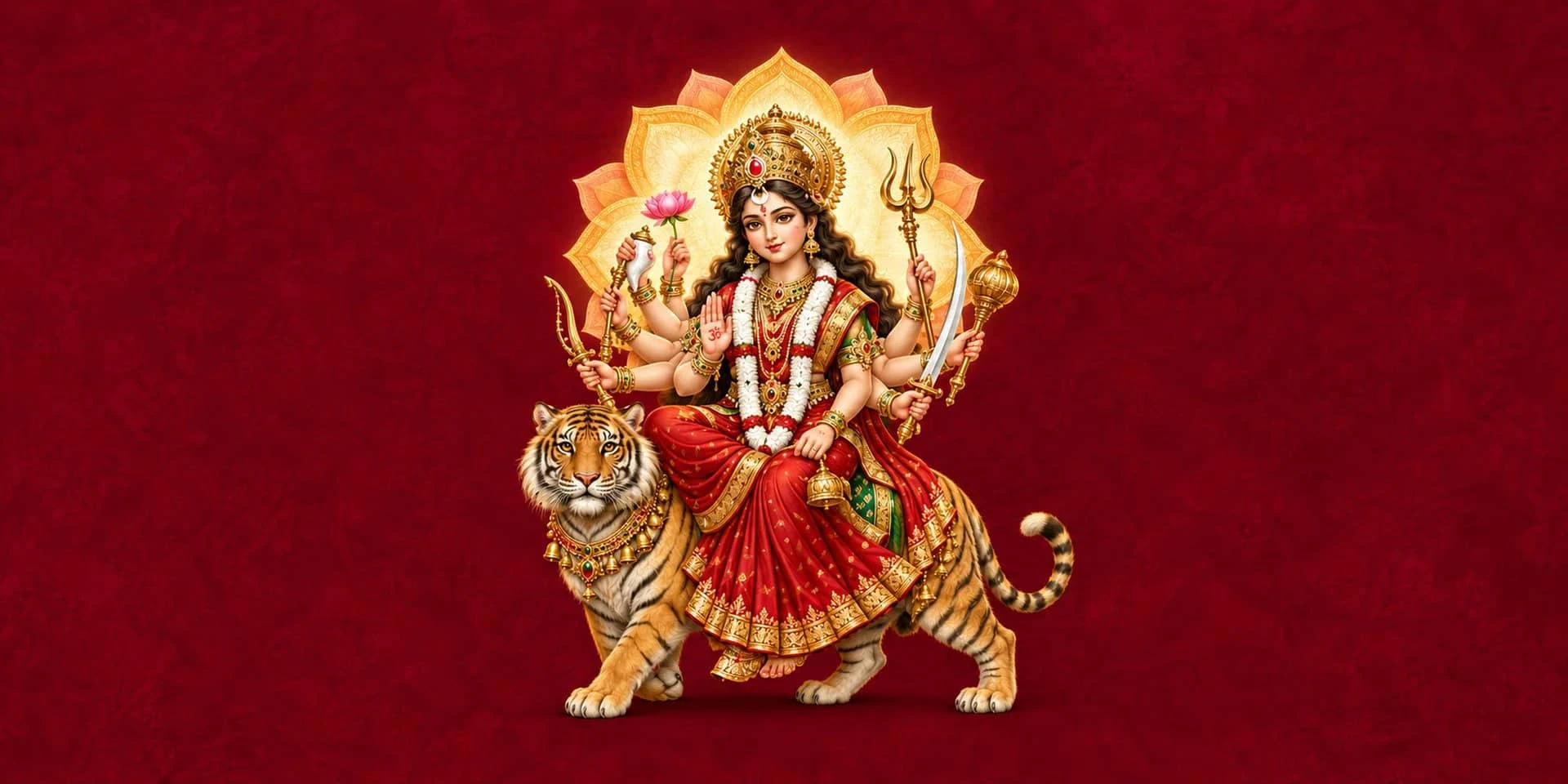
Navratri Day 3 falls on Tuesday, 13 October 2026 and honours Maa Chandraghanta, the third form of Navadurga. She combines serenity with fierce protection: calm toward her devotees, fearsome toward evil. The colour of the day in the commonly published 2026 sequence is red.
For all nine days, see our Navratri 2026 complete guide.
| Detail | Day 3 |
|---|---|
| Date | Tuesday, 13 October 2026 |
| Tithi | Ashwin Shukla Tritiya |
| Goddess | Maa Chandraghanta |
| Colour of the day | Red |
| Mount | Tiger (some depictions show a lion) |
| Arms | Ten |
| Traditional bhog | Milk, kheer or milk-based sweets |
The name comes from chandra (moon) and ghanta (bell): she wears a half moon shaped like a bell on her forehead. Chandraghanta is regarded as the married form of Parvati, after her union with Lord Shiva.
Popular retellings say that when Shiva arrived for his wedding to Parvati with a startling procession of ghosts, ascetics and spirits, her family was frightened. Parvati then took the radiant, fearsome form of Chandraghanta and, in some versions, persuaded Shiva to appear in a more pleasing form so the wedding could proceed.
Another strand of tradition holds that the sound of her bell drives away demons and negative forces. Either way, Chandraghanta represents protective strength used in the service of harmony.
| Feature | Description |
|---|---|
| Forehead | Bell-shaped half moon |
| Eyes | Three |
| Arms | Ten, holding a trishul, gada (mace), sword, kamandalu, bow and arrow, lotus and japa mala, with one hand in the abhaya (fearlessness) mudra |
| Complexion | Golden |
| Mount | Tiger |
The objects she holds vary slightly between images, but the bell on her forehead and the tiger are constant.
Follow your own family and regional customs where they differ.
Name mantra:
ॐ देवी चन्द्रघण्टायै नमः॥
Om Devi Chandraghantayai Namah
Dhyana shloka:
पिण्डजप्रवरारूढा चण्डकोपास्त्रकैर्युता।
प्रसादं तनुते मह्यं चन्द्रघण्टेति विश्रुता॥
Meaning: "May the goddess renowned as Chandraghanta, who rides the finest of beasts and bears fierce weapons, bestow her grace on me."
By popular tradition, milk, kheer or sweets made from milk are offered to Maa Chandraghanta. After the puja, the prasad is shared with family, and some households also donate milk or food to those in need.
Red signifies strength, passion and auspiciousness. It is also the colour of the chunri offered to the goddess and of the bridal saree, which suits a form associated with Parvati's marriage. As always, the colour custom is optional.
The first three days of Navratri are often grouped together as days of the goddess's energy and power. In many traditions, Days 4 to 6 then focus on prosperity, and Days 7 to 9 on knowledge and spiritual fulfilment. Chandraghanta closes the first group with a strong note of protection.
In Gujarat, the third night of Garba is in full swing, while Ramlila stages across North India move deeper into the Ramayana narrative.
Tuesday, 13 October 2026, on Ashwin Shukla Tritiya.
Because she wears a half moon shaped like a bell (ghanta) on her forehead.
Red, in the commonly published 2026 sequence.
Milk, kheer or milk-based sweets, along with red flowers.
Courage, protection and the calm strength to face fear.
Day 3 of Navratri 2026, on 13 October, honours Maa Chandraghanta, the goddess of courage. Ring the bell during puja, offer milk or kheer and, if you like, wear red. Day 4 is dedicated to Maa Kushmanda.
