•
•
•
•
•
•
•

Karwa Chauth 2026 falls on October 29. Know whether newlyweds can observe their first fast during Shukra Ast, the significance of Lakshmi Narayan Rajyog and the four zodiac signs highlighted in astrology.
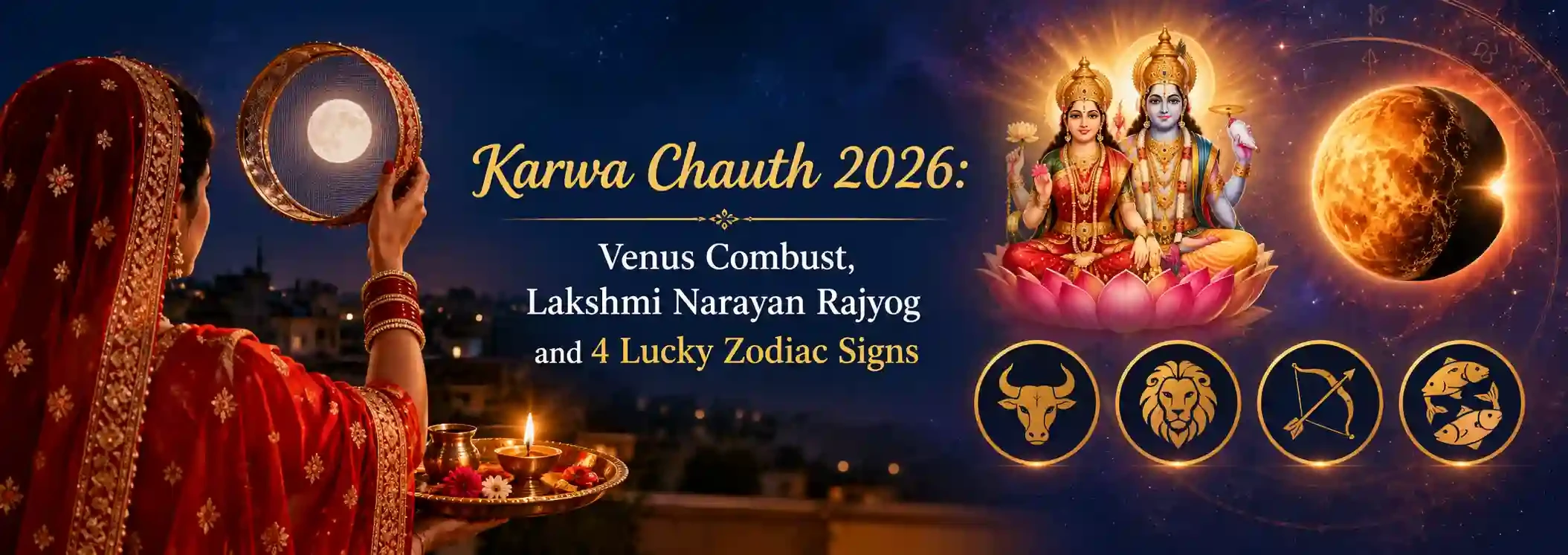
Karwa Chauth is one of the most cherished festivals in Hindu tradition, particularly across North India. The occasion combines devotion, family customs and prayers for a happy married life. As preparations begin for Karwa Chauth 2026, questions about the correct fasting rules, planetary positions and auspicious timings are attracting attention.
This year, Karwa Chauth will be observed on Thursday, October 29, 2026. One of the most frequently discussed questions is whether newly married women can observe their first Karwa Chauth fast while Venus, known as Shukra in Vedic astrology, is considered combust. Another topic attracting interest is the Lakshmi Narayan Rajyog and its traditional interpretation for Aries, Virgo, Libra and Aquarius.
For devotees planning the festival, understanding the distinction between established religious customs, local Panchang timings and astrological interpretations can help make preparations more informed and peaceful.
Karwa Chauth is observed on the Chaturthi Tithi of Krishna Paksha in the Hindu lunar calendar. In 2026, the festival falls on October 29.
Married women traditionally observe a fast and pray for their husbands' long life, well-being and the happiness of their married lives. In many families, the day begins with sargi, a pre-dawn meal traditionally prepared or arranged by the mother-in-law. Devotees then observe the fast according to their family customs and complete the evening rituals.
The main observances commonly include:
Although the central customs are widely shared, the precise sequence of rituals can differ by region and household.
One of the important questions ahead of Karwa Chauth 2026 concerns Shukra Ast, or the period when Venus is considered combust in traditional Indian astrology.
Venus is associated in Vedic astrology with love, marriage, comfort, beauty and material prosperity. Because of these associations, its combust phase can lead to questions about whether certain auspicious ceremonies should be performed during that period.
Some traditional interpretations advise caution regarding specific marriage-related ceremonies when Venus is combust. This has prompted newly married women to ask whether they should observe their first Karwa Chauth fast this year.
An important distinction, however, is that observing a traditional annual fast is not necessarily treated in the same way as conducting a wedding or beginning a new auspicious ceremony. The rules followed can depend on the religious tradition, family customs and the guidance of a knowledgeable priest or astrologer.
One astrological view is that Venus's combust state does not, by itself, prevent a devotee from observing Karwa Chauth. This interpretation points out that the festival's principal worship centres on Lord Shiva, Goddess Parvati and the Moon, rather than on the worship of Venus.
Therefore, newly married women should not assume that their first Karwa Chauth must automatically be skipped because of Shukra Ast. Those who follow specific family or regional traditions can consult a trusted priest to understand how those customs apply to their circumstances.
The important point is to avoid treating a single astrological interpretation as a universal religious rule. Traditions may vary, and individual families can follow different practices.
In Vedic astrology, a planet is generally described as combust when it appears to be very close to the Sun from Earth's perspective. This is an astronomical configuration that astrologers interpret through the traditional framework of planetary influences.
Venus is considered a benefic planet in many schools of Vedic astrology. It is traditionally associated with affection, relationships, artistic expression, comforts and prosperity. When Venus is combust, some astrological interpretations suggest that its usual qualities may be expressed differently or that certain ceremonies require additional consideration.
However, the meaning assigned to planetary combustion belongs to astrological belief. It is not scientific evidence that a religious fast will become ineffective or that a marriage will experience difficulties.
For Karwa Chauth devotees, the practical question is how to observe the festival in accordance with their faith and customs. Checking the local Panchang and consulting a trusted religious adviser can help resolve differences in interpretation without creating unnecessary anxiety.
Another astrological topic associated with Karwa Chauth 2026 is the Lakshmi Narayan Rajyog.
According to traditional Vedic astrology, this yog is associated with the conjunction of Mercury (Budh) and Venus (Shukra) in a horoscope or relevant astrological configuration. Mercury is linked with communication, intelligence, calculation, business and decision-making, while Venus is associated with comfort, relationships, luxury and material enjoyment.
Astrologers traditionally interpret a favourable Lakshmi Narayan Rajyog as a possible symbol of opportunities involving finances, professional growth, business and personal comfort.
The precise interpretation depends on the planetary placements, signs, houses and the individual's birth chart. Simply hearing that a yog is present does not mean every person will experience the same result.
For the Karwa Chauth period, astrological forecasts have highlighted four zodiac signs—Aries, Virgo, Libra and Aquarius—as potentially favoured under this traditional interpretation.
These predictions are best understood as general horoscope themes rather than promises of financial gain, promotion or other specific events.
For Aries, the traditional forecast emphasises opportunities connected with income, professional responsibilities and new plans.
People working in jobs may find this a useful period to demonstrate their skills, take initiative and communicate their ideas clearly. Business owners may consider reviewing growth plans, exploring potential customers or developing existing projects.
The astrological theme is one of initiative and opportunity, but practical judgement remains essential. Avoid rushing into investments or making major financial commitments based solely on a horoscope.
Traditional theme: Initiative, career development and careful financial planning.
Virgo is traditionally associated with analysis, organisation and attention to detail. In the context of the Lakshmi Narayan Rajyog forecast, the sign's themes centre on thoughtful decision-making and structured progress.
Professionals may use this period to review their goals, improve workplace communication or identify skills that could support career development. Business owners may benefit from examining expenses, schedules and long-term plans.
Rather than expecting sudden changes, the practical message is to focus on preparation and well-considered decisions.
Traditional theme: Planning, professional improvement and measured choices.
Venus is the ruling planet traditionally associated with Libra, making the sign particularly relevant in discussions of Venus-related astrological combinations.
The forecast highlights possible opportunities involving career growth, financial matters, professional relationships and business contacts. Employees may want to communicate their achievements and consider new responsibilities, while business owners can review partnerships and customer relationships.
These possibilities should not be mistaken for guaranteed results. Actual financial and professional outcomes depend on circumstances, skills, decisions and wider economic conditions.
Traditional theme: Career opportunities, cooperation and financial awareness.
For Aquarius, the traditional interpretation focuses on new connections, collaborative work and project development.
Professional networks may offer opportunities to exchange ideas, learn from others or explore future plans. People considering a business expansion or new project can use the period to research options and prepare a realistic strategy.
The emphasis is on turning ideas into practical steps rather than relying on favourable predictions alone.
Traditional theme: Networking, collaboration and organised project development.
Astrology note: These are general traditional interpretations. Individual horoscope readings vary, and zodiac predictions cannot guarantee particular financial, career or personal outcomes.
Puja timing is an important part of Karwa Chauth preparations. Published Panchang calculations give an indicative evening puja window of approximately 5:38 PM to 6:56 PM in New Delhi on October 29, 2026.
However, puja timings are location-dependent. Moonrise also differs between cities, so devotees should check the Panchang for their own location rather than relying on a single nationwide time.
The evening puja commonly involves preparing the puja thali, lighting a diya, offering traditional items and listening to the vrat katha. Many families also observe customs involving a decorated karwa, a sieve and prayers before completing the fast after moonrise.
Because calendar calculations and local traditions can differ, it is advisable to confirm the relevant timings with a trusted local Panchang or priest before the festival.
Karwa Chauth fasting practices vary. Many devotees observe a nirjala vrat, traditionally refraining from both food and water until the fast is completed. Others may follow different practices according to health needs, family customs or religious guidance.
People planning to fast can prepare by eating an appropriate pre-dawn meal if that is part of their tradition and by arranging their day to avoid unnecessary exertion. Those with medical conditions, those who are pregnant or breastfeeding, and anyone taking medicines that require food or water should seek appropriate medical advice before attempting a strict fast.
Religious observance should not require someone to disregard important health needs. Families can discuss suitable arrangements while respecting the meaning of the festival.
Beyond fasting and astrological discussions, Karwa Chauth has enduring cultural and emotional significance for many families. The festival brings relatives together, preserves regional traditions and creates opportunities for couples to express care and commitment.
Women often dress in traditional clothing, apply mehndi, prepare festive foods and participate in community or family gatherings. The vrat katha and evening rituals connect contemporary celebrations with stories and customs passed down through generations.
In some households, husbands also fast alongside their wives. Practices continue to evolve, with couples adapting rituals to reflect mutual respect, shared responsibility and personal beliefs.
The festival's significance therefore extends beyond a single ritual or planetary configuration. For many devotees, it is an occasion to reaffirm affection, family bonds and spiritual devotion.
Karwa Chauth 2026 will be celebrated on Thursday, October 29, with devotees preparing for the traditional fast, evening puja and Moon worship. The discussion around Shukra Ast has raised questions for newlyweds observing their first Karwa Chauth, but Venus's combust phase should not automatically be treated as a universal prohibition against the fast.
The Lakshmi Narayan Rajyog has also attracted astrological attention, particularly for Aries, Virgo, Libra and Aquarius. Traditional forecasts associate the combination with possible themes of career progress, financial awareness, cooperation and new opportunities, although these outcomes cannot be guaranteed.
For a smooth celebration, devotees should confirm local puja and moonrise timings, follow the traditions meaningful to their families and seek reliable guidance when customs differ. Above all, Karwa Chauth remains an occasion centred on devotion, care, family and the well-being of married couples.
