
Yemen War Escalates: Government Launches Offensive as Houthis Claim Riyadh Strike and Red Sea Tanker Faces Explosions

Yemen Launches Major Military Offensive Against Houthis
Yemen's long-running conflict has entered another dangerous phase after the country's internationally recognised, Saudi-backed government announced a major military operation to retake territory controlled by the Houthi movement.
Rashad al-Alimi, chairman of Yemen's Presidential Leadership Council, announced the operation on October 4, saying government forces had been ordered to restore state authority across the country.
The announcement came as fighting intensified around Taiz, one of Yemen's most strategically important cities. Houthi forces have reportedly made gains around the city and moved against key routes connecting Taiz with Aden, raising concerns that the city could face increasing pressure or isolation.
The renewed offensive represents one of the sharpest escalations in Yemen's conflict in recent years.
Houthis Claim Attack Near Riyadh
The escalation has also spilled beyond Yemen's borders.
The Houthis said they launched ballistic missiles and drones at an Aramco facility near Riyadh, describing the operation as retaliation for Saudi-led attacks on Houthi-controlled areas of Yemen.
Houthi military spokesman Yahya Saree claimed the operation achieved its objectives and caused fires at the targeted sites.
However, the Saudi-led coalition rejected the claim, describing the Houthis' assertion that they had targeted Riyadh as misleading. Coalition spokesman Turki al-Maliki said the group was attempting to divert attention from its losses on the battlefield.
Reports of flames and smoke near an oil facility south of Riyadh have added to the uncertainty surrounding the incident, but the competing claims mean that the exact impact and nature of the alleged Houthi operation remain disputed.
Fighting Intensifies Around Taiz
The latest military campaign follows a rapid deterioration in the situation on the ground.
According to Yemen's government forces, hundreds of Houthi fighters were killed during a series of operations targeting Houthi positions and military movements. The military claimed that 257 precision operations were carried out on Saturday and that at least 700 Houthi fighters were killed.
Those casualty figures are claims from the Yemeni government and could not be independently verified.
The Saudi-led coalition has also reported conducting dozens of operations against Houthi reinforcements around the Taiz and Tor al-Baha fronts.
Taiz is particularly significant because of its location between Houthi-held territory and areas controlled by the internationally recognised government. Control of routes around the city could affect military supply lines and access between central Yemen and the southern coast.
New Red Sea Shipping Alarm
The military escalation has also raised fresh concerns about commercial shipping in the Red Sea and Bab el-Mandeb region.
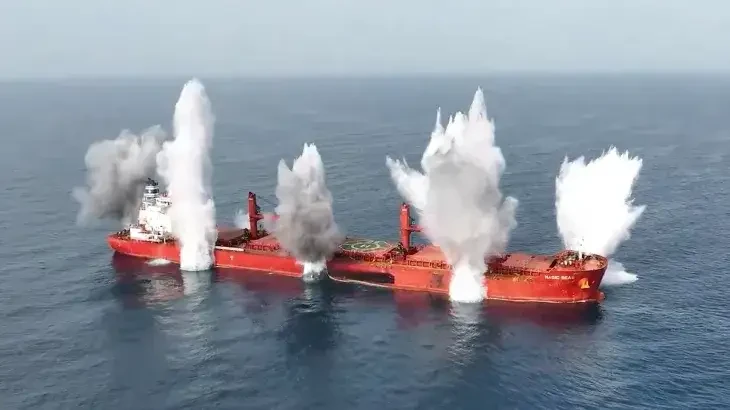
On October 4, the United Kingdom Maritime Trade Operations (UKMTO) reported that a tanker had seen multiple explosions close to the vessel approximately 60 nautical miles south of Mokha, Yemen.
The crew was reported safe and no environmental damage was reported. Authorities are investigating the incident, and UKMTO advised vessels operating in the area to exercise caution. Importantly, the maritime agency did not identify the cause of the explosions or attribute the incident to the Houthis.
The incident is significant because the waters around Yemen are a major international shipping corridor. Any sustained increase in attacks or security incidents could increase risks for commercial vessels using the Red Sea and Bab el-Mandeb Strait.
Why the Latest Yemen Escalation Matters
The latest developments bring together three interconnected security concerns: the battle for territory inside Yemen, attacks and counterattacks involving Saudi Arabia, and threats to international maritime traffic.
The Houthis have controlled Yemen's capital, Sanaa, and large parts of the country's northwest since 2014. Their recent military advances have increased pressure on government-held areas and strategically important coastal routes. Reuters reported that the group had also made gains around the Bab el-Mandeb area, a crucial maritime chokepoint linking the Red Sea with the Gulf of Aden.
The renewed fighting also threatens to worsen Yemen's humanitarian crisis. The World Food Programme has warned that the latest violence is disrupting supplies and leaving many families facing severe food insecurity.
What Happens Next?
The coming days could determine whether the latest offensive becomes a sustained campaign or leads to another attempt at de-escalation.
For Yemen's government and its Saudi-backed forces, the immediate objective is to prevent further Houthi territorial gains and regain strategically important areas. For the Houthis, maintaining control of territory and applying pressure through missile, drone and maritime operations remains central to their military strategy.
Meanwhile, the disputed Riyadh attack claim and the unexplained tanker explosions demonstrate how quickly fighting in Yemen can affect Saudi security and global shipping routes.
With the conflict intensifying around Taiz and the Red Sea, international attention is likely to remain focused on whether the latest escalation expands into a broader regional security crisis.