
Serbia Election 2026: Student Movement Defeats Vučić’s Political Camp

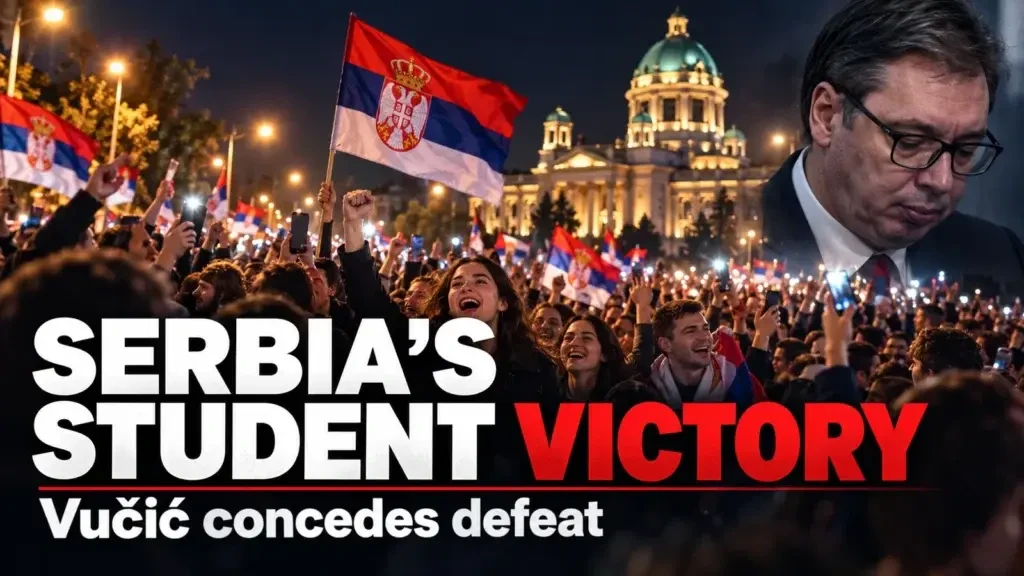
Serbia Election 2026: Student Movement Delivers Historic Political Setback
Serbia is facing a major political transition after the student-led Student List movement secured a decisive victory in the parliamentary election on October 25, 2026. Longtime political leader Aleksandar Vučić conceded defeat, acknowledging that his political camp had lost its parliamentary majority after more than a decade of dominance.
Preliminary projections indicated that the Student List could win between 135 and 140 seats in Serbia’s 250-member parliament, compared with approximately 105 seats for Vučić’s Serbian Progressive Party-led political camp. Final official results were still pending at the time of the initial concession.
The outcome marks a significant turning point for the Balkan country, where university students transformed a protest movement into a nationwide electoral challenge. Celebrations erupted in Belgrade and other cities after the concession, with supporters welcoming the prospect of a change in political leadership.
The election followed months of campaigning and nearly two years of demonstrations against alleged corruption, declining institutional accountability and concerns about democratic standards. The ruling camp has previously rejected accusations of wrongdoing and defended its record in government.
How Student Protests Became an Electoral Force
The movement gained momentum after a railway station canopy collapsed in the northern city of Novi Sad in November 2024, killing 16 people. The disaster triggered widespread public anger and questions about construction standards, infrastructure oversight and possible corruption linked to the station’s renovation.
Students organised demonstrations, university blockades and public campaigns demanding accountability and institutional transparency. Their protests gradually attracted support from people beyond university campuses, including citizens dissatisfied with established political parties.
Rather than relying solely on traditional party structures, the Student List presented itself as an alternative to the existing political establishment. Its campaign brought together candidates from different professional backgrounds and emphasised the need for stronger institutions, greater transparency and action against corruption.
The election demonstrated how sustained public mobilisation can develop into an organised political challenge. It also showed that younger voters and protest movements can influence national politics when their demands reach a broader electorate.
Vučić Concedes as Voter Turnout Rises
Vučić acknowledged the defeat on election night, citing preliminary estimates that placed the Student List well ahead of his political camp. The result represents a major setback for a leader who has shaped Serbia’s domestic politics and international relations for more than a decade.
Turnout was reported at close to 70%, making it one of the strongest electoral participation levels in the country’s recent history. Long queues at polling stations in several locations reflected intense public interest in the contest.
Vučić’s political influence has extended across his periods as prime minister and president. He resigned from the presidency in September 2026 and had sought a return to executive power through the parliamentary election.
The outcome now raises questions about the future of his party, its role in opposition and the balance of power within Serbia’s political institutions. The full implications will become clearer as final results are confirmed and the process of forming a new government begins.
What the Election Could Mean for Serbia
The Student List faces the challenge of translating electoral success into effective government. Its campaign focused on accountability, institutional reform and the fight against corruption, creating public expectations for concrete changes in how the country is governed.
Potential priorities include strengthening judicial independence, improving transparency in public procurement, protecting media freedom and ensuring greater accountability for public officials. Delivering these reforms will require political coordination, administrative capacity and sustained support within parliament.
Economic issues will also demand attention. Serbia must address employment, public services, investment and the cost of living while maintaining stability during the political transition.
The movement’s ability to build a governing team and establish clear policy priorities will be critical. A broad coalition of voters can unite around demands for change, but governing often requires difficult compromises and detailed policy decisions.
Serbia’s European Union Relations Under Scrutiny
The election is also likely to draw attention from European governments and international partners. Serbia has pursued closer integration with the European Union while maintaining important political and economic ties with Russia and China.
A new government could face pressure to make progress on the rule of law, democratic institutions and media freedom as part of the country’s European integration process. However, the precise direction of Serbia’s foreign policy will depend on the new leadership’s programme and decisions.
Relations with Kosovo, energy security and regional stability will remain important issues for any incoming administration. Serbia’s choices in these areas will affect both its domestic politics and its wider position in southeastern Europe.
A New Political Chapter Begins
The Student List’s victory represents a remarkable transition from street protests to parliamentary power. It reflects widespread demands for greater accountability and a change in the country’s political direction.
Yet the election is only the beginning of a new phase. The movement must now demonstrate that it can form a stable government, implement its promises and respond to the expectations of voters who supported change.
As Serbia moves towards the formation of a new administration, attention will focus on the final election results, the distribution of parliamentary seats and the policy agenda of the incoming leadership. The challenge ahead will be to turn a historic electoral victory into lasting institutional and political change.