
IMF Boosts 2026 Global Growth Forecast to 3.1% Amid Rising Economic Uncertainty

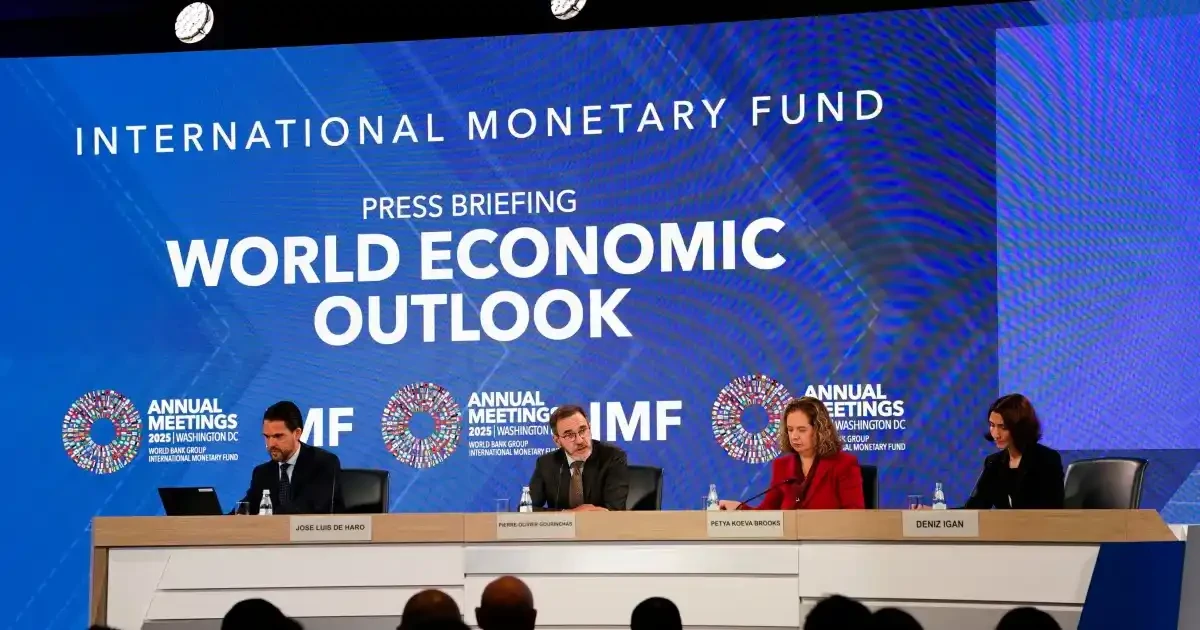
IMF Upgrades Global Economic Growth Forecast for 2026
The International Monetary Fund (IMF) has modestly improved its outlook for the global economy, raising its 2026 global GDP growth forecast to 3.1%, up from the 3.0% projected in July. The latest estimate reflects the ability of businesses, governments and financial markets to adapt to significant economic shocks, including geopolitical conflicts and rising energy costs.
In its October 2026 World Economic Outlook, released on October 13, the IMF maintained its global growth projection for 2027 at 3.4%. However, the revised forecast remains below the 3.5% global growth recorded in 2025, indicating that the world economy continues to face substantial challenges.
Geopolitical Conflicts and Rising Oil Prices Threaten Growth
Despite the improved forecast, the IMF has warned that the global economy could face renewed pressure from prolonged conflicts and energy supply disruptions. Higher oil prices have increased production and transportation costs, putting additional pressure on businesses, consumers and governments.
The Fund noted that the global economy has absorbed the energy shock better than initially anticipated, partly because suppliers redirected energy exports and production increased in regions outside the conflict zone. However, declining oil inventories and elevated energy prices have reduced the buffer available to withstand further disruptions.
The IMF also cautioned that an extended conflict could push oil prices higher, weaken economic activity and increase inflation. Countries that depend heavily on imported energy are particularly exposed to rising import bills, currency pressures and declining household purchasing power.
AI Investment Supports Growth but Creates Financial Risks
Artificial intelligence (AI) investment has emerged as an important driver of economic activity, helping offset some of the negative effects of geopolitical instability. Spending on semiconductors, data centres and advanced computing infrastructure has supported investment, exports and financial markets in technology-linked economies.
However, the IMF warned that the benefits remain concentrated in a relatively small group of countries. It also highlighted the risk that excessive expectations surrounding AI profitability could trigger a market correction if anticipated productivity gains fail to materialise.
Such a downturn could affect investment, business confidence and financial stability, creating another challenge for the global economic outlook.
Inflation and Government Debt Remain Major Concerns
The IMF expects global headline inflation to rise from 4.1% in 2025 to 4.7% in 2026 before easing to 4.1% in 2027. Persistent energy costs could make it more difficult for central banks to control inflation without slowing economic growth.
At the same time, rising public debt and borrowing costs are limiting governments' ability to respond to future crises. Emerging and developing economies face additional pressure from currency volatility, expensive financing and higher energy import bills.
The IMF has urged policymakers to rebuild fiscal capacity, manage inflation carefully and provide targeted support to vulnerable households rather than relying on broad fuel subsidies.
India and the Global Economy: What Comes Next?
India remains a comparatively strong performer in the IMF's latest outlook. The Fund projects India's growth at 7% in both 2026 and 2027 on a fiscal-year basis, supported by domestic demand and the services sector. However, higher oil prices could still increase costs and put pressure on the country's import bill.
Overall, the IMF's modest upward revision signals resilience rather than a complete recovery. The global economy continues to navigate geopolitical tensions, energy market uncertainty, inflation and mounting debt. Whether growth strengthens further will depend on how these risks evolve and whether governments can maintain economic stability while supporting investment and productivity.