•
•
•
•
•
•
•

From a railway-station tea stall in Vadnagar to a third term as India's Prime Minister
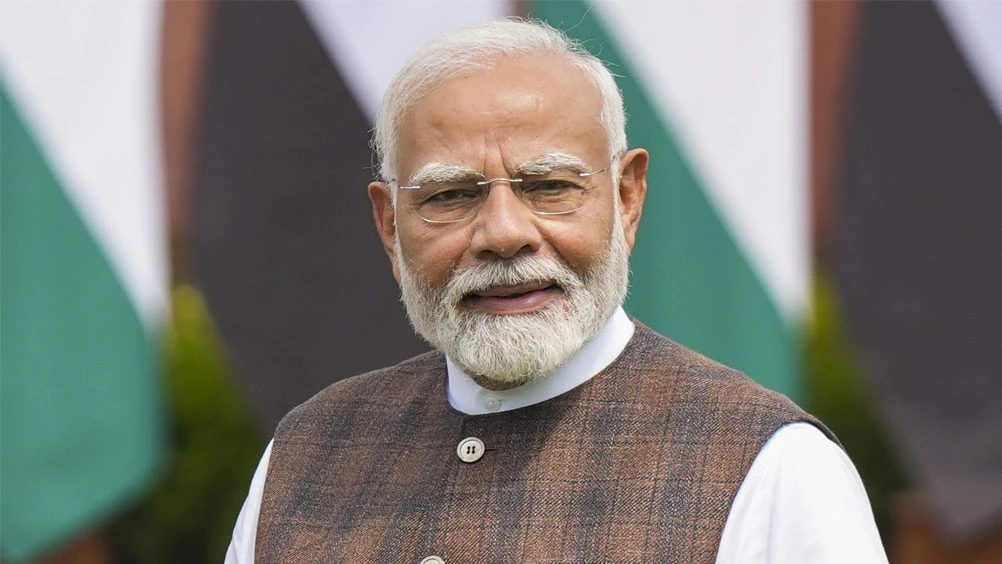
Narendra Modi is the 14th Prime Minister of India and one of the most recognisable political leaders of the 21st century. He first took office in May 2014, won a larger mandate in 2019, and was sworn in for a third consecutive term in June 2024 — making him only the second Indian Prime Minister, after Jawaharlal Nehru, to win three straight general elections.
His time in office has been marked by large welfare and infrastructure programmes, a push for digital public infrastructure, bold and sometimes controversial economic decisions, and a more assertive Indian presence on the world stage.
Modi was born on 17 September 1950 in Vadnagar, a small town in Gujarat's Mehsana district, the third of six children of Damodardas Mulchand Modi and Hiraben Modi. The family was of modest means; as a boy he helped his father sell tea near the local railway station, a story that later became central to his public identity.
As a teenager he joined the Rashtriya Swayamsevak Sangh (RSS), the Hindu nationalist volunteer organisation. He left home in his late teens and spent several years travelling across India before becoming a full-time RSS worker, or pracharak. According to official records, he completed a BA in political science through distance learning from Delhi University and an MA from Gujarat University.
The RSS assigned Modi to the Bharatiya Janata Party (BJP) in the 1980s. He gained a reputation as a skilled organiser, helping plan major party campaigns and rising to become a national general secretary of the BJP in the 1990s.
In October 2001, the BJP appointed Modi Chief Minister of Gujarat. Months later, in 2002, the state was hit by communal riots that killed more than a thousand people, most of them Muslims. Modi faced intense criticism over the state government's response; a Special Investigation Team appointed by the Supreme Court later found no evidence to prosecute him.
He went on to win three more state elections and became Gujarat's longest-serving Chief Minister. His "Gujarat model" of development — focused on infrastructure, power supply and investment summits such as Vibrant Gujarat — became the springboard for his national campaign.
| Area | Key initiatives |
|---|---|
| Financial inclusion | Jan Dhan Yojana bank accounts, direct benefit transfers |
| Digital economy | Digital India, Aadhaar-linked services, UPI payments growth |
| Sanitation & welfare | Swachh Bharat Mission, Ujjwala gas connections, housing schemes |
| Economic reform | Goods and Services Tax (2017), Insolvency and Bankruptcy Code |
| Manufacturing | Make in India, production-linked incentive schemes |
| Constitutional change | Revocation of Jammu and Kashmir's special status (2019) |
| Space & science | Chandrayaan-3 Moon landing (2023) |
The 2016 demonetisation of high-value banknotes, intended to curb black money, caused major short-term disruption and remains widely debated. The Citizenship (Amendment) Act of 2019 triggered nationwide protests. Critics, including international press-freedom and rights groups, have raised concerns about democratic backsliding, media freedom and the treatment of minorities, which the government rejects.
Modi has travelled more widely than most of his predecessors, building ties with the United States, the Gulf states, Japan and Europe while maintaining relations with Russia. India held the G20 presidency in 2023, and in February 2026 New Delhi hosted the AI Impact Summit, attended by global technology leaders. In 2026 his government has also navigated trade and tariff tensions with Washington and attempts to steady relations with China.
Modi is known for direct-to-public communication. His monthly radio programme Mann Ki Baat, launched in October 2014, has run for more than a decade, and he is among the most-followed politicians on social media.
Modi was married as a teenager to Jashodaben in an arranged union but did not live with her; he publicly acknowledged the marriage in 2014. He is known for a disciplined routine and has promoted yoga globally — the UN declared 21 June the International Day of Yoga in 2014 following his proposal.
He has been Prime Minister since May 2014 and is serving his third consecutive term, which began in June 2024.
He is a member of the Bharatiya Janata Party (BJP) and leads the National Democratic Alliance coalition government.
He served as Chief Minister of Gujarat for nearly 13 years, from 2001 to 2014.
It is Modi's monthly radio address to the nation, broadcast since October 2014.
GST, Digital India, Jan Dhan Yojana, Swachh Bharat, Make in India and the revocation of Article 370 are among the most significant.
Narendra Modi's journey from a tea-seller's son to a three-term Prime Minister is one of modern politics' most striking stories. Supporters credit him with faster infrastructure growth, digital transformation and a stronger global voice for India; critics point to concerns over institutions, civil liberties and social cohesion. Either way, his imprint on India will shape the country for decades.
