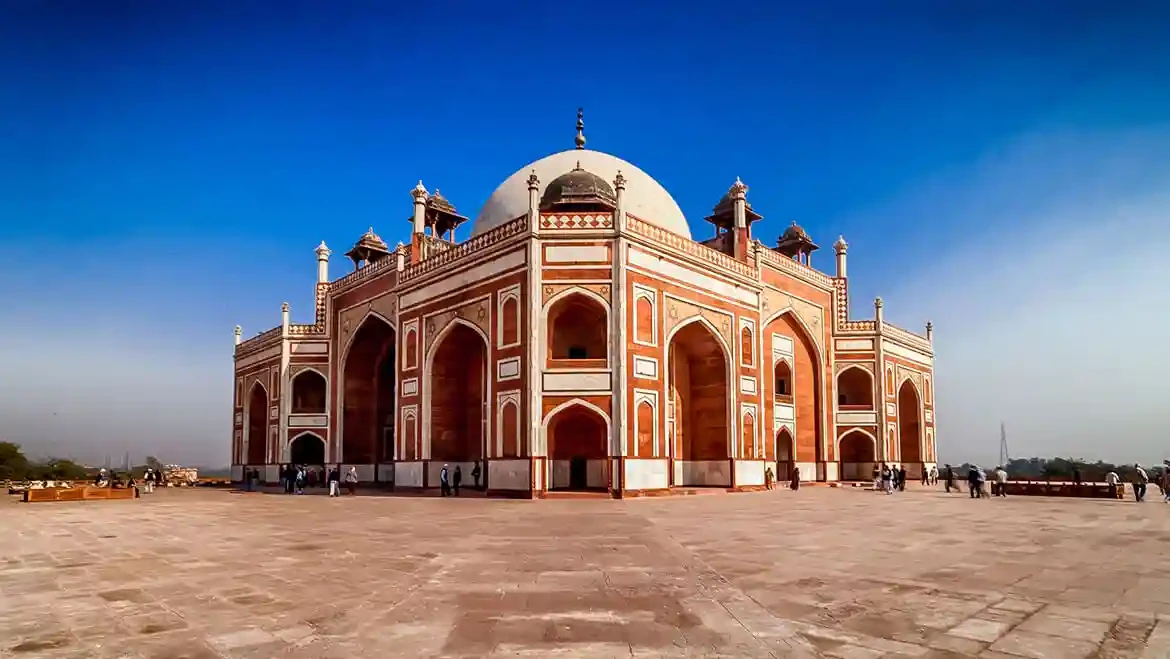
Mughal architecture flourished in the 16th and 17th centuries, blending Persian, Central Asian and Indian elements. This guide explains its defining features such as charbagh gardens, double domes and pietra dura, and traces its evolution through the reigns of Humayun, Akbar, Jahangir, Shah Jahan and Aurangzeb.
Mughal architecture is the distinctive style that developed under the Mughal emperors in the Indian subcontinent from the 16th to the 18th centuries. It combined Persian and Timurid design ideas with Indian building traditions, craftsmanship and materials. The result includes some of the world's most celebrated monuments, several of them UNESCO World Heritage Sites.
Defining Features
- Charbagh gardens: Four-part gardens divided by water channels and walkways, symbolising the paradise gardens described in Islamic tradition.
- Symmetry and axial planning: Buildings and gardens aligned along clear central axes.
- Bulbous domes and double domes: An outer dome for grandeur and an inner dome for interior proportion.
- Iwans and arches: Large vaulted entrance portals.
- Chhatris: Domed pavilions on pillars, borrowed from Rajput architecture.
- Jalis: Intricately carved stone screens that filter light and air.
- Materials: Red sandstone in the early period; increasing use of white marble later.
- Pietra dura (parchin kari): Inlay of semi-precious stones into marble to create floral patterns.
- Calligraphy: Quranic verses inlaid around gateways and arches.
Evolution by Reign
Babur (1526–1530)
The dynasty's founder focused on gardens. Few buildings survive from his short reign.
Humayun (1530–1540, 1555–1556)
Humayun's Tomb in Delhi, completed around 1570 and commissioned by his widow Bega Begum, was designed by Persian architect Mirak Mirza Ghiyas. It was the first garden tomb on the subcontinent and set the template for later tombs, including the Taj Mahal. It became a UNESCO World Heritage Site in 1993.
Akbar (1556–1605)
Akbar's era blended Persian forms with Indian elements, often in red sandstone.
- Agra Fort, rebuilt from the 1560s
- Fatehpur Sikri (built c. 1571–1585), Akbar's short-lived capital, featuring the Buland Darwaza, Panch Mahal and Diwan-i-Khas with its unique central pillar
- Akbar's Tomb at Sikandra, completed under Jahangir
Jahangir (1605–1627)
Gardens and refined decoration flourished.
- Shalimar Bagh in Srinagar
- Tomb of I'timad-ud-Daulah in Agra, built by Empress Nur Jahan for her father, one of the first Mughal structures faced in white marble with extensive inlay, often called the "Baby Taj"
Shah Jahan (1628–1658): The Golden Age
Shah Jahan's reign is considered the peak of Mughal architecture.
- Taj Mahal (c. 1632–1653), Agra: A white marble mausoleum for Empress Mumtaz Mahal, with architect Ustad Ahmad Lahauri widely credited. It features perfect symmetry, a raised plinth, four minarets and exquisite pietra dura. It became a UNESCO World Heritage Site in 1983.
- Red Fort (1639–1648), Delhi: The palace-fortress of the new capital, Shahjahanabad. UNESCO World Heritage Site since 2007.
- Jama Masjid, Delhi (1650–1656): One of India's largest mosques.
- Moti Masjid in Agra Fort.
Aurangzeb (1658–1707)
Building activity slowed but notable works include:
- Badshahi Mosque, Lahore (1671–1673)
- Bibi Ka Maqbara, Aurangabad (Chhatrapati Sambhajinagar), built for Aurangzeb's wife, often compared to the Taj Mahal
Timeline of Landmark Monuments
| Monument | Location | Approx. date | Patron |
|---|
| Humayun's Tomb | Delhi | c. 1570 | Bega Begum |
| Fatehpur Sikri | Uttar Pradesh | 1571–1585 | Akbar |
| I'timad-ud-Daulah | Agra | 1622–1628 | Nur Jahan |
| Taj Mahal | Agra | 1632–1653 | Shah Jahan |
| Red Fort | Delhi | 1639–1648 | Shah Jahan |
| Jama Masjid | Delhi | 1650–1656 | Shah Jahan |
| Badshahi Mosque | Lahore | 1671–1673 | Aurangzeb |
Legacy and Influence
Mughal forms influenced later Rajput palaces, Sikh architecture, including elements of the Golden Temple's design, and Indo-Saracenic architecture under British rule, visible in buildings such as the Victoria Memorial and many railway stations.
Conservation Challenges
- Air pollution causing discolouration of marble, including at the Taj Mahal
- Urban encroachment and heavy tourist footfall
- Groundwater and river changes affecting foundations
The Archaeological Survey of India and conservation partners such as the Aga Khan Trust for Culture, which restored Humayun's Tomb, work to protect these sites.
Frequently Asked Questions
What is the first major Mughal garden tomb?
Humayun's Tomb in Delhi, completed around 1570.
What is pietra dura?
An inlay technique using cut and polished semi-precious stones set into marble to create images, especially floral designs.
Who built the Taj Mahal?
Emperor Shah Jahan commissioned it in memory of Mumtaz Mahal; Ustad Ahmad Lahauri is widely credited as chief architect.
Conclusion
Mughal architecture represents a remarkable synthesis of cultures, engineering and artistry. From Humayun's Tomb to the Taj Mahal, its monuments remain among the finest expressions of India's shared heritage.