
Supreme Court Refuses to Stay UPI Merchant Charges Above ₹2,000; Seeks Centre, RBI and NPCI Replies

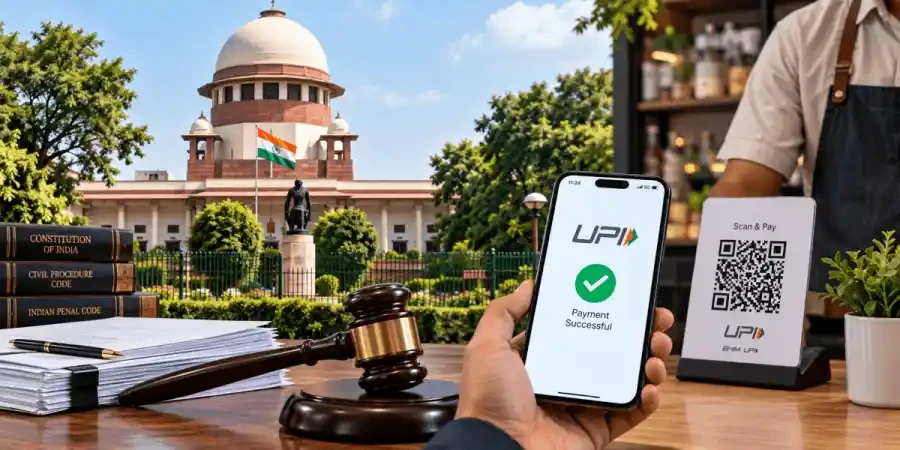
New Delhi, October 1, 2026: The Supreme Court has declined to stay the Centre's decision to permit a merchant discount rate (MDR) on specified UPI person-to-merchant (P2M) transactions above ₹2,000. The framework is scheduled to take effect from October 15, 2026.
What Happened
A bench led by Chief Justice Surya Kant, with Justices Joymalya Bagchi and V Mohana, heard a petition challenging the new charges on Monday, September 28. The court refused interim relief but issued notice to the Centre, the Reserve Bank of India (RBI) and the National Payments Corporation of India (NPCI), asking them to file counter-affidavits within four weeks. It also asked the government to explain the statutory source and legal character of the levy.
What the New Framework Says
- A finance ministry gazette notification dated September 14 listed UPI transactions up to ₹2,000 (and RuPay debit cards) as payment modes on which banks and system providers cannot impose charges.
- As reported by Inc42, eligible P2M transactions above ₹2,000 are expected to attract an MDR of 0.4%, capped at ₹300.
- Person-to-person (P2P) transfers remain free.
The Arguments
The petitioner questioned the ₹2,000 threshold and a ₹1 lakh monthly receipt limit linked to merchant exemptions, arguing that the data and methodology behind them had not been disclosed. The petitioner also pointed to a sharp cost jump at the threshold: a ₹2,001 payment could attract MDR while a ₹2,000 payment would not.
For the Centre, Additional Solicitor General N Venkataraman told the court that the MDR is neither a tax nor a fee collected by the government, that P2P transfers stay free, and that around 96% of merchant transactions would be unaffected, according to reports of the hearing.
Why It Matters
UPI has grown rapidly under a zero-MDR regime since 2020. Inc42 reported that UPI processed about 2,451 crore transactions worth ₹29.82 lakh crore in August 2026. Payment companies and banks have long argued that zero MDR limits investment in the system, while small traders worry that charges could push customers back to cash. Some merchants have already protested, and petrol-pump dealers have reportedly considered restricting larger UPI payments.
What Happens Next
- The MDR framework is scheduled to start on October 15, subject to further court proceedings.
- Responses from the Centre, RBI and NPCI are due within four weeks, after which the matter will be heard again.
- Merchants should check with their payment service providers about which transactions will be charged and how settlements will reflect the fee.
Key Facts
- Court: Supreme Court of India
- Decision: No interim stay; notice issued
- Threshold: P2M UPI payments above ₹2,000
- Reported rate: 0.4% with a ₹300 cap
- Start date: October 15, 2026
FAQ
Will I pay extra when I send money to a friend on UPI?
No. Person-to-person transfers remain free.
Who pays the MDR?
MDR is charged to merchants for processing payments, not to paying customers. Whether merchants pass it on is a separate business decision.