
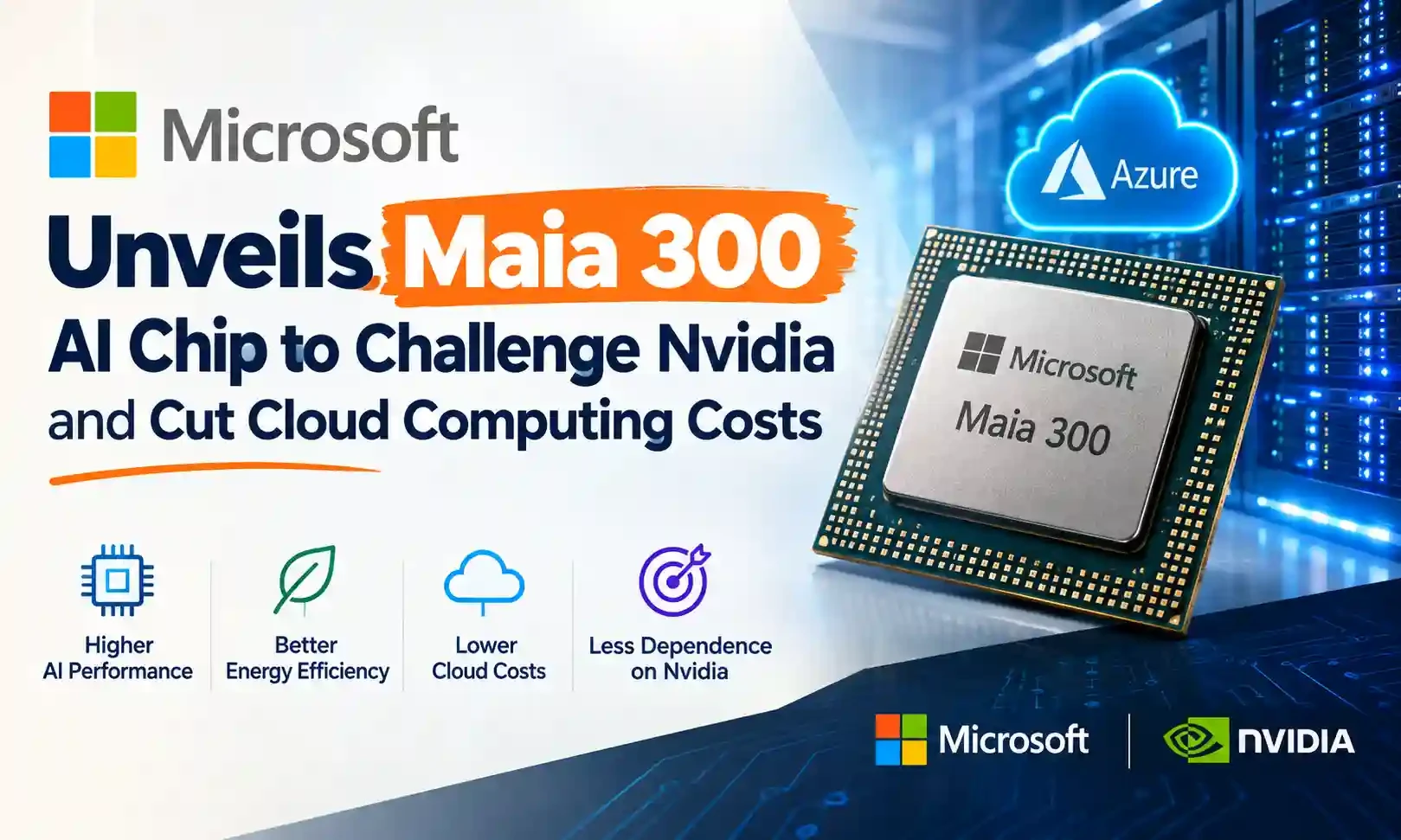
Microsoft Unveils Maia 300 AI Chip to Challenge Nvidia and Cut Cloud Computing Costs

Microsoft Expands Its Custom AI Chip Strategy
Microsoft is accelerating its investment in artificial intelligence infrastructure with the introduction of its Maia 300 AI chip, the third generation of its in-house AI accelerator programme. Announced on October 12, 2026, the new system is designed to support the growing demand for generative AI, cloud computing and advanced AI-powered applications.
The company plans to expand its Azure Maia infrastructure to multi-gigawatt deployments beginning in 2027. This expansion reflects Microsoft's broader strategy to develop more of its own computing technology rather than depending entirely on external semiconductor suppliers.
As AI adoption increases across businesses, demand for powerful processors and data centre capacity continues to rise. By developing custom AI chips, Microsoft aims to optimise computing performance, manage operating expenses and deliver AI services more efficiently through its Azure cloud platform.
Maia 300 Targets Higher AI Performance and Energy Efficiency
A major feature of the Maia 300 system is its focus on improving the amount of AI computation delivered for every unit of electricity consumed.
Microsoft expects Maia 300 to deliver 40% more tokens per megawatt than leading GPU-based systems. In AI applications, tokens represent units of text or other data processed by a model, making token throughput an important measure of inference performance.
The company also says a fully configured rack containing 96 Maia 300 accelerators can achieve up to seven times the rack-scale token throughput of its predecessor, Maia 200.
Each rack is designed to operate within a power envelope of approximately 167 kilowatts. The system combines high-bandwidth memory, specialised computing components and high-speed networking to process demanding AI workloads.
These improvements are particularly relevant for AI inference, the stage at which trained AI models generate responses, analyse information or carry out tasks. As AI assistants and autonomous AI agents handle increasingly complex requests, efficient inference infrastructure could help cloud providers serve more users without proportionally increasing energy consumption.
Microsoft Aims to Reduce Dependence on Nvidia
The launch comes as major technology companies develop proprietary AI processors to strengthen control over their computing infrastructure. Nvidia remains a leading supplier of AI accelerators, while companies such as Microsoft, Google and Amazon are investing in custom silicon tailored to their own workloads.
Microsoft's Maia 300 uses a chiplet-based architecture that separates computing, memory-controller and input/output functions. Its computing chiplets use advanced manufacturing technology from Taiwan Semiconductor Manufacturing Company, while other components use different process technologies to balance performance and cost.
This design gives Microsoft greater control over how its hardware, software and data centre systems work together. Rather than relying exclusively on general-purpose AI accelerators, the company can optimise its chips around the specific requirements of Azure and its own AI products.
However, the Maia programme does not necessarily eliminate Microsoft's need for external processors. Its infrastructure strategy remains dependent on choosing suitable hardware for different AI models, workloads and customer requirements.
Azure Maia to Power Copilot, GitHub and Enterprise AI
Microsoft intends to use its custom AI hardware across a growing range of products and services, including Microsoft Copilot, GitHub Copilot, Microsoft Foundry, Teams and Dragon Copilot.
The existing Maia 200 system is already serving production workloads, while Maia 300 is expected to begin production deployments in 2027. The newer chip is designed for long-context reasoning, responsive conversations and multi-step AI agent tasks.
For enterprise customers, improvements in AI infrastructure could translate into faster responses, greater processing capacity and potentially more cost-efficient cloud services. Developers may also benefit from more efficient AI-powered coding tools, while businesses could deploy AI agents to automate complex workflows.
Microsoft's infrastructure expansion is part of a much larger investment in AI computing capacity. The company has indicated that its capital expenditure for 2026 will exceed $175 billion, reflecting the substantial cost of building and operating the data centres required for next-generation AI.
What Microsoft's Maia 300 Means for the AI Industry
Microsoft's Maia 300 announcement highlights a broader shift in the technology industry: competition is no longer limited to AI models and software. Companies are also competing to control the chips, networking systems, electricity supply and data centres that make large-scale AI possible.
If Maia 300 achieves its projected efficiency gains, Microsoft could improve the economics of delivering AI services while gaining greater flexibility over its infrastructure. Nevertheless, the actual benefits will depend on real-world deployment, workload performance, manufacturing capacity and operating costs.
As AI adoption accelerates, custom AI chips are likely to become an increasingly important part of cloud computing strategies. Microsoft's expansion of Azure Maia signals its intention to compete across the entire AI technology stack, from silicon and infrastructure to the applications used by businesses and consumers.