•
•
•
•
•
•
•

The 2026 Chemistry Nobel honours discoveries in asymmetric organic synthesis that help explain how one mirror-image form of a molecule can become dominant in a reaction.
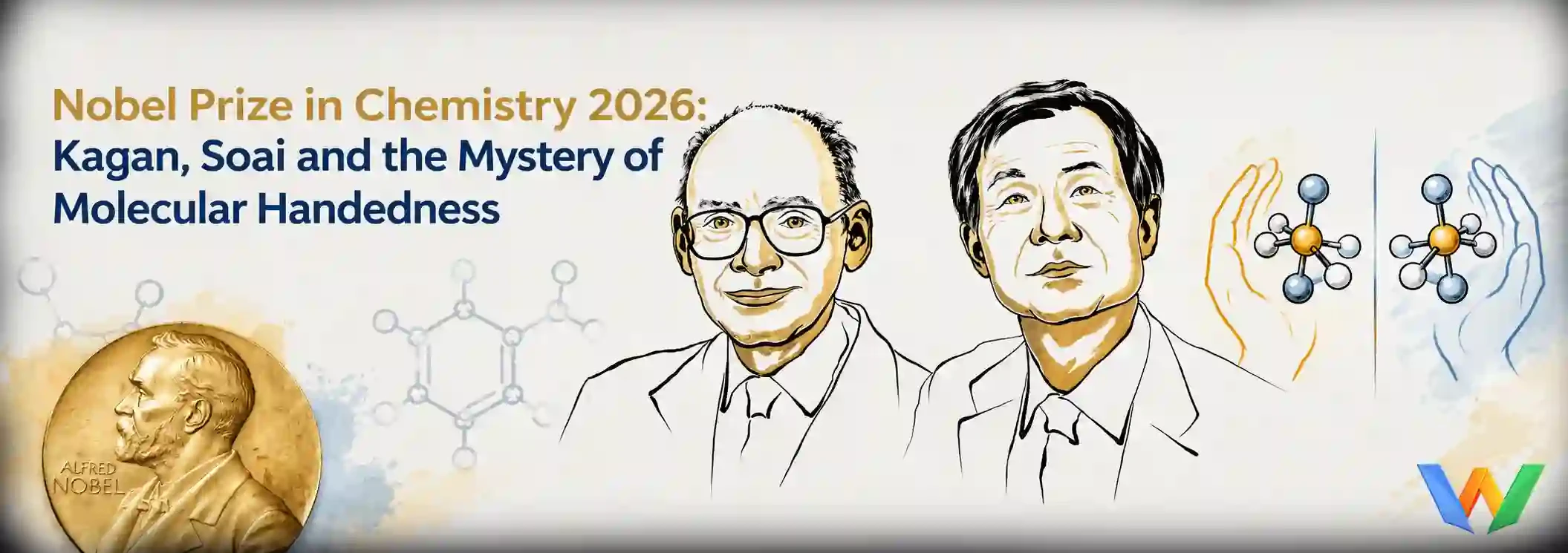
The 2026 Nobel Prize in Chemistry was awarded to Henri B. Kagan of France and Kenso Soai of Japan for “the discovery of non-linear effects and autocatalysis in asymmetric organic synthesis.” The Royal Swedish Academy of Sciences announced the award on 7 October 2026. Official announcement
Their work addresses a central question in chemistry: how a reaction can produce more of one mirror-image form of a molecule than the other.
| Detail | Information |
|---|---|
| Prize | Nobel Prize in Chemistry 2026 |
| Laureates | Henri B. Kagan and Kenso Soai |
| Announcement | 7 October 2026 |
| Research | Nonlinear effects and autocatalysis in asymmetric organic synthesis |
| Key concept | Molecular chirality, or handedness |
| Applications | Producing molecules with a desired three-dimensional form |
Some molecules exist in two forms that are mirror images but cannot be superimposed, much like left and right hands. This property is called chirality, and the two forms are known as enantiomers.
The distinction matters because biological systems are three-dimensional and selective. Two enantiomers of a compound can interact differently with enzymes, receptors or other molecules. Controlling which form is produced can be important for medicines and chemical manufacturing.
Kagan's research showed how nonlinear effects in asymmetric synthesis can amplify a small imbalance in a chiral catalyst into a larger imbalance in reaction products. The ratio of mirror-image products does not always simply match the ratio of the catalyst's two forms.
This work provided an important way to understand and control selectivity in chemical reactions.
Soai developed a reaction in which a chiral product also acts as a catalyst, helping generate more product with the same handedness. This is called asymmetric autocatalysis. Under suitable conditions, a small initial imbalance can be amplified as the reaction proceeds.
The Soai reaction is a key experimental example in research on how chemical systems can develop a strong preference for one mirror-image form. It does not, by itself, prove exactly how life began or why biological handedness emerged.
Many medicines contain chiral molecules. Methods that control the ratio of enantiomers help chemists manufacture compounds with desired properties.
Asymmetric synthesis can reduce the need to separate unwanted mirror-image products and improve the efficiency of producing complex molecules.
Scientists investigate how early chemical systems could have developed the strong handedness seen in biological molecules. The Kagan and Soai findings provide useful principles, but the precise path from prebiotic chemistry to life remains an open research question.
It helps explain how small imbalances can grow into large ones under certain reaction conditions. It does not establish a complete account of why life on Earth uses particular handed forms. Researchers continue to investigate prebiotic pathways, environmental influences and the chemistry of early Earth.
Henri B. Kagan and Kenso Soai shared the prize for discoveries in nonlinear effects and autocatalysis in asymmetric organic synthesis.
Chirality means that a structure and its mirror image cannot be superimposed, like left and right hands.
Autocatalysis occurs when a reaction product helps catalyse the reaction that produces more of that product.
Mirror-image molecules can interact differently with biological targets, so controlling molecular form can matter in drug design and production.
The 2026 Chemistry Nobel recognises Kagan and Soai's contributions to understanding how reactions can favour one molecular mirror image over another. Their discoveries have practical value in asymmetric synthesis and offer insight into a longstanding question about the handedness of life's molecules, while leaving important questions about the origin of biological chirality open.
This article was authored and reviewed by Wipidia's technical editorial desk in Jalandhar, Punjab. Every code snippet, algorithm breakdown, and strategic framework is independently tested against live production standards before publication.
