•
•
•
•
•
•
•

JWST observations and a technique called transmission strings reveal that the hot Jupiter WASP-17b has an uneven atmospheric edge shaped by extreme heat and winds.
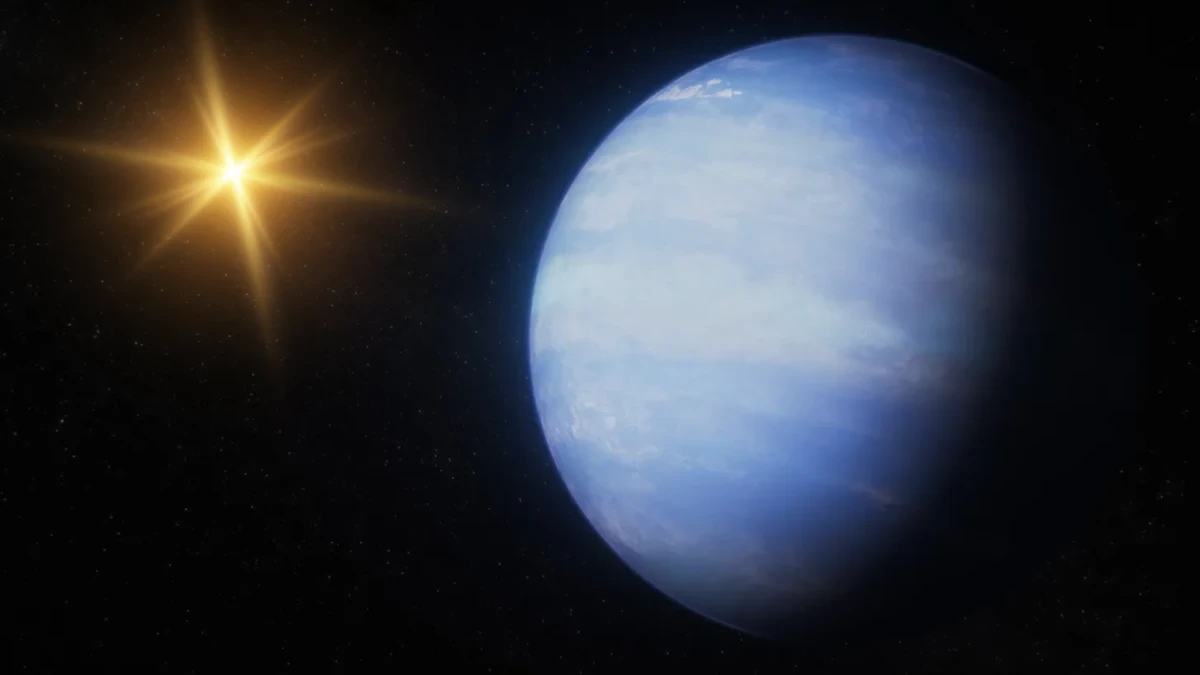
Astronomers used NASA’s James Webb Space Telescope (JWST) to measure an uneven atmospheric edge around WASP-17b, a hot Jupiter roughly 1,300 light-years from Earth. Instead of assuming that the atmosphere has the same apparent extent all the way around the planet, researchers mapped differences around its limb. The results show an asymmetry consistent with strong heating and winds on this extremely hot world.
The research was published in Nature Astronomy in October 2026. It is a measurement-based reconstruction of the atmosphere, not a conventional photograph of the planet.
| Detail | Finding |
|---|---|
| Planet | WASP-17b |
| Planet type | Hot Jupiter |
| Distance | About 1,300 light-years |
| Telescope | James Webb Space Telescope |
| Technique | Transmission strings mapping |
| Journal | Nature Astronomy |
| Main result | Atmospheric extent differs around the planet’s limb |
WASP-17b is a gas giant that orbits very close to its host star. Its intense irradiation makes its atmosphere extremely hot. Like other close-in giant planets, it is expected to experience large temperature contrasts and powerful atmospheric circulation.
On a planet with such conditions, winds can carry heat from the star-facing region towards the cooler side. Differences in temperature change how much the gas expands, which can affect the apparent height of the atmosphere.
During a transit, a planet passes in front of its star from our viewpoint. A small amount of starlight travels through the planet’s atmosphere before reaching a telescope. Different gases absorb light at different wavelengths, giving astronomers information about the atmosphere.
Earlier analyses often simplified the atmospheric edge as a uniform ring. The newer method allows the inferred atmospheric radius to vary around the limb. Researchers found that one side extends farther than the other, revealing structure that an averaged measurement could hide.
This is not evidence that the planet itself is shaped like an egg. The finding concerns the measured extent of its atmosphere.
Transmission strings is a mapping technique developed by researchers at the University of Bristol. It analyses transit observations while allowing the atmospheric radius to vary with position around the planet’s edge. This provides a more detailed view of atmospheric asymmetries than a model that assumes a uniform limb.
The method complements other techniques, including eclipse mapping, which studies changes in light as a planet passes behind its star. Together, such observations can help researchers investigate how temperature, winds and atmospheric chemistry vary across distant worlds.
The published study reports a substantial temperature-related difference between the morning and evening atmospheric limbs. The inferred thermal scale height is consistent with a hotter, more extended evening side and a cooler morning side. The result agrees with expectations that winds transport heat around the planet.
These measurements help constrain models of the planet’s atmospheric circulation. They do not mean that researchers have directly watched individual winds or photographed the atmosphere’s shape; the map is inferred from telescope data and a physical model.
Exoplanet atmospheres are three-dimensional systems. A single average temperature or spectrum can conceal differences between regions. Mapping asymmetries gives scientists another way to test atmospheric models against observations.
WASP-17b is particularly useful because it is a strongly irradiated gas giant with a detectable atmosphere. Techniques developed on such planets may help astronomers study other exoplanets, although smaller rocky planets are harder to measure because their signals are much weaker.
No. WASP-17b is an extremely hot gas giant and is not considered an Earth-like habitable world. This research concerns atmospheric structure, heat transport and the tools astronomers use to study exoplanets. It is not evidence of life.
It is approximately 1,300 light-years from Earth.
No. Researchers inferred the atmospheric structure from starlight measured during a planetary transit.
It is a method that allows astronomers to map changes in the apparent atmospheric radius around a planet’s limb.
The observed pattern is consistent with temperature differences and winds that redistribute heat around the planet.
In Nature Astronomy in October 2026.
The WASP-17b study shows how JWST data and a more detailed mapping method can reveal atmospheric differences hidden by simpler averages. By measuring an uneven atmospheric edge, researchers gain a stronger way to test ideas about heat and winds on hot Jupiters. The result is a step forward in exoplanet atmospheric science—not a direct image of the planet and not a discovery of extraterrestrial life.
This article was authored and reviewed by Wipidia's technical editorial desk in Jalandhar, Punjab. Every code snippet, algorithm breakdown, and strategic framework is independently tested against live production standards before publication.
