•
•
•
•
•
•
•

A fact-focused review separates the reported allegation from the public denial and explains what evidence is—and is not—available.
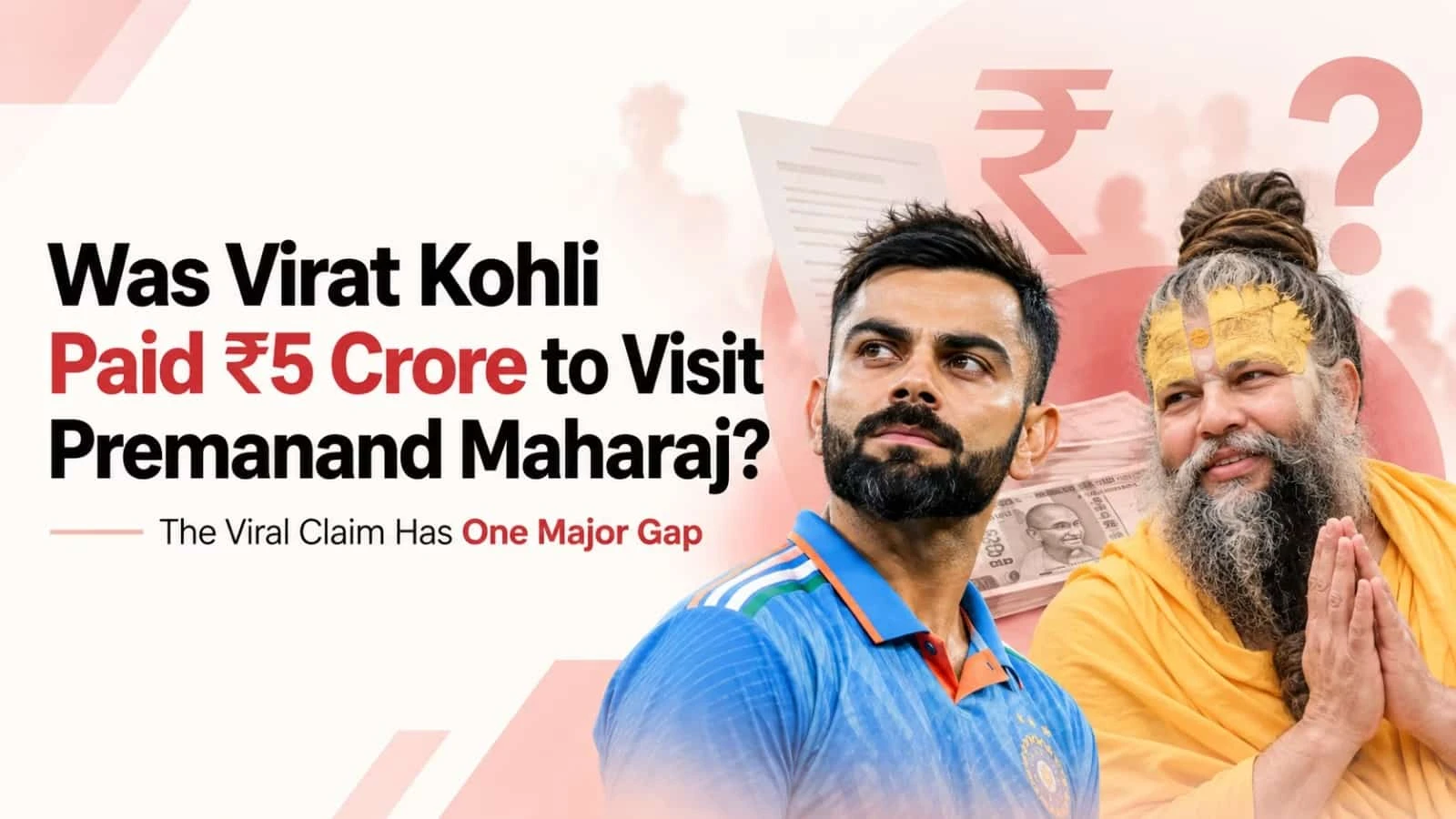
A claim circulated in October 2026 alleging that Indian cricketer Virat Kohli received ₹5 crore in connection with a visit to spiritual leader Premanand Maharaj's ashram in Vrindavan. The figure attracted attention online, but it is important to distinguish an allegation from an established fact. Kohli's spokesperson publicly rejected the claim, describing it as false and baseless. Public reporting has not produced verified payment documentation establishing that Kohli received the amount.
This article separates the main points that can be attributed to published reporting from details that remain unproven. Because the allegation concerns a named individual and a potentially damaging financial claim, it should not be repeated as fact without reliable evidence.
Reports published on October 6 and 7, 2026, attributed the allegation to Dinesh Sharma, also known as Falahari Maharaj. The reports said he alleged that a Rajasthan-based private company or people associated with a property-related group had spent ₹5 crore to facilitate Kohli's visit. The claim was discussed in connection with a letter reportedly sent to Uttar Pradesh Chief Minister Yogi Adityanath.
Those details describe what news reports attributed to the person making the allegation; they do not independently prove that money changed hands. A reported claim, a letter containing an accusation, and a verified financial transaction are different kinds of evidence. A responsible account must preserve that distinction throughout the story.
News organisations reported that Kohli's spokesperson strongly denied the allegation on October 7, 2026. The statement described the claims as “completely false, baseless and factually incorrect” and said Kohli visits Premanand Maharaj out of personal faith and reverence. The spokesperson also urged media organisations to verify claims before reporting or amplifying them.
That denial is a relevant and attributable response and should be included whenever the allegation is discussed. It does not require a publisher to speculate about motives or add unverified explanations. The most accurate summary is that an allegation was reported, Kohli's representative rejected it, and publicly available reporting has not established the claimed payment through independent documentary evidence.
Kohli and his wife, actor Anushka Sharma, have been publicly seen visiting Premanand Maharaj in Vrindavan on multiple occasions. Reports place an early visit in January 2023, with further visits in later years. These visits are a separate, documented matter from the claim about money.
A photograph or video showing a visit cannot establish whether a payment was made. Likewise, the existence of a spiritual relationship does not prove or disprove a separate financial allegation. Each claim requires evidence suited to the question being asked.
For a specific payment claim, useful evidence could include authenticated contracts, invoices, financial records, a clear statement from a directly involved party, or findings from a credible investigation. Documents would need to be assessed for authenticity, context and whether they show that the money was actually paid to the named person rather than discussed, promised or spent by a third party.
As of the published reporting referenced here, there is no publicly verified payment record establishing that Kohli personally received ₹5 crore for the visit. This is not the same as claiming access to every private record. It means the claim has not been substantiated by evidence available in the cited public reporting.
Social platforms can strip away context as a claim is copied from one post to another. A headline may present an allegation in question form, while a repost turns it into a confident statement. Images of a real event can then be used to imply that an unrelated claim is confirmed.
Readers can reduce this risk by checking the original report, identifying who made the claim, looking for the response from the person concerned and checking whether independent evidence is supplied. A report that repeats an allegation is not necessarily independent confirmation of it. Several outlets may be relying on the same original source.
| Date or period | What reporting indicates | What it does not prove |
|---|---|---|
| January 2023 | Kohli and Anushka Sharma were reported to have visited Premanand Maharaj | That any payment was made |
| October 6, 2026 | Reports circulated the ₹5 crore allegation | That the allegation was verified |
| October 7, 2026 | Kohli's spokesperson publicly denied the claim | Independent access to private financial records |
| At the time of this update | Public reports did not establish a verified payment record | That every possible private document has been examined |
The claim was publicly denied by Kohli's spokesperson. Publicly available reporting cited here has not established that Kohli received the money, so it should not be stated as a confirmed payment.
News reports attributed it to Dinesh Sharma, also known as Falahari Maharaj. This identifies the reported source of the allegation, not proof that it is true.
Yes, media reports have documented visits by Kohli and Anushka Sharma. The visits themselves do not verify the separate financial claim.
Financial allegations about identifiable people can cause reputational harm if presented as fact without evidence. Accurate reporting labels claims, includes relevant responses and explains what remains unverified.
The ₹5 crore claim should be treated as an allegation that Kohli's spokesperson has explicitly denied, not as an established payment. The public record described in the cited reporting confirms that the allegation circulated and that a denial was issued, but does not establish that Kohli received the money. If new authenticated evidence or an official finding becomes available, the article should be updated with the source and date rather than relying on social-media repetition.
This article was authored and reviewed by Wipidia's technical editorial desk in Jalandhar, Punjab. Every code snippet, algorithm breakdown, and strategic framework is independently tested against live production standards before publication.
