•
•
•
•
•
•
•

Veteran Bollywood and Marathi actor Nana Patekar has died at 75 in Goa after a reported cardiac arrest, leaving behind a remarkable legacy in Indian cinema.
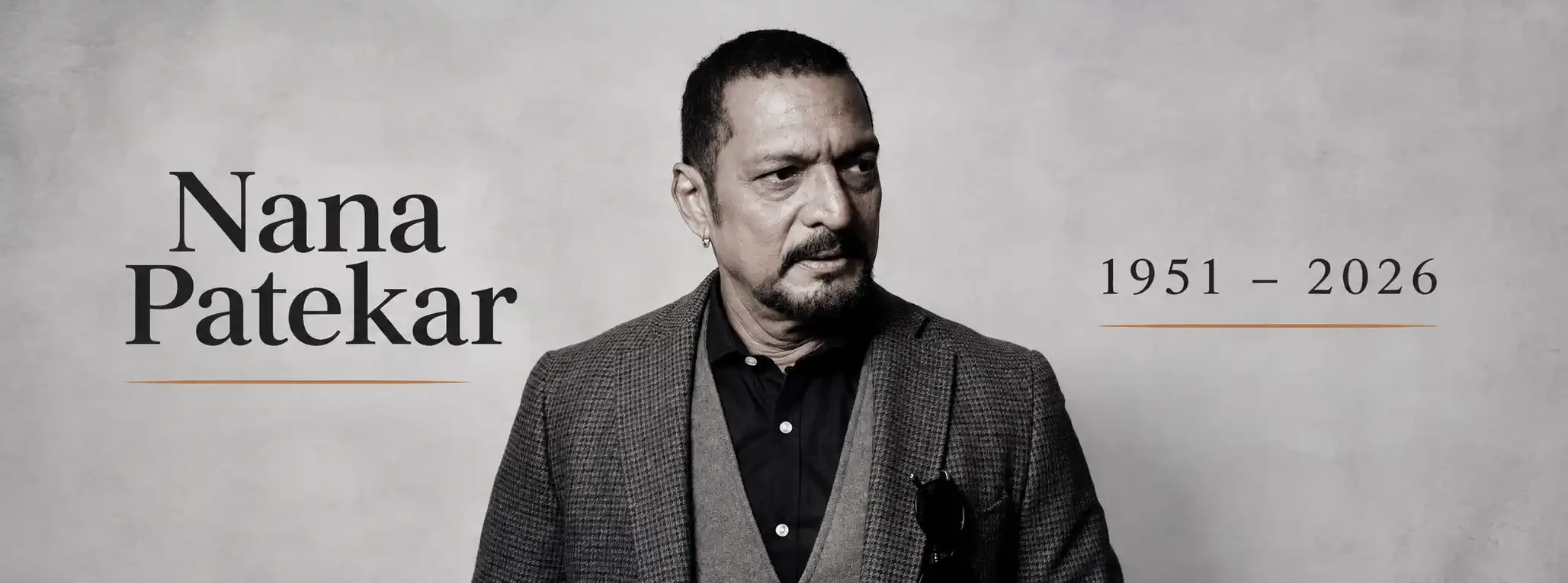
Indian cinema has lost one of its most distinctive and respected performers. Nana Patekar, the veteran actor known for powerful performances across Hindi and Marathi cinema, died on Thursday, October 8, 2026, at the age of 75.
Patekar was found unconscious at his residence in Dona Paula, Goa, during the early hours of Thursday. He was subsequently taken to Manipal Hospital, where doctors attempted to revive him. According to hospital officials, medical teams performed CPR for approximately 45 minutes, but the actor could not be revived. He was declared dead at around 5:20 a.m.
The cause of death has been reported as cardiac arrest, although a post-mortem examination has been ordered as part of the medico-legal process to establish the exact cause.
The news has triggered an outpouring of grief across Bollywood, Marathi cinema, theatre and Indian entertainment, with political leaders and fellow actors remembering Patekar's extraordinary contribution to the arts.
Born Vishwanath Patekar in Maharashtra in 1951, Nana Patekar developed his craft through theatre before establishing himself as one of India's most respected screen actors.
Unlike conventional Bollywood stars, Patekar built his reputation largely through the strength of his acting rather than traditional leading-man image. His ability to portray troubled, aggressive, vulnerable, authoritative and morally complex characters made him one of the most recognisable performers in Indian cinema.
His career stretched across Hindi and Marathi films, theatre and filmmaking.
Patekar made his Hindi film debut with Gaman in 1978, beginning a journey that would eventually make him a household name across generations of Indian movie audiences.
Patekar's rise coincided with a period when Indian cinema increasingly embraced realistic and unconventional storytelling.
His performances in films such as Parinda, Prahaar: The Final Attack, Krantiveer, Agni Sakshi, Khamoshi: The Musical, Ab Tak Chhappan, Apaharan and Natsamrat demonstrated his extraordinary range.
One of his most internationally recognised performances came in Mira Nair's Salaam Bombay!, which received global acclaim and an Academy Award nomination for Best Foreign Language Film.
Patekar was equally comfortable playing a serious dramatic character or a larger-than-life commercial role.
His work in mainstream cinema later introduced him to younger audiences through films such as Welcome, where his portrayal of Uday Shetty became one of the most memorable comic gangster characters in Hindi cinema.
That ability to move between intense drama and comedy was a major part of what made Nana Patekar unique.
Throughout his career, several Nana Patekar films became particularly important to his legacy.
Directed by Vidhu Vinod Chopra, Parinda is widely regarded as one of the defining crime dramas of its era. Patekar's performance contributed significantly to the film's dark and realistic atmosphere.
Patekar's performance in Krantiveer remains one of his most celebrated roles. The film earned him the National Film Award for Best Actor, further establishing his position among India's leading performers.
Patekar also directed and starred in Prahaar: The Final Attack, a military drama exploring the lives, discipline and struggles of soldiers.
The film reflected his long-standing interest in socially grounded storytelling and gave audiences another example of his work beyond conventional commercial cinema.
His performance in Agni Sakshi earned Patekar another National Film Award, this time for Best Supporting Actor.
The role demonstrated his ability to create tension and emotional complexity without relying solely on conventional heroic characters.
The Marathi film Natsamrat became another landmark in Patekar's career.
Adapted from V. V. Shirwadkar's acclaimed Marathi play, the film explored ageing, family relationships, identity and the emotional struggles of a retired stage actor.
Patekar's performance was widely praised for its emotional depth and theatrical intensity.
While Patekar had already established himself as a serious actor, Welcome introduced another side of his personality to mainstream audiences.
His portrayal of Uday Shetty became an enduring part of Indian pop culture, with his dialogue delivery and comic timing turning the character into one of Bollywood's most recognisable comedic figures.
Nana Patekar's contribution to Indian cinema was recognised with some of the country's most prestigious honours.
He won three National Film Awards, India's highest film awards, across acting categories during his career.
He was also awarded the Padma Shri in 2013 for his contribution to cinema and the arts.
His achievements extended beyond mainstream Hindi cinema, with significant contributions to Marathi theatre and Marathi films.
This combination of theatre, regional cinema, Bollywood and filmmaking made Patekar's career unusually broad.
What separated Nana Patekar from many of his contemporaries was his unmistakable screen presence.
His acting was often intense and direct. He could deliver a line with minimal movement and still dominate an entire scene.
His voice, expressions and ability to communicate anger, pain or vulnerability became central elements of his performances.
At the same time, Patekar was not limited to one style.
He could portray a hardened soldier in one film, a troubled dramatic character in another and a comic antagonist in a mainstream entertainer.
That versatility helped him remain relevant across different generations of Indian cinema.
From art-house films and serious dramas to Bollywood blockbusters and Marathi cinema, Patekar repeatedly demonstrated that strong character acting could command the centre of the screen.
Patekar's death came only days after one of his final public appearances in Goa.
On October 4, he attended and addressed an installation ceremony connected with Samraat Club International in Dona Paula. During the event, he spoke about performing arts, life and the importance of contributing something meaningful to society.
His remarks have received renewed attention following his death because he spoke about the uncertainty of life and the fact that everyone eventually has to leave.
The event became one of the final public appearances of an actor who had spent decades engaging audiences through cinema and theatre.
News of Patekar's death prompted tributes from across India's political and entertainment circles.
Prime Minister Narendra Modi expressed condolences, praising Patekar's versatility and creativity and noting the lasting impact of the characters he portrayed.
President Droupadi Murmu also mourned the actor's death, describing his performances as powerful and evocative and highlighting his contribution to Indian cinema and social service.
Actors and filmmakers from Hindi and Marathi cinema have also remembered Patekar as an exceptionally talented performer whose approach to acting was difficult to replicate.
His death represents a significant loss not only for Bollywood but also for Marathi theatre and Indian performing arts.
The Maharashtra government has announced that Nana Patekar will be accorded a state funeral in recognition of his contribution to Marathi theatre and Hindi and Marathi cinema.
His last rites are scheduled to be performed at Donje near Pune, where he had a close association with his farmhouse. The cremation is expected to take place with full state honours.
The decision reflects the scale of Patekar's contribution to India's cultural landscape.
Patekar's influence was not restricted to acting.
Over the years, he was also associated with theatre, filmmaking and social causes. His public image was notably different from that of conventional Bollywood celebrities, and he frequently maintained a relatively private lifestyle.
His performances often focused on ordinary people, social struggles, military life, crime, family conflict and moral dilemmas.
That connection with grounded characters helped him develop a loyal audience across Hindi-speaking India and Maharashtra.
The death of Nana Patekar marks the end of a remarkable chapter in Indian cinema.
From his early theatre years and 1978 film debut in Gaman to acclaimed performances in Parinda, Krantiveer, Agni Sakshi, Salaam Bombay!, Natsamrat and Welcome, Patekar created a body of work that crossed genres and generations.
He was never simply a conventional Bollywood star.
He was an actor's actor — a performer whose voice, expressions, intensity and ability to inhabit difficult characters made him instantly recognisable.
At 75, Nana Patekar leaves behind an extraordinary cinematic legacy, three National Film Awards, the Padma Shri and countless performances that remain deeply embedded in Indian popular culture.
For millions of viewers, his films will continue to serve as a reminder of an era when powerful acting and unforgettable characters could define an entire film.
Nana Patekar may have left the screen, but his performances will continue to speak for generations.
