•
•
•
•
•
•
•

Lionel Messi’s journey from Rosario to Barcelona, Argentina glory and Inter Miami has made him one of the greatest footballers in history, with a career defined by records, trophies and extraordinary longevity.
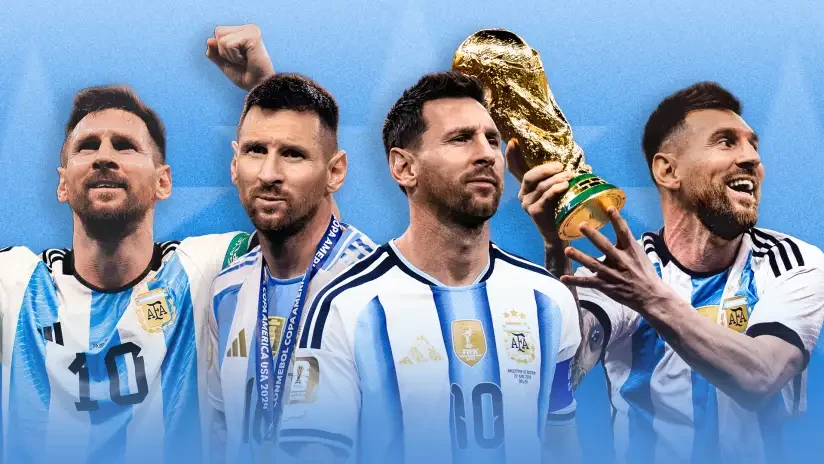
Few footballers have changed the sport as profoundly as Lionel Messi.
For more than two decades, his name has been associated with extraordinary dribbling, impossible goals, precise passing, creative genius and a level of consistency rarely seen in professional football.
Born in Rosario, Argentina, on June 24, 1987, Messi grew up in a football-loving family. His connection with the game began remarkably early, and by childhood it was clear that he possessed an unusual relationship with the ball. The Argentine Football Association records that he began playing organised football at just four years old before joining Newell's Old Boys as a youngster.
The child from Rosario would eventually become FC Barcelona's greatest player, Argentina's all-time leading scorer, a World Cup winner and an eight-time Ballon d'Or recipient.
In October 2026, Messi is also preparing to close the international chapter of his career. He is scheduled to play his final Argentina match against Benin at Buenos Aires' Estadio Monumental on October 6, bringing an emotional conclusion to more than two decades with the national team.
But to understand why the moment matters, it is necessary to go back to where the story began.
Lionel Andrés Messi was born in Rosario, Santa Fe, Argentina, into a family where football was central to everyday life.
His father, Jorge Messi, worked in a factory and was involved in youth football, while his mother, Celia, played an important role in supporting the family. Messi was the third of four children.
From an early age, his small stature contrasted sharply with his ability on the football field.
At around four years old, he began playing for Abanderado Grandoli, a local club in Rosario. He later joined Newell's Old Boys, where his extraordinary goal-scoring ability became increasingly obvious. According to the AFA, Messi scored 234 goals in 176 matches during his time in Newell's youth setup.
Yet Messi's childhood also involved a significant challenge.
He was diagnosed with a growth hormone deficiency, requiring expensive medical treatment. At the age of 13, an opportunity arrived that would completely change his life: FC Barcelona offered him a place in its famous La Masia academy and agreed to help cover his medical treatment.
Messi and his family moved from Argentina to Spain.
It was a huge personal sacrifice for a young teenager who was leaving his hometown, friends and familiar surroundings behind.
But Barcelona had discovered a player who would eventually redefine the club's history.
Messi joined Barcelona's youth system at just 13 years old.
His progress through the academy was extraordinary. He eventually made his first-team debut during the 2004-05 season, becoming one of the youngest players to appear for the club.
His first Barcelona goal came in May 2005 against Albacete.
What followed was one of the most extraordinary individual careers in football history.
Messi gradually evolved from a gifted teenage winger into a complete attacking footballer capable of playing almost anywhere across the forward line.
His low centre of gravity, acceleration, close control and ability to change direction made him extremely difficult to defend.
But his greatest quality was perhaps his football intelligence.
Messi did not simply dribble past opponents. He appeared to understand spaces before they opened.
He could drop into midfield, create chances, score from distance, deliver through balls, combine in tight areas and finish attacks himself.
At Barcelona, he became the central figure of one of the greatest club sides ever assembled.
The club won multiple La Liga titles, Copa del Rey trophies and UEFA Champions League titles during his era. Barcelona's official profile credits Messi with four Champions League titles and 10 La Liga championships during his time at the club.
One of the defining moments of Messi's career came in 2009.
Barcelona won the Champions League, La Liga and Copa del Rey, completing a historic treble.
Messi was no longer simply viewed as a promising young player.
He had become the best player on one of the best teams in the world.
That year also brought his first Ballon d'Or.
It would be the beginning of a remarkable individual-awards era.
Messi eventually won the prestigious award eight times, more than any other player. His Ballon d'Or victories came in 2009, 2010, 2011, 2012, 2015, 2019, 2021 and 2023.
If one season demonstrated Messi's extraordinary scoring ability, it was 2012.
He produced goal after goal for Barcelona and Argentina and finished the calendar year with 91 goals, breaking Gerd Müller's long-standing record of 85 goals in a calendar year.
That achievement became one of the most recognisable statistical milestones in modern football.
Messi's game, however, was never only about goals.
He became equally famous for his assists, chance creation, vision and ability to control matches.
This combination is one reason the Lionel Messi vs Cristiano Ronaldo debate became one of the defining sporting rivalries of the 21st century.
Ronaldo represented extraordinary athleticism, aerial ability, finishing and physical power.
Messi represented close control, creativity, acceleration, passing and an almost instinctive understanding of space.
Both became record-breaking superstars.
But Messi's unique combination of scoring and playmaking eventually made him one of the most complete attacking players football has ever produced.
Messi's club success did not immediately translate into acceptance with the Argentina national team.
In fact, his relationship with Argentina was complicated for many years.
Because Messi moved to Spain as a teenager, some Argentine supporters questioned whether he truly belonged to the national-team culture.
There were also comparisons with Diego Maradona, perhaps the most revered footballer in Argentina before Messi.
For years, Messi was criticised for failing to win a major senior international trophy despite repeatedly reaching finals.
He lost the 2014 FIFA World Cup final to Germany and then suffered consecutive Copa América final defeats in 2015 and 2016.
The criticism became so intense that after the 2016 Copa América final, Messi briefly announced his retirement from international football.
That decision lasted only a short time.
Argentina needed Messi — and Messi ultimately chose Argentina again.
Reuters has described his relationship with the country as a gradual transformation from scepticism to deep affection. The player who was once questioned by supporters eventually became a symbol of national pride.
Everything changed at the 2021 Copa América.
Argentina defeated Brazil in the final at the Maracanã, giving Messi his first major senior international trophy with Argentina.
For Messi personally, it was enormously important.
He had reached international finals before, but now he finally had a major trophy with his country.
The victory also changed the public conversation around his international career.
The question was no longer whether Messi could win with Argentina.
He had finally done it.
Then came the defining chapter.
At the 2022 FIFA World Cup in Qatar, Messi led Argentina through one of the most dramatic tournament campaigns in football history.
Argentina lost their opening match to Saudi Arabia, immediately creating doubts about their chances.
But Messi and his teammates responded.
They progressed through the tournament, defeated the Netherlands in a dramatic quarter-final, overcame Croatia in the semi-final and reached the World Cup final against France.
The final became an instant classic.
Messi scored twice, while Argentina eventually defeated France on penalties after the match finished 3-3 following extra time.
At last, Messi was a FIFA World Cup champion.
He had achieved the trophy that had been missing from his collection.
Messi also won the Golden Ball as the tournament's best player, becoming the first player to win the award twice.
The World Cup triumph dramatically changed his place in football history.
For many supporters, it ended the argument over whether Messi could be considered alongside Maradona and the greatest players of all time.
The term GOAT — Greatest of All Time — is subjective, especially in a sport with different generations and playing styles.
Yet Messi's case is unusually strong.
His legacy combines:
But statistics alone do not explain Messi's reputation.
What makes him different is how he played.
His dribbling was not based simply on speed. He could manipulate defenders with body movement, changes of direction and tiny touches.
His passing was not simply accurate. He frequently saw opportunities before other players recognised them.
His finishing was similarly diverse: left-footed strikes, chips, curling efforts, close-range finishes, free kicks and one-on-one combinations.
That complete attacking package is central to the argument that Messi is the greatest footballer ever.
After 17 seasons with Barcelona, Messi's relationship with the club came to an emotional end in 2021.
Barcelona announced that it could not renew his contract because of financial and La Liga regulatory restrictions.
Messi then joined Paris Saint-Germain.
At PSG, he played alongside stars including Neymar and Kylian Mbappé.
The move was very different from his Barcelona years, but Messi still helped the club win domestic honours.
His two seasons in Paris also demonstrated how his game was evolving.
Rather than relying solely on explosive dribbling, Messi increasingly became a creative organiser — controlling possession, finding runners and determining the rhythm of attacks.
In 2023, Messi made another historic move.
Instead of returning to Barcelona or moving to another European giant, he joined Inter Miami in Major League Soccer.
His arrival transformed the profile of American soccer.
Messi immediately became one of the biggest sporting attractions in the United States and helped generate unprecedented international attention for Inter Miami and MLS.
His first major trophy with the club came through the 2023 Leagues Cup, while his influence continued to grow.
MLS says Messi's arrival brought unprecedented global attention to Inter Miami and the league, while he has continued producing elite numbers despite being well into his late 30s.
Remarkably, Messi has also continued reaching major career milestones in Miami.
In 2026, he passed 900 career goals, another landmark in a career already filled with records.
His Inter Miami contract extends into 2028, meaning his club career can continue even after his international retirement.
The end of Messi's Argentina career is particularly emotional because of how difficult the journey once was.
On August 31, 2026, Messi announced his retirement from international football after Argentina's run to the 2026 World Cup final.
Argentina reached the final again but lost 1-0 to Spain after extra time.
Messi nevertheless produced an extraordinary tournament.
FIFA records that he scored eight goals and provided four assists during the 2026 World Cup, helping Argentina reach the final.
His final international statistics are remarkable.
Messi finishes his Argentina career as the country's record appearance maker and all-time leading scorer, with 207 appearances, 125 goals and 66 assists according to the Argentine Football Association.
His international trophy collection includes:
He also won the 2005 FIFA Under-20 World Cup and the 2008 Olympic gold medal with Argentina's Olympic side.
Messi's final Argentina appearance is scheduled for October 6, 2026, against Benin at the Estadio Monumental in Buenos Aires.
It is more than a friendly.
It is a celebration of a career that changed Argentine football.
Messi will wear the famous No. 10 shirt, a number previously associated with icons such as Maradona and Juan Román Riquelme.
Argentina's relationship with the number after Messi is complicated because FIFA tournament regulations require squad numbers to be assigned, meaning the No. 10 cannot simply disappear permanently from major competitions.
For the farewell itself, a special commemorative Argentina shirt has also been created, featuring gold detailing and tributes to Messi's extraordinary career.
The symbolism is obvious.
The player who once struggled to win Argentina's affection is now leaving the national team as its greatest statistical leader.
Perhaps the most fascinating part of Lionel Messi's biography is not his trophies.
It is his relationship with his country.
Messi left Argentina as a teenager and spent almost his entire professional career abroad.
For years, some fans believed he could never truly reproduce his Barcelona magic in the national shirt.
That perception gradually changed.
He returned after his brief retirement.
He kept playing.
He kept reaching finals.
And eventually, he started winning them.
Under coach Lionel Scaloni, Messi became the undisputed leader of a new Argentina generation.
The team became more balanced, aggressive and emotionally resilient.
Messi no longer had to carry the entire national team.
Instead, he became its conductor.
Reuters described the evolution as a long, hard-won relationship between player and country — one that developed over years rather than appearing instantly.
That may ultimately be one of the most important parts of his legacy.
Messi's playing style has evolved dramatically throughout his career.
As a teenager, he was primarily an explosive dribbler.
At Barcelona, he became a prolific goalscorer.
Under Pep Guardiola, he developed into an extraordinary attacking weapon capable of operating centrally as a false nine.
Later, he increasingly became a playmaker.
With age, Messi learned to conserve energy, walk through portions of matches, observe defensive structures and then suddenly produce the decisive pass, dribble or finish.
That tactical evolution explains why he has remained elite far beyond the age at which most footballers decline sharply.
CBS Sports' assessment of Messi's final international chapter highlighted precisely this remarkable longevity: even at 39, he remained capable of elite scoring and creative output at the highest level.
Messi's influence extends beyond statistics.
He has become a global sports icon recognised far outside football.
His name is associated with Argentina, Barcelona, the No. 10 shirt and the modern debate over sporting greatness.
For younger footballers, his career provides a blueprint built around technical ability rather than physical dominance.
For fans, his rivalry with Cristiano Ronaldo became one of the defining sporting narratives of the 21st century.
And for Argentina, his story represents perseverance.
Messi endured criticism.
He lost finals.
He briefly retired.
He returned.
He won.
And eventually, he lifted the World Cup.
There is a strange quality to Messi's career.
Even after more than two decades, his story still feels as though another chapter could exist.
He has already won almost everything football can offer.
He has broken scoring records.
He has collected individual awards.
He has won domestic championships, Champions League titles, Copa América trophies and the FIFA World Cup.
He has played in six World Cups.
He has scored more than 900 career goals.
And even at 39, he remains capable of producing moments that remind audiences why he became famous in the first place.
His Argentina farewell therefore does not necessarily represent the end of Lionel Messi the footballer.
It represents the end of Messi the Argentina international.
His club career with Inter Miami continues.
But the image of Messi wearing Argentina's blue and white, carrying the No. 10 shirt and leading his country onto the world's biggest stages is approaching its final frame.
Lionel Messi's biography is ultimately a story about much more than football success.
It is a story of a small boy from Rosario who crossed an ocean at 13, faced enormous expectations and eventually became one of the most influential athletes of his generation.
It is the story of a Barcelona teenager who became a global superstar.
It is the story of an Argentina captain who endured years of criticism before becoming a World Cup-winning national hero.
And it is the story of a footballer who continued to reinvent himself as his body and the game around him changed.
Whether someone considers Messi the greatest footballer of all time is ultimately a matter of personal opinion.
But his place among football's greatest figures is beyond serious dispute.
His combination of goals, assists, trophies, longevity, creativity, records and international success makes his career almost impossible to replicate.
As Lionel Messi prepares for his final Argentina appearance, football is not simply saying goodbye to a player.
It is marking the closing chapter of one of the greatest careers the sport has ever seen.
And perhaps the most fitting description of Messi's legacy is the simplest one:
The boy from Rosario became the No. 10 who conquered football.
