•
•
•
•
•
•
•

From a Denny's booth to leading the world's most valuable company
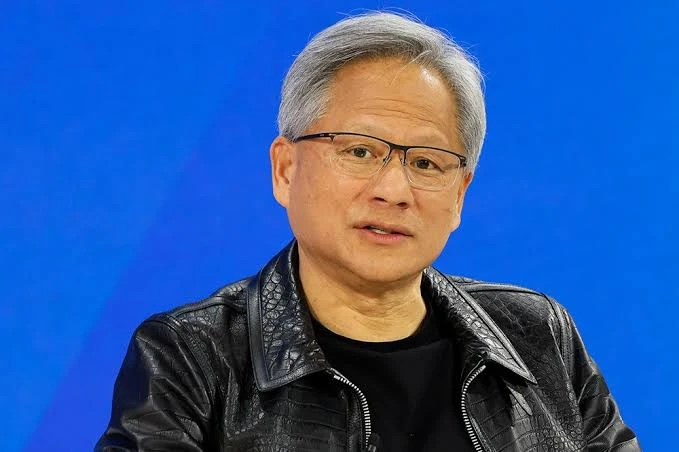
Jensen Huang is the founder and chief executive of Nvidia, the company that turned the graphics processing unit (GPU) into the engine of the artificial intelligence boom. Few business leaders have run the company they founded for more than 30 years — and fewer still have seen it become the most valuable company on Earth. Known for his signature black leather jacket, Huang has become the public face of the AI hardware era.
Huang was born on 17 February 1963 in Tainan, Taiwan, and spent part of his childhood in Thailand. At around age nine, he and his brother were sent to live with relatives in the United States and attended the Oneida Baptist Institute in rural Kentucky, where Huang has recalled cleaning bathrooms as one of his chores. His family later reunited in Oregon.
Huang earned a bachelor's degree in electrical engineering from Oregon State University in 1984 and a master's in electrical engineering from Stanford University in 1992. He worked as a chip designer at AMD and then at LSI Logic, gaining experience in microprocessor design and business.
In 1993, Huang co-founded Nvidia with engineers Chris Malachowsky and Curtis Priem — famously sketching their plans at a Denny's restaurant in San Jose. The company's mission was to bring 3D graphics to gaming and multimedia.
Early years were difficult and the company nearly failed, but the RIVA 128 and then the GeForce 256 (1999), marketed as the world's first GPU, established Nvidia as a leader in PC graphics.
In 2006, Nvidia launched CUDA, a software platform that allowed GPUs to be used for general-purpose computing, not just graphics. It was a costly, long-term bet. It paid off in 2012, when researchers used Nvidia GPUs to train AlexNet, a breakthrough deep-learning model. From then on, GPUs became the standard hardware for training AI.
When generative AI took off in the 2020s, Nvidia's data-centre chips — Hopper, Blackwell and the newer Vera Rubin platforms — became the most sought-after technology in the world.
| Year | Milestone |
|---|---|
| 1993 | Nvidia founded |
| 1999 | GeForce 256 launched; company goes public |
| 2006 | CUDA platform introduced |
| 2012 | AlexNet trained on Nvidia GPUs sparks deep-learning boom |
| 2023 | Market value passes US$1 trillion |
| 2025 | First company ever to pass US$4 trillion, then US$5 trillion |
| 2026 | Shares hit record highs; announced deal to acquire Hugging Face (Sept) |
Huang is known for a flat management structure with dozens of direct reports, a preference for open meetings over one-on-ones, and an intense, hands-on involvement in product strategy. He frequently describes Nvidia as a company always "30 days from going out of business" — a reminder to stay paranoid about competition.
Huang and his wife, Lori, whom he met at Oregon State, have two children. They have donated to Oregon State University and Stanford, including funding engineering and computing facilities.
Founding and leading Nvidia, whose GPUs power most of the world's AI systems.
Oregon State University (bachelor's) and Stanford University (master's), both in electrical engineering.
In 1993, by Jensen Huang, Chris Malachowsky and Curtis Priem.
Its GPUs and CUDA software are the standard tools for training and running large AI models.
Jensen Huang's story combines immigrant grit, engineering depth and a willingness to make long bets years before the market caught up. By building the hardware and software that made modern AI possible, he has become one of the most influential business leaders of the century.
