
.webp9dce81e5-8fb6-4c94-ab2b-e64a74992c7b.webp)
ai-search
Sep 30, 2026

Explore all verified articles and guides in Ai Search.
Showing 13–20 of 20 guides
What the new AI Mode button, longer conversational queries and falling click-through rates mean for users, publishers and businesses
Google says its AI Mode now has more than 1 billion monthly users, a scale comparable to ChatGPT, as the company places AI Mode entry points directly on the Google homepage and below AI Overviews. Research cited in September 2026 shows users write longer queries in AI Mode, trust its answers and click out far less, with significant consequences for publishers and retailers.

How optimizing for AI-generated answers differs from optimizing for a traditional list of search results
As AI-powered answer engines increasingly summarize information directly, marketers are adapting their strategies beyond traditional SEO. This guide compares answer engine optimization and traditional SEO side by side, covering how each approaches content, ranking signals, and measurement.
.webp459b3270-614e-4bcb-838a-4d8239242430.webp)
Rankings alone no longer tell the full story. Here is how to track whether AI search engines mention, cite and send traffic to your brand.
AI Overviews, AI Mode and chat assistants are changing how people find information. This guide sets out a practical measurement framework — citations, mentions, referral traffic, prompt tracking and business outcomes — for teams that need to prove AI search visibility.
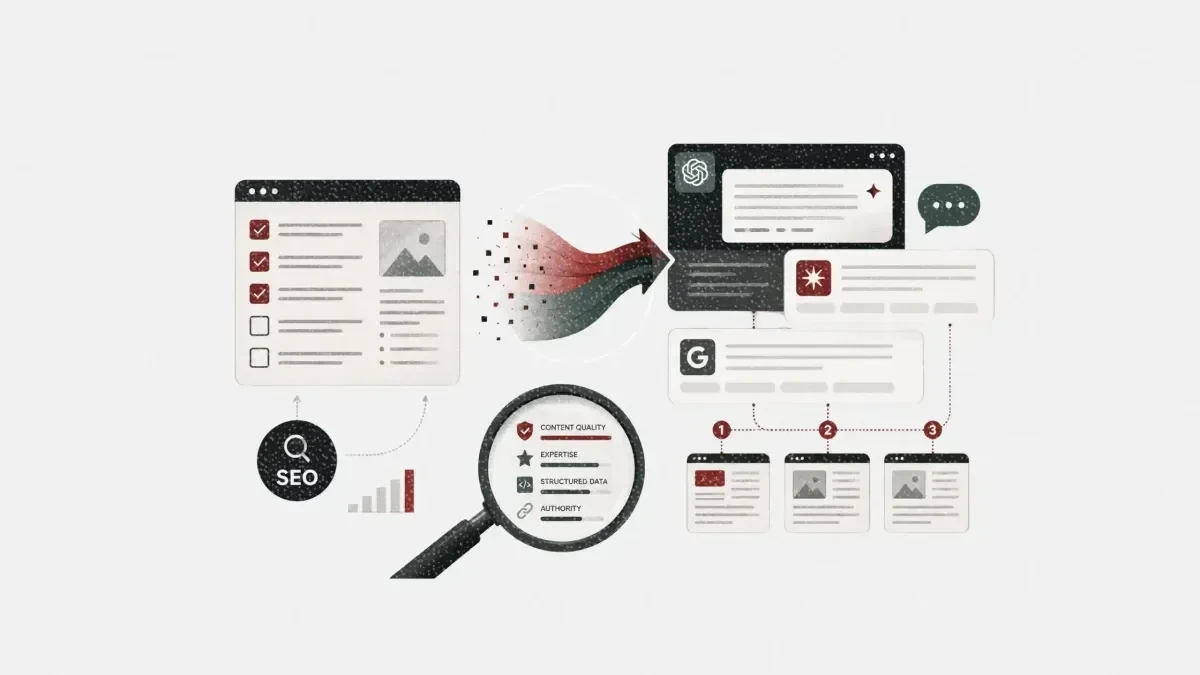
A practical checklist for evaluating whether your content is structured to be found and cited by AI answer engines
As AI-powered search tools increasingly summarize and cite web content directly, publishers need a way to evaluate their own readiness. This guide walks through a practical content audit for generative engine optimization, covering structure, clarity, and technical signals that influence whether AI systems surface a page.

Inside the shift from typed keywords to image, camera, and voice-driven search — and what it means for creators and SEO
Multimodal AI search combines text, image, and voice inputs into a single query pipeline, letting users point a camera or speak naturally instead of typing keywords. This guide explains how visual and voice search actually work, why adoption is accelerating, and what content creators need to change about images, structured data, and audio-friendly writing to stay discoverable.
How to optimize content so it gets cited by AI Overviews, ChatGPT, Perplexity, and other AI answer engines
Generative Engine Optimization (GEO) is the practice of optimizing content to be cited and surfaced by AI-powered answer engines rather than only ranked in traditional search results. This guide explains how GEO differs from SEO and how to build content that performs well in both.
.webp5ac7ed9c-15ba-413b-ab89-d14ec04216de.webp)
A practical guide to Answer Engine Optimization — how AI answer engines select and cite sources, and what to change in your content strategy to earn those citations.
Answer Engine Optimization (AEO) is the practice of structuring content so AI answer engines such as ChatGPT Search, Perplexity, and Google AI Overviews can retrieve, understand, and cite it. This guide explains how these systems actually select sources, how AEO differs from traditional SEO, and provides a practical checklist covering structured data, E-E-A-T signals, and content formatting for higher citation rates.

Nearly a quarter of Indian business leaders have already deployed agentic AI — but data governance and system integration remain the biggest roadblocks
Agentic AI — systems that can plan and execute multi-step tasks with limited human input — has moved from experimentation to real deployment inside Indian enterprises in 2026, backed by a INR 10,000 crore government mission and 40,000 GPUs. Here is what the data shows about adoption, challenges and what regulators are doing about it.
Page 2 of 2