•
•
•
•
•
•
•

Why power, transmission and permitting now limit AI growth, and what is being done about it
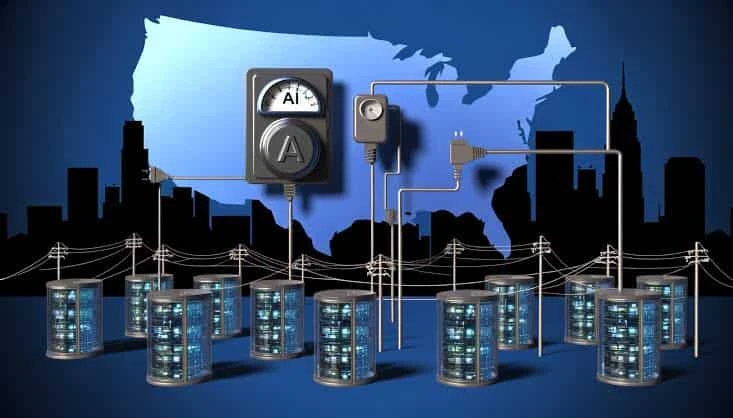
Artificial intelligence runs on concrete, copper and electricity. As AI models grow, the biggest constraint is no longer only chips. It is power infrastructure: substations, transmission lines and generation. This guide explains why AI data centers are straining electricity grids in 2026, who pays for upgrades, and what solutions are emerging.
The UN's economic commission for Europe warned in September 2026 that data-intensive technologies, especially AI data centres, are growing faster than electricity infrastructure can handle. That raises concerns about the reliability and resilience of energy systems worldwide.
The scale is striking. Big technology companies were estimated to spend around $650 billion on AI data centers in 2026, and Morgan Stanley research earlier this year projected that US data center demand could reach 74 GW by 2028, with a shortfall of about 49 GW in available power access. Developers worry about shortages in 2027 and 2028.
The core problem is speed. Data centers can be built far faster than the power networks that feed them.
| Infrastructure | Typical Timeline |
|---|---|
| Large data center facility | About 2 to 5 years |
| Grid connection in major US markets | About 3 to 4 years |
| Grid connection in northern Virginia | Up to 7 years |
| Transmission lines and grid expansion | More than 10 years |
Long planning, approval and construction processes explain the gap. Power Engineering noted that of 16 GW announced for delivery in 2026, only around 5 GW was under construction by this summer.
A major unresolved question is who should pay. Connecting large data centres can require significant infrastructure investment, but there is no consistent framework for dividing costs between developers, electricity companies and consumers. The UN commission warns that without clear rules, necessary investment may be delayed.
At the DPX 2026 conference in Washington, D.C. on September 30 to October 1, power and data center leaders debated who bears risk before infrastructure is built. One framework discussed would require certain customers to pay minimum charges based on 85% of contracted transmission and distribution demand and 60% of contracted generation demand. Utilities want credible load signals before committing capital, while hyperscalers want confidence that power will arrive on schedule.
The flagship Stargate campus in west Texas, part of a $500 billion AI infrastructure initiative backed by OpenAI, Oracle, SoftBank and MGX, is operating, but its ramp has taken longer than some early estimates. Oracle reported in September that OpenAI had taken delivery of about 75% of the capacity it is providing there. The lesson for utilities is that building completion, energization and full compute load are different milestones.
Oracle's 1.3 GW Wisconsin data center campus waits on transmission. A utility applied in September 2025 for approval of more than $1 billion in transmission infrastructure needed to serve it.
Data centers also have a large power and water footprint and generate heat and noise. By July 2026, local community resistance had blocked the construction of AI data centers worth about $130 billion, according to one tally. Local acceptance is now a core part of infrastructure planning.
For the infrastructure sector, AI demand is creating opportunities in transmission, generation, cooling, electrical equipment and construction, as well as risks from overbuilding, delays and local opposition. Morgan Stanley still finds that long-term demand for compute and power is likely to justify current investment levels.
Why do AI data centers use so much electricity?
AI computing needs dense racks of chips and heavy cooling, which together draw large, constant power.
Is the power grid the main bottleneck for AI?
Increasingly, yes. Securing grid access can take longer than building the facility itself.
Who pays for grid upgrades?
There is no consistent rule yet, which is why frameworks such as minimum demand charges are being debated.
AI's future depends on infrastructure that moves at the speed of concrete and copper, not software. The winners will be regions and companies that align power, permitting and community support early.
