•
•
•
•
•
•
•

A new crew for the ISS, 130 satellites on one rocket and the growth of military space
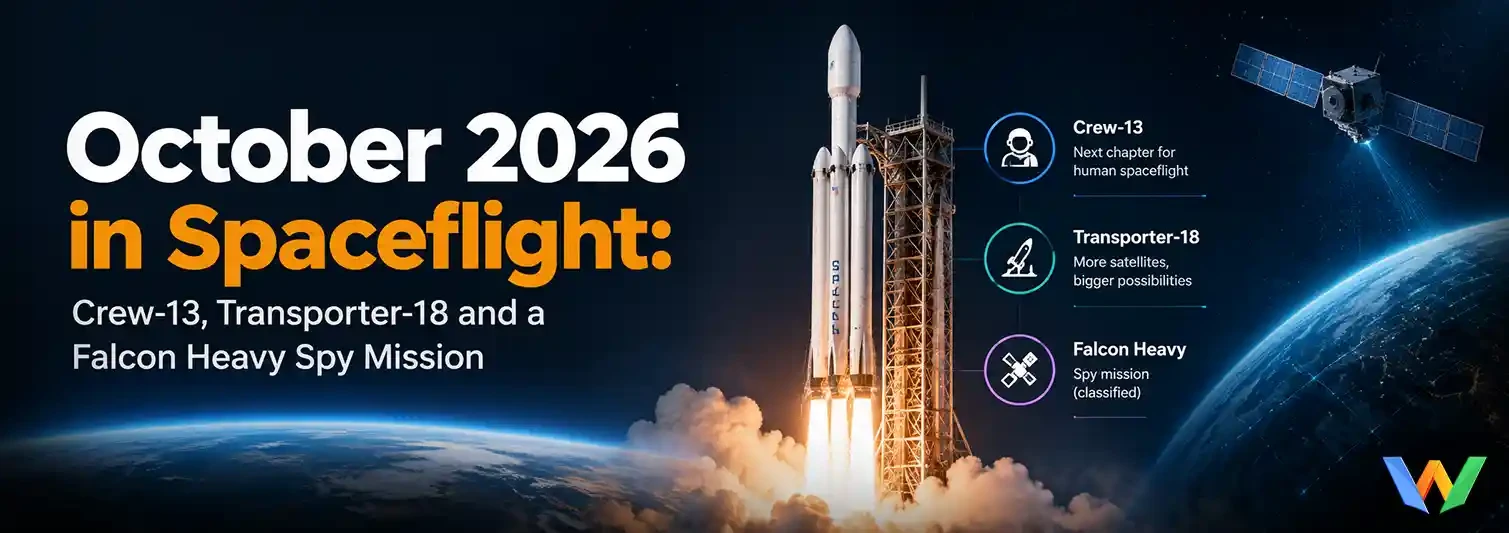
The first days of October 2026 were busy for spaceflight. On 1 October, NASA and SpaceX's Crew-13 launched four astronauts to the International Space Station (ISS) from Cape Canaveral. On the same day, SpaceX's Transporter-18 rideshare lifted off from California carrying about 130 spacecraft, and the 14th Falcon Heavy was scheduled for its first mission for the US National Reconnaissance Office (NRO). On 9 October, a Falcon 9 launched 21 data-relay satellites for the US Space Development Agency.
| Item | Detail |
|---|---|
| Launch | 1 October 2026, 11:10 a.m. EDT |
| Launch site | Space Launch Complex 40, Cape Canaveral Space Force Station |
| Rocket | Falcon 9 |
| Spacecraft | Crew Dragon |
| Mission length | About six months |
Crew:
The crew includes a Russian cosmonaut, continuing the seat-swap arrangement under which NASA astronauts fly on Russian Soyuz spacecraft and cosmonauts fly on Dragon. The arrangement has kept space cooperation going despite tensions on Earth. Kutryk's flight is part of Canada's contribution to the ISS partnership.
SpaceX's Transporter missions are rideshare flights: dozens of small satellites from different companies, universities and governments share one rocket to a Sun-synchronous orbit. Transporter-18 launched from Vandenberg Space Force Base at 11:32 a.m. PDT on 1 October with about 130 spacecraft.
Why it matters:
The 14th Falcon Heavy was scheduled to launch from Launch Complex 39A at Kennedy Space Center late on 1 October on a classified mission for the National Reconnaissance Office, the agency that operates US spy satellites. It was reported as Falcon Heavy's first mission for the NRO. Details of the payload are classified.
On 9 October, a Falcon 9 launched 21 data transport satellites for the Space Development Agency's Tranche 1 Transport Layer, part of the Proliferated Warfighter Space Architecture. The launch had been scrubbed on 4 October. The constellation is designed to relay military data quickly through many satellites in low Earth orbit instead of a few large ones.
Jessica Watkins (commander), Luke Delaney (pilot), Russian cosmonaut Sergey Teteryatnikov and Canadian astronaut Joshua Kutryk.
On 1 October 2026 at 11:10 a.m. EDT from Cape Canaveral.
A mission where many satellites from different customers share one rocket, reducing the cost for each.
The US agency that designs, builds and operates the country's reconnaissance (spy) satellites.
One week of launches in October 2026 covered most of the modern space industry: international crews on the ISS, low-cost access for small satellites, and fast-growing military constellations, with commercial rockets carrying most of the load.
