•
•
•
•
•
•
•

From a thruster-powered sports car to driverless taxis and humanoid robots, here is what Tesla has actually built this year, and what is still a promise
For most of its history, Tesla's story was about one thing: making electric cars that people wanted to buy. In 2026, the company is trying to prove it is something bigger, a builder of autonomous vehicles, humanoid robots, AI chips and energy systems, with cars as just one part of the business.
This year has brought more genuine product launches than any year since the Model 3 ramp of 2017–2018. It has also brought the familiar Tesla pattern of bold timelines, some met and some missed.
Here is a clear look at every major innovation, what has actually shipped, and what is still on the roadmap.
| Innovation | What it is | Status (October 2026) |
|---|---|---|
| Cybercab | Two-seat robotaxi with no steering wheel or pedals | In production at Giga Texas; paid rides in Austin since September |
| Robotaxi network | Driverless ride-hailing using Tesla's FSD software | Unsupervised rides in Austin, Dallas and Houston |
| Next-gen Roadster | Sports car with SpaceX-style cold-gas thrusters | Unveiled October 15; production targeted for 2028 |
| Optimus | General-purpose humanoid robot | Early production at Fremont; external sales targeted for 2027 |
| Tesla Semi | Class 8 electric truck | Volume production started in Nevada |
| AI5 chip | In-house AI processor for cars and robots | Design taped out; volume production expected 2027 |
| Megapack 3 | Grid-scale battery system | Volume production scheduled for 2026 |
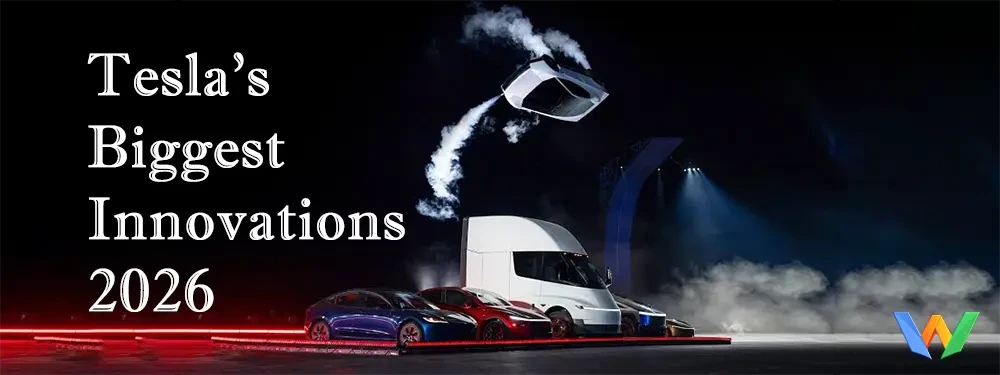
On the night of October 15, 2026, Tesla finally unveiled the second-generation Roadster, nine years after it first showed a prototype in 2017. The livestreamed event took place at SpaceX's rocket test site in McGregor, Texas, after a planned October 1 date was postponed due to severe weather.
The headline moment: the car left the ground. During the demonstration, the Roadster used suction to climb a ramp, used thrusters to flip in the air and land, and then leapt over a line-up of Tesla's other vehicles: a Cybercab, Cybertruck, Semi, Model Y and Model 3. Tesla also claimed a 0–60 mph time of under one second using its rear thrusters.
| Trim | Positioning | Reservation |
|---|---|---|
| Performance | Road-ready two-seater with active aerodynamics and suction | $50,000 |
| Thrust | Adds the thruster package | $250,000 |
| Rocket | Top trim | Invite only |
Tesla has not announced a final price for any trim.
Musk said production will begin in 2028. Given that the Roadster was originally due in 2020, many analysts treat that date cautiously. Experts in the emerging flying-car industry have also pointed out that a thruster-assisted hop is not the same as sustained flight, and road-legal certification of such a vehicle would raise complex regulatory questions.
Still, as a statement of engineering ambition, and of how closely Tesla and SpaceX now share technology, the reveal was one of the most talked-about auto launches in years.
Tesla first showed the Cybercab at its "We, Robot" event in October 2024. It is a two-seat, two-door robotaxi built entirely for autonomous driving: no steering wheel, no pedals.
In 2026, it became real:
The Cybercab's biggest innovation may be how it is built. Traditional car factories move a single body down a long line while thousands of parts are added. Tesla's unboxed process builds large sections of the vehicle in parallel and joins them near the end.
Tesla says this approach:
Musk has floated an eventual long-term target of producing a Cybercab every few seconds and has spoken of a goal of 2 million Cybercabs a year across multiple factories, though early production has been deliberately slow.
Production numbers remain small. Texas motor vehicle records showed roughly 45 Cybercabs registered to Tesla's robotaxi fleet as of August 2026. The next few quarters will show whether the unboxed process can actually scale.
Tesla's robotaxi service launched in Austin on June 22, 2025, initially with a human safety monitor in the passenger seat. 2026 is the year those monitors started to disappear:
| Date | Milestone |
|---|---|
| January 22, 2026 | First public rides without a safety monitor in Austin, starting with a small share of the fleet |
| April 2026 | Operations, including some unsupervised vehicles, extend to Dallas and Houston |
| June 2026 | Tesla reports metro-wide unsupervised service in Austin, including the airport |
Tesla has also received regulatory approval to operate ride-hailing in Arizona, and has named Phoenix, Las Vegas, Miami, Orlando and Tampa as future markets. However, in its Q1 2026 report Tesla dropped specific launch dates for those cities, replacing them with "preparations underway". Musk said the limiting factor is "rigorous validation" for safety.
Tesla's approach relies on cameras and AI only, without the lidar and detailed pre-mapping used by rival Waymo, which operates in more cities. Tesla argues its vision-only method will scale faster and cheaper. Critics argue it is harder to prove safe. US safety regulator NHTSA has continued to examine Full Self-Driving performance, particularly in low-visibility conditions, and that oversight will shape how quickly the service can expand.
Optimus is Tesla's general-purpose humanoid robot, roughly the height of an average adult, designed eventually to perform repetitive or dangerous physical tasks in factories and, Musk says, one day in homes.
Optimus has more than 10,000 unique parts, and its human-like hands have proved especially difficult to manufacture. Musk himself warned production would be "extremely slow at first". Some earlier public demonstrations used robots that were tethered to power or remotely operated by humans, which has made observers cautious about judging real autonomy.
Competition is strong. Boston Dynamics, Figure AI, Agility Robotics and fast-growing Chinese firms such as Unitree are all deploying humanoid robots in pilot programmes. Optimus's success will depend on whether it can perform useful work reliably across a full shift, not just in demos.
First unveiled in 2017 with a promised 2019 launch, the Tesla Semi spent years in limited pilot production, with early units going to customers such as PepsiCo.
In 2026, the first truck rolled off a high-volume production line at a dedicated factory next to Gigafactory Nevada. Key details:
For the logistics industry, an affordable long-haul electric truck built at scale could matter as much as any passenger car Tesla makes. It will face established rivals such as Volvo, which entered e-truck volume production years earlier.
Every self-driving Tesla and every Optimus robot depends on Tesla's in-house AI chip. The current generation in cars is AI4.
The next chip, AI5, reached key milestones in 2026:
Tesla is dual-sourcing the chip from Samsung and TSMC, a costly but deliberate choice to secure enormous future volumes. Samsung signed a reported $16.5 billion chip agreement with Tesla in 2025. Musk has set a goal of bringing a new chip design to volume production every 12 months, with AI6 already in development.
High-volume AI5 production is expected in 2027. In the meantime, Tesla plans an upgraded AI4.1 (AI4+) with more memory and bandwidth.
Tesla's energy storage business rarely makes headlines, but it keeps growing. Tesla deployed 13.7 GWh of storage in Q3 2026, about 10% more than a year earlier, and its second-best quarter ever. Megapack 3, the next generation of its grid-scale battery, is scheduled for volume production this year. As data centres and power grids demand more storage, this segment could become one of Tesla's most important.
Tesla's new ventures are funded by its car business, which has held steady in a tough market.
| Metric | Q3 2026 |
|---|---|
| Vehicles delivered | 486,532 |
| Vehicles produced | 464,391 |
| Model 3/Y deliveries | 478,237 |
| Analyst consensus | 461,974 |
| Change vs Q3 2025 | Down about 2% |
| Energy storage deployed | 13.7 GWh |
Q3 2026 was Tesla's best quarter since the US federal EV tax credit expired in September 2025, and its third-best ever. Tesla's CFO has said the company expects more than $25 billion in capital expenditure in 2026, covering Optimus lines, the Cybercab ramp, the Semi and chip research.
Tesla's history suggests some of these dates will slip. The difference in 2026 is that several long-promised products, including the Cybercab, Semi and Optimus, have moved from slides to factory floors.
The most consequential is arguably the Cybercab and the driverless robotaxi service, because they test whether Tesla can turn autonomous driving into a real business. The most eye-catching was the flying Roadster reveal on October 15.
In its demonstration, it used thrusters to lift off, flip and jump over other cars. That is a short, assisted hop rather than sustained flight, and Tesla has not shown it is certified to fly on public roads.
Musk said production will start in 2028. Reservations require $50,000 for the Performance trim and $250,000 for the Thrust trim. Final prices have not been announced.
As of October 2026, Tesla operates robotaxi service in Austin, Dallas and Houston, Texas, including rides with no safety monitor on board. Paid Cybercab rides began in Austin in September 2026.
Not yet. Tesla began early production in 2026 and aims for Optimus to be useful outside Tesla sometime in 2027. No consumer price has been confirmed.
Yes. Tesla ended Model S and Model X production at Fremont in 2026 and repurposed the line for Optimus.
Tesla delivered 486,532 vehicles in Q3 2026, beating analyst expectations of about 462,000.
2026 marks a turning point for Tesla. The company has begun building a car with no steering wheel, given paying passengers rides with nobody in the driver's seat, started producing humanoid robots and electric trucks at scale, and staged a thruster-powered sports car reveal that blurred the line between automotive and aerospace. Many of these programmes are still small, and Tesla's timelines have a history of slipping. But the gap between what Tesla promises and what it actually builds is narrower this year than it has been in a long time, and the next 12 months will show how far these innovations can scale.
