•
•
•
•
•
•
•

Understand how Model Context Protocol (MCP) connects AI applications with external tools, databases and services through a standardised communication framework.
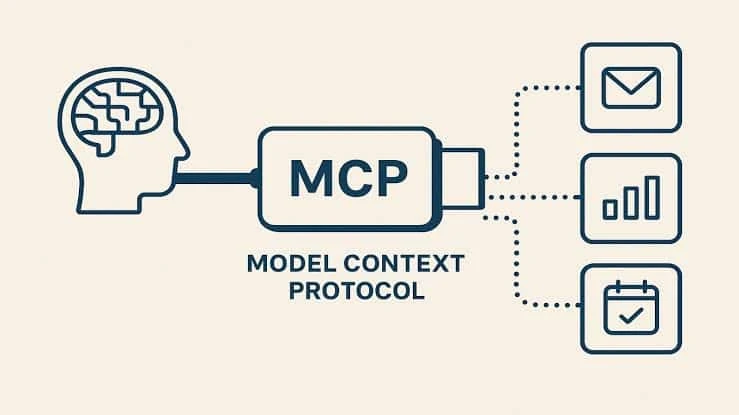
Artificial intelligence models can generate answers, analyse information and understand user instructions, but they often need access to external tools and data to complete practical tasks. Model Context Protocol (MCP) addresses this limitation by providing a standard way for AI applications to connect with external systems.
Model Context Protocol (MCP) is an open standard that allows AI applications to communicate with external tools, services and data sources through a consistent interface.
Instead of building a separate integration for every AI model and external service, developers can use MCP to establish a common connection between them.
For example, an AI assistant connected to an MCP server could retrieve information from a database, read project files, search documentation or interact with supported business applications.
MCP was introduced by Anthropic in November 2024 and is designed to make integrations easier to develop, maintain and reuse.
MCP follows a client-server architecture. Each component has a specific responsibility.
The protocol mainly involves three components:
When a user requests information or an action, the AI application can discover available capabilities through the MCP server. It can then request an appropriate tool, receive the result and use that information to respond.
For example, if a developer asks an AI assistant to check recent project activity, an MCP-connected GitHub server can provide access to relevant repository information.
MCP provides a common interface for connecting AI applications with external services. Developers do not need to create completely different integration methods for every supported application.
MCP servers can expose resources such as documents, database records, project information and other useful data. This allows AI applications to work with information beyond their built-in knowledge.
MCP supports tools that AI applications can discover and invoke. These tools can perform operations such as searching files, querying databases, creating records or interacting with external services.
Sensitive actions should require appropriate user approval and access controls.
Developers can build an MCP server once and make its capabilities available to multiple compatible AI applications. This reduces duplicated integration work and makes it easier to maintain connections.
MCP provides three important ways for servers to expose capabilities.
| Component | Purpose | Example |
|---|---|---|
| Tools | Perform actions | Create a GitHub issue |
| Resources | Provide contextual data | Read project documentation |
| Prompts | Provide reusable instructions | Generate a code review prompt |
These capabilities help developers organise how AI applications access information and interact with external systems.
MCP can support several development and business workflows.
The actual capabilities depend on the MCP server, available permissions and the AI application being used.
Connecting AI applications to external systems introduces security risks that developers must manage carefully.
An MCP server may have access to sensitive files, business records or tools that can modify external data. If permissions are too broad, an incorrect AI action or malicious instruction could expose information or cause unwanted changes.
Developers should follow these security practices:
MCP standardises communication, but it does not automatically make connected systems secure. Security still depends on how developers implement and manage each integration.
Traditional APIs allow applications to exchange information, but developers generally need to build custom integration logic for each service.
MCP introduces a standardised way for AI applications to discover and interact with external capabilities.
| Area | Traditional API Integration | MCP |
|---|---|---|
| Main purpose | Application communication | AI-to-tool communication |
| Integration | Often custom-built | Standardised protocol |
| Tool discovery | Usually developer-configured | Supported through MCP |
| Data access | API-defined endpoints | Resources and tools |
| AI compatibility | Requires integration work | Designed for AI applications |
| Reusability | Depends on implementation | Reusable MCP servers |
MCP does not replace traditional APIs. Instead, it can provide an additional layer that makes existing services easier for AI applications to use.
Model Context Protocol is an important development in AI integration because it provides a common way for AI applications to connect with external tools and information sources. It helps developers build reusable integrations and enables AI assistants to participate in practical workflows rather than simply generating responses.
As AI applications become more connected to business systems and development environments, standardised protocols such as MCP can play an important role in building more capable and useful AI-powered applications.
This article was authored and reviewed by Wipidia's technical editorial desk in Jalandhar, Punjab. Every code snippet, algorithm breakdown, and strategic framework is independently tested against live production standards before publication.
