•
•
•
•
•
•
•

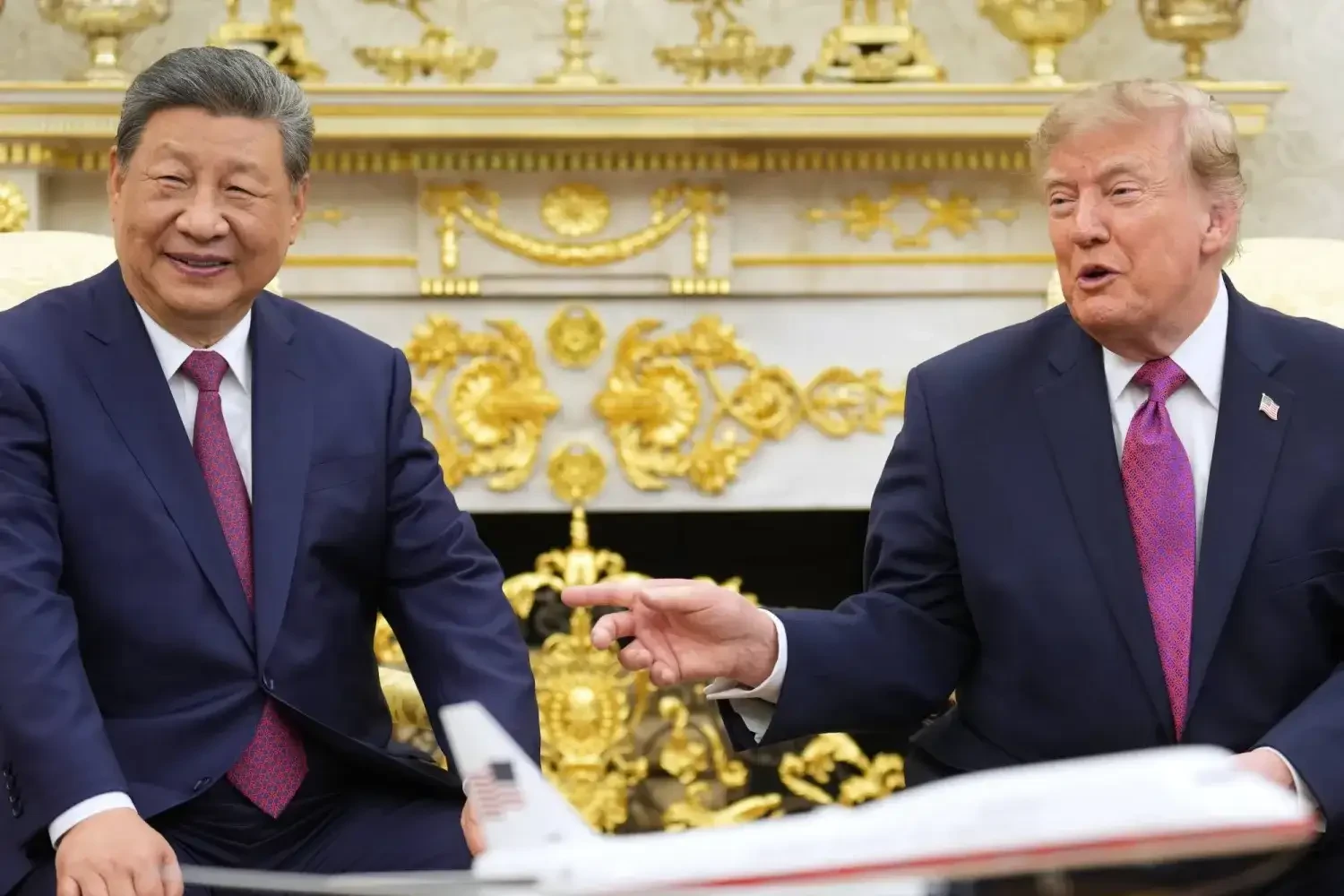
Donald Trump welcomed Chinese President Xi Jinping to the White House on Thursday for talks aimed at managing one of the world's most consequential geopolitical relationships.
The meeting brought US-China trade, artificial intelligence, Taiwan and Iran into focus as Washington and Beijing attempt to stabilise relations after years of tariffs, export controls and strategic competition. Reuters described the discussions as taking place against the backdrop of a broader US-China rivalry.
Trump described the meeting positively, while Xi called for competition between the two countries to remain within limits and warned against the so-called “Thucydides Trap” — the risk of confrontation between an established power and a rising one.
Trade was one of the most immediate areas of focus.
The US and China had already agreed to extend an existing trade arrangement, with the extension giving negotiators additional time to work through tariffs and other economic disputes. The agreement was extended from its previous November deadline to January 10, according to US Treasury Secretary Scott Bessent.
The broader trade relationship remains significant for the global economy, with disagreements involving tariffs, Chinese exports, market access and US restrictions on sensitive technologies.
For businesses and investors, the summit's most important question is whether the temporary easing of tensions can develop into a more durable US-China trade agreement.
Taiwan was another central issue.
China claims Taiwan as part of its territory, while Taiwan operates under its own democratic government. Washington maintains an unofficial relationship with Taipei and has historically supported Taiwan's ability to defend itself while maintaining a policy aimed at avoiding a direct conflict over the island.
During the summit, Xi urged Trump to oppose Taiwanese independence and handle the Taiwan issue cautiously, according to China's state news agency Xinhua. The White House had not released an equivalent detailed account of the Taiwan discussion at the time of reporting.
The issue is particularly sensitive because US arms sales to Taiwan have become part of the wider negotiations between Washington and Beijing.
Artificial intelligence has become another major area of US-China strategic competition.
Both countries view AI as important to economic growth, technological leadership and national security. However, Washington and Beijing remain divided over advanced semiconductor exports, access to computing power and regulation of AI technology.
Ahead of the summit, US and Chinese officials were already discussing AI-related issues. Reuters also identified artificial intelligence as one of the central themes surrounding the Trump-Xi meeting.
The AI discussion therefore extends beyond consumer chatbots. It also involves AI chips, semiconductor technology, data centres, national security and technological competition.
The conflict involving Iran also complicated the summit.
Washington has sought greater Chinese cooperation in dealing with Tehran, while China maintains important economic ties with Iran. According to Al Jazeera, the talks did not produce a reported breakthrough on the issue, although Xi expressed support for the US and Iran returning to an interim agreement.
This means the Trump-Xi relationship is increasingly connected to issues extending well beyond bilateral trade.
The meeting highlighted an effort by Washington and Beijing to keep communication open while disagreements remain over trade, Taiwan, technology and global security.
The two countries have strong economic links but increasingly compete over advanced technology, military influence and geopolitical power.
For now, the summit appears to have placed emphasis on dialogue and managing competition rather than resolving every major dispute.
The next stage will depend on whether the trade truce can be extended into longer-term economic arrangements and whether Washington and Beijing can establish mechanisms for handling increasingly sensitive areas such as AI and Taiwan.