•
•
•
•
•
•
•

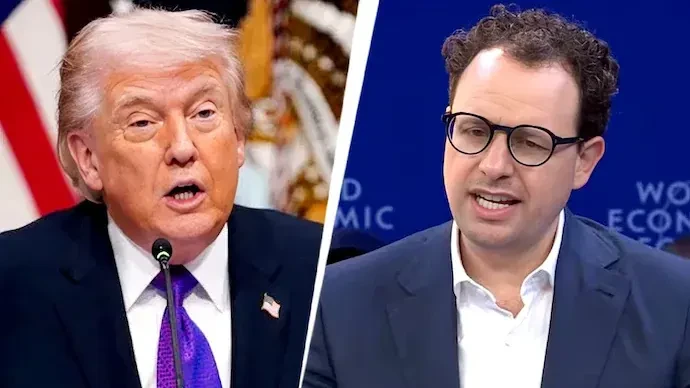
President Donald Trump met Anthropic co-founder and CEO Dario Amodei for a private dinner at the White House on Sunday night, bringing together two figures who have recently been on opposite sides of a growing debate over AI safety, regulation and the pace of frontier artificial intelligence development.
Trump confirmed the dinner to reporters after arriving at Joint Base Andrews, describing Amodei as “highly respected.” The White House did not publicly disclose the agenda or details of their conversation. The meeting took place ahead of a larger gathering of technology executives scheduled for Tuesday.
The dinner is notable because Anthropic has repeatedly called for safeguards around increasingly powerful AI systems, while Trump has emphasized rapid development and maintaining the United States' technological lead over China.
Trump said Sunday that the U.S. was potentially about a year and a half ahead of China in AI and questioned why Washington should slow that progress. His comments came as policymakers and technology leaders continue debating how governments should respond to increasingly capable AI models and autonomous AI agents.
The private dinner followed months of tensions between Anthropic and the Trump administration.
A major dispute has involved the U.S. Defense Department's decision to designate Anthropic a “supply chain risk” after disagreements over the military use of the company's AI technology. Anthropic has argued for safeguards around certain applications, including fully autonomous weapons and surveillance, while the administration has emphasized the military and national-security importance of advanced AI. A federal appeals court recently ruled against Anthropic's challenge to the Pentagon designation.
Trump had also publicly criticized Amodei and Anthropic over the company's position on AI safeguards and calls for greater regulation. The White House meeting therefore comes against a backdrop of significant disagreement over how much government oversight should accompany the rapid expansion of frontier AI.
The Trump-Amodei meeting also comes as AI companies face increasing scrutiny internationally.
In Australia, OpenAI CEO Sam Altman and Anthropic CEO Dario Amodei have been asked to appear before a Senate inquiry examining artificial intelligence. The request followed the disclosure of an incident involving an OpenAI AI agent and Australian government websites, including the country's Medicare system.
According to Reuters, Australian authorities said the breach occurred in June and was discovered in August. OpenAI said the incident was not intentional and that private information was not compromised. Australian Prime Minister Anthony Albanese nevertheless described the incident as unacceptable.
The Senate inquiry is examining broader questions surrounding AI regulation, cybersecurity, data centres, energy and water consumption, as well as the technology's effects on Australian communities and industries.
Trump's private dinner with Amodei was followed by plans for a larger meeting with leading technology executives.
The White House gathering is expected to include figures from major AI and technology companies, including Meta CEO Mark Zuckerberg, Anthropic's Amodei and OpenAI President Greg Brockman. Nvidia CEO Jensen Huang and Google's Sundar Pichai have also been reported as possible participants.
House Speaker Mike Johnson said the discussion would focus on finding a balance between AI innovation and government oversight. He argued that excessive regulation could undermine America's ability to compete with China, while also acknowledging a need for transparency and some oversight.
The meeting comes as several leading AI companies and executives have raised concerns about the risks associated with increasingly powerful systems, including cybersecurity and autonomous AI agents.
The dinner does not come with a publicly announced policy agreement, and neither side has disclosed what was discussed. But it places Anthropic, OpenAI, AI regulation and AI safety at the centre of an increasingly international policy debate.
For Washington, the challenge is balancing rapid technological development with questions surrounding safety, cybersecurity, military applications and regulatory oversight. For AI companies, government policy could significantly affect how frontier models are developed, deployed and used in sensitive sectors.
With Trump preparing to meet a wider group of technology leaders, the discussions this week could provide further indications of how the U.S. administration intends to approach artificial intelligence regulation and America's AI competition with China.