•
•
•
•
•
•
•

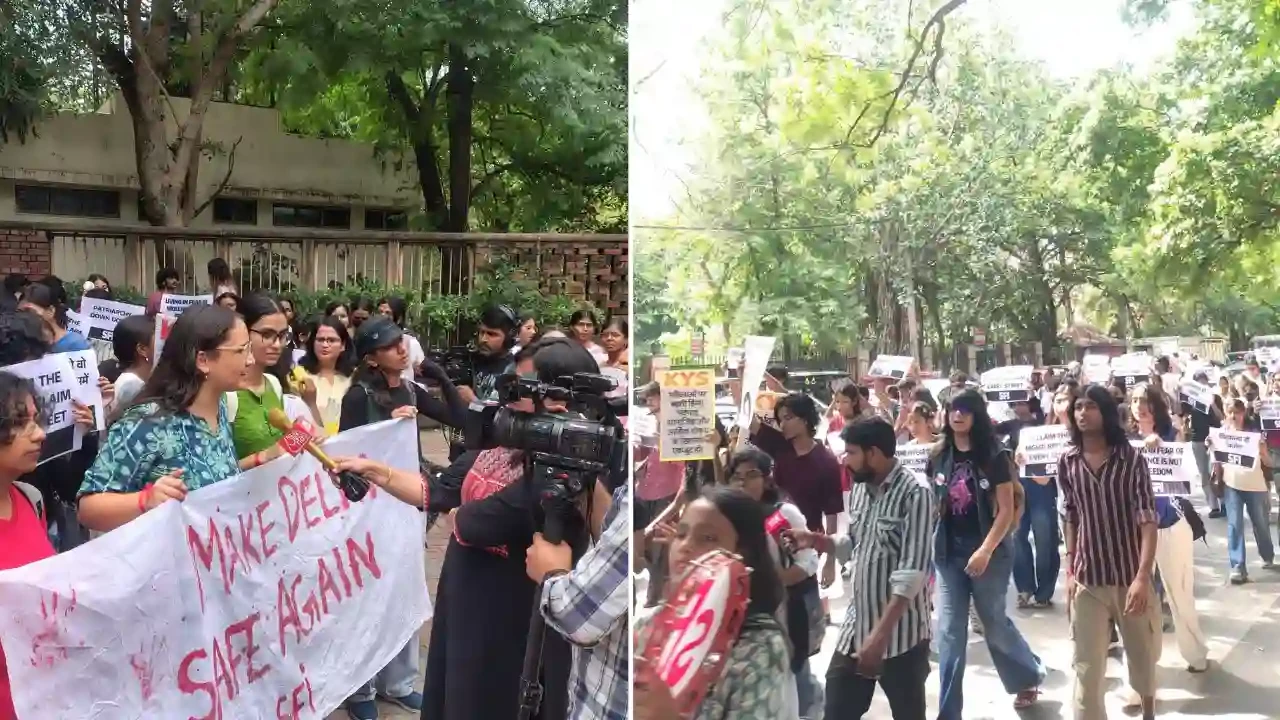
A striking slogan — “Sharam nahi hai mardon mein, aurat kyun hai parde mein?” — has emerged in the wider social-media conversation around recent student protests over women’s safety.
Translated as “Men have no shame, so why should women be behind the veil?”, the slogan challenges the idea that women should face restrictions on their clothing, movement or access to public spaces because of crimes committed against them.
The debate gained renewed attention as students across Delhi protested following the alleged gang rape of a 17-year-old girl at Aastha Kunj Park near Kalkaji. The demonstrations have increasingly focused on public infrastructure, policing and women's freedom to travel and use public spaces safely.
Hundreds of Delhi University students marched from Miranda House towards the Faculty of Arts despite heavy rain, carrying posters and raising slogans about women's safety.
The latest demonstration was described as the third and largest protest in a week. Earlier protests were held around Lady Shri Ram College, Gargi College and Kamala Nehru College, with students highlighting concerns about unsafe roads, inadequate lighting, harassment and difficulties faced during evening commutes.
One prominent message from the demonstrations was “Raaton par bhi haq hai hamara”, or “We have a right to the nights too.”
Students argued that women should not have to surrender access to public spaces after dark because of concerns about violence.
The protests followed the alleged gang rape of a 17-year-old girl at Aastha Kunj Park near Kalkaji Mandir.
According to police accounts reported by the Times of India, the teenager was allegedly approached by three men who claimed to be policemen. The accused allegedly separated her from her male friend and took her towards a secluded section of the park. The girl was subsequently medically examined and an FIR was registered under relevant provisions, including the Protection of Children from Sexual Offences Act. Police arrested all three accused.
The incident has also raised questions about security infrastructure in large public parks.
Reports have highlighted concerns over street lighting, CCTV coverage and police patrolling, particularly in areas surrounding women's colleges and major commuting routes.
The central demand of the Delhi protests has been for stronger safety infrastructure rather than restrictions on women's freedom.
Students have called for:
Protesters have also spoken about the restrictions they themselves face, including parental curfews and concerns about travelling alone after dark.
Their argument is that women's mobility should not become the price of public safety.
The Delhi demonstrations have also attracted attention because of the language used on students' handmade posters.
Alongside conventional demands for safety and accountability, protesters carried messages such as “Raaton par bhi haq hai hamara” and other slogans questioning why women are expected to modify their behaviour because of the actions of perpetrators.
Some students also explicitly pushed back against the idea that the demonstrations were simply social-media activism.
The protests have instead been presented by organisers as demands for tangible changes in the physical and institutional environment surrounding colleges.
Meanwhile, a separate student protest at Lovely Professional University (LPU) in Punjab has added another dimension to the national discussion around campus safety.
Students gathered following claims circulating online about the alleged sexual assault of a female student on campus. The claims initially remained unverified, and LPU said the allegations circulating on social media were false and misleading.
The situation later escalated into vandalism, fires and a blockade of the Jalandhar-Phagwara highway. Police subsequently said a case had been registered based on a student's statement and announced a Special Investigation Team to investigate the allegations.
The university has continued to reject the allegations, making it important to distinguish between verified developments, allegations under investigation and claims circulating on social media.
The protests in Delhi and the separate unrest at LPU have unfolded in different circumstances, but both have brought student concerns about safety and institutional accountability into the spotlight.
For Delhi University protesters, the Aastha Kunj case has become a catalyst for demanding safer streets, better surveillance and reliable public infrastructure.
The viral slogan — “Sharam nahi hai mardon mein, aurat kyun hai parde mein?” — captures one of the central questions being raised by protesters: whether the burden of preventing sexual violence should fall on women through restrictions, or on institutions and society through stronger prevention, accountability and enforcement.
As investigations continue into the incidents that prompted these protests, students are demanding that concerns about women's safety lead to concrete action rather than temporary restrictions on where and when women can move freely.
| Detail | Information |
|---|---|
| Main protest location | Delhi University |
| Major protest route | Miranda House to Faculty of Arts |
| Triggering incident | Alleged gang rape of a 17-year-old at Aastha Kunj Park |
| Location of incident | South Delhi, near Kalkaji |
| Major demands | Lighting, CCTV, police patrols and safer public spaces |
| Key slogan | “Sharam nahi hai mardon mein, aurat kyun hai parde mein?” |
| Other viral slogan | “Raaton par bhi haq hai hamara” |
| Other colleges involved in protests | LSR, Gargi College, Kamala Nehru College and Miranda House |
| Separate Punjab development | LPU student protests over disputed sexual-assault allegations |
| LPU investigation | FIR registered and SIT formed |