•
•
•
•
•
•
•

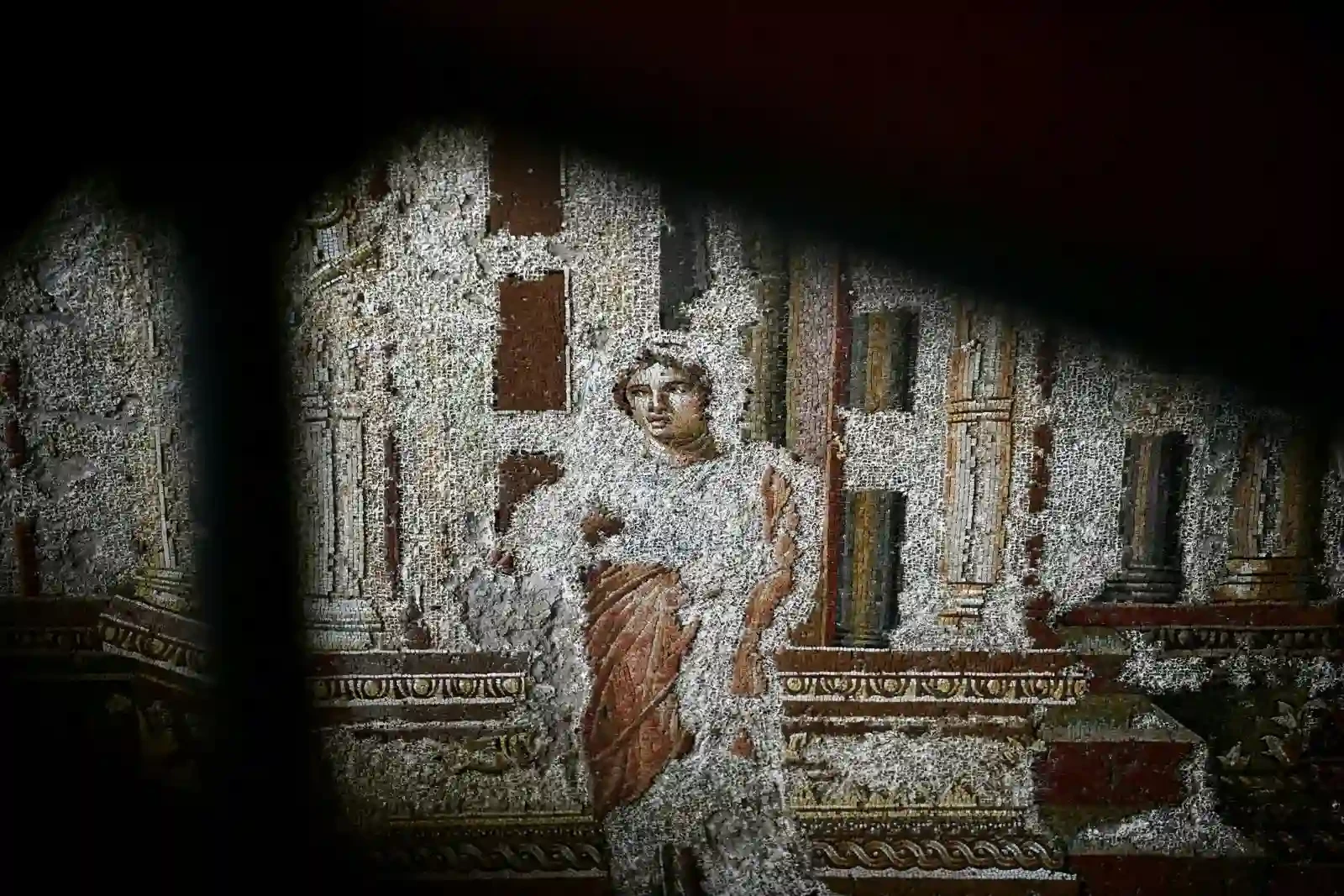
Rome has revealed another remarkable chapter of its ancient past with the unveiling of an enormous Roman wall mosaic hidden beneath the Oppian Hill, just a short distance from the Colosseum.
The artwork stands around 10 metres high and stretches approximately 16 metres along the wall, making it a potential record-holder among Roman wall mosaics. Archaeologists believe the surviving section may not represent the full extent of the artwork, with excavation still continuing around the site.
The mosaic is thought to have been created during the 1st century AD, when Rome was at the height of its imperial power. Its original setting remains uncertain. Researchers believe it may once have formed part of a wealthy private residence or possibly the sprawling Domus Aurea, the palace complex associated with Emperor Nero.
The surviving mosaic offers an unusually detailed glimpse into Roman decorative art.
Among its most striking features are life-sized figures, including a bearded philosopher, a centaur and a young poet receiving a laurel crown. The figures appear alongside columns, architectural elements and richly decorated surfaces.
The colour palette is particularly notable. Archaeologists have identified intense blue elements believed to have been produced using valuable gemstone material, while white mosaic pieces were used to create highlights and the appearance of sunlight on architectural surfaces.
The sophistication and scale of the artwork suggest that it was created for an important and wealthy environment rather than an ordinary domestic space.
The mosaic's extraordinary survival is linked to one of Rome's major transformations.
Around AD 109, Emperor Trajan built a huge public bath complex over the area. The earlier structures were buried as the new complex was constructed, effectively sealing parts of the earlier Roman landscape beneath it.
That later construction helped preserve the mosaic for almost two millennia.
Today, visitors can see the artwork in an underground gallery beneath the archaeological remains of Trajan's Baths. Officials have described the project as an effort to bring a previously hidden part of Rome's history back into public view.
One of the most intriguing discoveries lies toward the lower section of the mosaic.
Archaeologists have found detailed architectural imagery resembling a port city, complete with buildings and urban structures. However, researchers have not yet determined whether the scene represents a real location or an idealised city created by the Roman artist.
That uncertainty could make the discovery even more significant.
If the city represents a real place, the depiction could provide clues about how Romans visualised important urban centres beyond Rome. If it is imaginary, it could instead reveal how Roman artists constructed idealised landscapes and cities for elite audiences.
Researchers are continuing to investigate the imagery and the mosaic's remaining sections.
The mosaic is not the only remarkable artwork being brought back into view.
Nearby, archaeologists have also restored a large Painted City fresco. The artwork depicts a heavily fortified urban landscape with walls, towers, gates, a theatre and golden statues, surrounded by what appears to be water.
The level of detail is striking, with individual buildings and architectural features visible within the painted city. Researchers are still debating whether it represents a real settlement or an imagined urban centre.
The discoveries form part of a broader effort to restore and reopen archaeological areas around the Oppian Hill and Trajan's Baths.
Above ground, portions of Trajan's Baths have also undergone restoration. Archaeologists believe one surviving semicircular structure, known as an exedra, may have functioned as a library, with niches in its walls potentially used to store books and documents.
The renewed archaeological complex is expected to offer visitors a rare opportunity to experience several layers of Roman history in one location.
For archaeologists, however, the investigation is far from over.
The full extent of the monumental mosaic remains unknown, and further excavation could reveal additional figures, scenes or clues about the building for which it was originally created.
After roughly 2,000 years underground, one of ancient Rome's most ambitious artistic creations is finally returning to public view — while still keeping some of its greatest mysteries intact.